



 Chat with AI
Exam 51: Salt and Water Balance and Nitrogen Excretion

Exam 1: Studying Life246 Questions
Exam 2: Small Molecules and the Chemistry of Life246 Questions
Exam 3: Proteins, Carbohydrates, and Lipids246 Questions
Exam 4: Nucleic Acids and the Origin of Life246 Questions
Exam 5: Cells: the Working Units of Life248 Questions
Exam 6: Cell Membranes246 Questions
Exam 7: Cell Communication and Multicellularity246 Questions
Exam 8: Energy, Enzymes, and Metabolism246 Questions
Exam 9: Pathways That Harvest Chemical Energy246 Questions
Exam 10: Photosynthesis: Energy From Sunlight242 Questions
Exam 11: The Cell Cycle and Cell Division260 Questions
Exam 12: Inheritance, Genes, and Chromosomes250 Questions
Exam 13: Dna and Its Role in Heredity257 Questions
Exam 14: From Dna to Protein: Gene Expression252 Questions
Exam 15: Gene Mutation and Molecular Medicine251 Questions
Exam 16: Regulation of Gene Expression245 Questions
Exam 17: Genomes249 Questions
Exam 18: Recombinant Dna and Biotechnology243 Questions
Exam 20: Mechanisms of Evolution243 Questions
Exam 21: Reconstructing and Using Phylogenies246 Questions
Exam 22: Speciation247 Questions
Exam 23: Evolution of Genes and Genomes252 Questions
Exam 24: The History of Life on Earth246 Questions
Exam 25: Bacteria, Archaea, and Viruses262 Questions
Exam 26: The Origin and Diversification of Eukaryotes252 Questions
Exam 27: Plants Without Seeds: From Water to Land251 Questions
Exam 28: The Evolution of Seed Plants259 Questions
Exam 29: The Evolution and Diversity of Fungi261 Questions
Exam 30: Animal Origins and the Evolution of Body Plans248 Questions
Exam 31: Protostome Animals244 Questions
Exam 32: Deuterostome Animals246 Questions
Exam 33: The Plant Body243 Questions
Exam 34: Transport in Plants248 Questions
Exam 35: Plant Nutrition247 Questions
Exam 36: Regulation of Plant Growth246 Questions
Exam 37: Reproduction in Flowering Plants247 Questions
Exam 38: Plant Responses to Environmental Challenges246 Questions
Exam 39: Physiology, Homeostasis, and Temperature Regulation258 Questions
Exam 40: Animal Hormones249 Questions
Exam 41: Immunology: Animal Defense Systems265 Questions
Exam 42: Animal Reproduction261 Questions
Exam 43: Animal Development261 Questions
Exam 44: Neurons, Glia, and Nervous Systems250 Questions
Exam 45: Sensory Systems249 Questions
Exam 46: The Mammalian Nervous System: Structure and Higher Functions254 Questions
Exam 47: Musculoskeletal Systems259 Questions
Exam 48: Gas Exchange247 Questions
Exam 49: Circulatory Systems252 Questions
Exam 50: Nutrition, Digestion, and Absorption259 Questions
Exam 51: Salt and Water Balance and Nitrogen Excretion251 Questions
Exam 52: Animal Behavior249 Questions
Exam 53: The Physical Environment and Biogeography of Life248 Questions
Exam 54: Populations259 Questions
Exam 55: Species Interactions254 Questions
Exam 56: Communities247 Questions
Exam 57: Ecosystems238 Questions
Exam 58: A Changing Biosphere222 Questions
Select questions type


Of the nitrogenous wastes produced by vertebrates, _______ is the most toxic and soluble in water.
(Short Answer)
4.9/5  (83)
(83) If a long loop of Henle is functioning properly, then it will not
(Multiple Choice)
4.8/5 (87)
(87) Evaluate the following statement: Humans are ureotelic, which means they only excrete urea.
(Essay)
4.8/5 (82)
(82) Which feature is not one of the adaptations that allows reptiles to live in terrestrial environments where water must be conserved?
(Multiple Choice)
4.9/5 (91)
(91) Choose the incorrect pairing between type of environment and response of the brine shrimp Artemia.
(Multiple Choice)
4.9/5 (72)
(72) Refer to the figure of the human kidney. 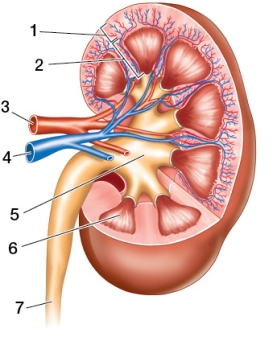 Identify structure 5.What structures empty into structure 5, and what are they carrying?
 (Short Answer)
4.9/5 (90)
(90) Cartilaginous fishes (sharks and rays) have a specialized gland that excretes excess salt taken in with their food.Which organisms also possess a gland for excreting excess salt acquired through their food?
(Multiple Choice)
4.9/5 (79)
(79) Organisms that are ionic regulators maintain their extracellular fluids at an _______ concentration that _______ that of the environment.
(Multiple Choice)
4.7/5 (80)
(80) Which statement about the filtration process of the excretory systems of animals with closed circulatory systems is false?
(Multiple Choice)
4.7/5 (87)
(87) Which feature does not characterize atrial natriuretic peptide (ANP)?
(Multiple Choice)
5.0/5 (69)
(69) Refer to the figure of the countercurrent multiplier mechanism in the mammalian kidney. 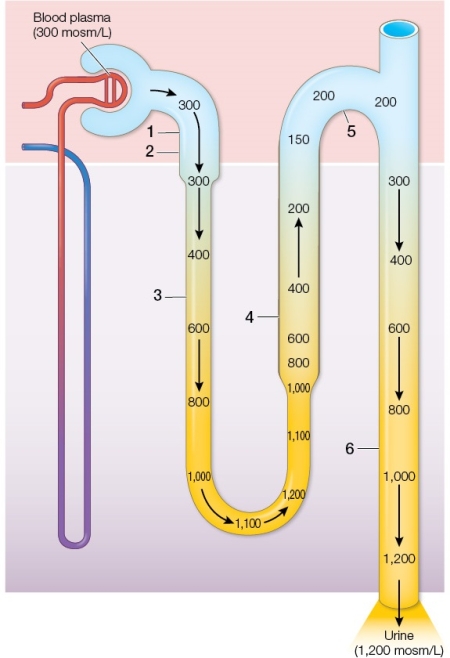 Based on the figure, which nitrogenous waste moves out of region 6, and what happens to it?
 (Short Answer)
4.8/5 (75)
(75) Which statement about the excretory system of annelids and that of flatworms is false?
(Multiple Choice)
4.9/5 (78)
(78) In the mammalian kidney, the filtrate flows through the _______ immediately before entering a collecting duct.
(Multiple Choice)
4.8/5 (92)
(92) Which statement about the nitrogenous wastes of humans is true?
(Multiple Choice)
4.7/5 (71)
(71) Alcohol inhibits antidiuretic hormone (ADH) release, which results in the production of
(Multiple Choice)
4.8/5 (95)
(95) Destruction of the cilia on a flame cell of a protonephridium would prevent all the following except
(Multiple Choice)
4.8/5 (71)
(71) You are a physician, and one of your obese patients, who eats a diet high in protein, describes pain in his big toe.You explain that the condition is called _______ and that it results from the precipitation of _______.
(Multiple Choice)
4.8/5 (94)
(94) 
Filters
- Essay(0)
- Multiple Choice(0)
- Short Answer(0)
- True False(0)
- Matching(0)