



 Chat with AI
Exam 51: Salt and Water Balance and Nitrogen Excretion

Exam 1: Studying Life246 Questions
Exam 2: Small Molecules and the Chemistry of Life246 Questions
Exam 3: Proteins, Carbohydrates, and Lipids246 Questions
Exam 4: Nucleic Acids and the Origin of Life246 Questions
Exam 5: Cells: the Working Units of Life248 Questions
Exam 6: Cell Membranes246 Questions
Exam 7: Cell Communication and Multicellularity246 Questions
Exam 8: Energy, Enzymes, and Metabolism246 Questions
Exam 9: Pathways That Harvest Chemical Energy246 Questions
Exam 10: Photosynthesis: Energy From Sunlight242 Questions
Exam 11: The Cell Cycle and Cell Division260 Questions
Exam 12: Inheritance, Genes, and Chromosomes250 Questions
Exam 13: Dna and Its Role in Heredity257 Questions
Exam 14: From Dna to Protein: Gene Expression252 Questions
Exam 15: Gene Mutation and Molecular Medicine251 Questions
Exam 16: Regulation of Gene Expression245 Questions
Exam 17: Genomes249 Questions
Exam 18: Recombinant Dna and Biotechnology243 Questions
Exam 20: Mechanisms of Evolution243 Questions
Exam 21: Reconstructing and Using Phylogenies246 Questions
Exam 22: Speciation247 Questions
Exam 23: Evolution of Genes and Genomes252 Questions
Exam 24: The History of Life on Earth246 Questions
Exam 25: Bacteria, Archaea, and Viruses262 Questions
Exam 26: The Origin and Diversification of Eukaryotes252 Questions
Exam 27: Plants Without Seeds: From Water to Land251 Questions
Exam 28: The Evolution of Seed Plants259 Questions
Exam 29: The Evolution and Diversity of Fungi261 Questions
Exam 30: Animal Origins and the Evolution of Body Plans248 Questions
Exam 31: Protostome Animals244 Questions
Exam 32: Deuterostome Animals246 Questions
Exam 33: The Plant Body243 Questions
Exam 34: Transport in Plants248 Questions
Exam 35: Plant Nutrition247 Questions
Exam 36: Regulation of Plant Growth246 Questions
Exam 37: Reproduction in Flowering Plants247 Questions
Exam 38: Plant Responses to Environmental Challenges246 Questions
Exam 39: Physiology, Homeostasis, and Temperature Regulation258 Questions
Exam 40: Animal Hormones249 Questions
Exam 41: Immunology: Animal Defense Systems265 Questions
Exam 42: Animal Reproduction261 Questions
Exam 43: Animal Development261 Questions
Exam 44: Neurons, Glia, and Nervous Systems250 Questions
Exam 45: Sensory Systems249 Questions
Exam 46: The Mammalian Nervous System: Structure and Higher Functions254 Questions
Exam 47: Musculoskeletal Systems259 Questions
Exam 48: Gas Exchange247 Questions
Exam 49: Circulatory Systems252 Questions
Exam 50: Nutrition, Digestion, and Absorption259 Questions
Exam 51: Salt and Water Balance and Nitrogen Excretion251 Questions
Exam 52: Animal Behavior249 Questions
Exam 53: The Physical Environment and Biogeography of Life248 Questions
Exam 54: Populations259 Questions
Exam 55: Species Interactions254 Questions
Exam 56: Communities247 Questions
Exam 57: Ecosystems238 Questions
Exam 58: A Changing Biosphere222 Questions
Select questions type


Which group of vertebrates can produce urine that is more concentrated than their extracellular fluids, allowing them to live in habitats with little water?
(Multiple Choice)
4.7/5  (89)
(89) The enzyme renin, released by the kidney, initiates the conversion of a circulating protein into an active hormone known as _______.
(Short Answer)
4.8/5 (82)
(82) Which pairing between region of the vertebrate nephron and location in the kidney is incorrect?
(Multiple Choice)
4.9/5 (73)
(73) The _______ is characterized by numerous microvilli on its cells.
(Multiple Choice)
4.8/5 (92)
(92) A scientist interested in studying active transport mechanisms could be advised to examine the process in the
(Multiple Choice)
4.9/5 (87)
(87) Choose the correct path by which filtrate moves, beginning with where it enters a nephron.
(Multiple Choice)
4.8/5 (77)
(77) Which statement includes two advantages of excreting uric acid instead of urea?
(Multiple Choice)
4.7/5 (87)
(87) What is the structure into which filtrate flows from Bowman's capsule?
(Multiple Choice)
4.8/5 (83)
(83) When osmoreceptor neurons in the hypothalamus detect a rise in blood osmolarity, they stimulate
(Multiple Choice)
4.8/5 (91)
(91) Which feature does not characterize the Malpighian tubules of insects?
(Multiple Choice)
4.7/5 (93)
(93) Refer to the figure showing the vertebrate nephron. 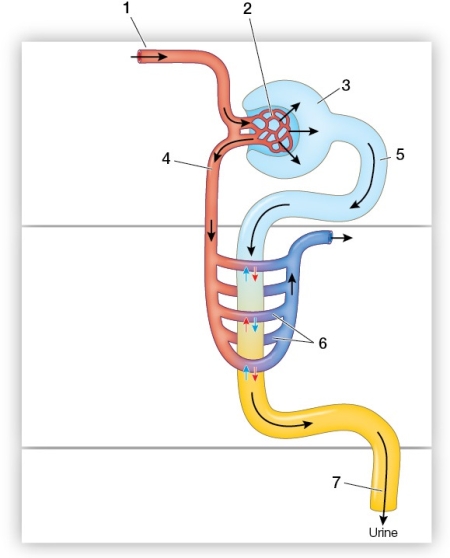 Based on the figure, which statement is false?
 (Multiple Choice)
4.9/5 (83)
(83) The autoregulatory mechanisms of the kidneys, one of which involves the enzyme renin, ensure that _______ remains constant in the face of decreases in blood pressure or cardiac output.
(Multiple Choice)
4.8/5 (78)
(78) The cells lining the proximal convoluted tubule have numerous microvilli and mitochondria.This indicates that these cells
(Multiple Choice)
4.9/5 (91)
(91) Which statement about the excretory system of insects is false?
(Multiple Choice)
4.8/5 (88)
(88) When a person undergoes renal dialysis, a machine is used to replace the function of the kidneys.Substances to be removed from the blood move across the dialysis membrane into the dialysis solution.To be maximally effective at removing urea from the blood, the concentration of urea in the dialysis solution should be
(Multiple Choice)
5.0/5 (80)
(80) Like freshwater fishes, _______ live in or near fresh water and conserve salts and produce large amounts of dilute urine.
(Multiple Choice)
4.8/5 (86)
(86) Refer to the figure showing the excretory system of an annelid. 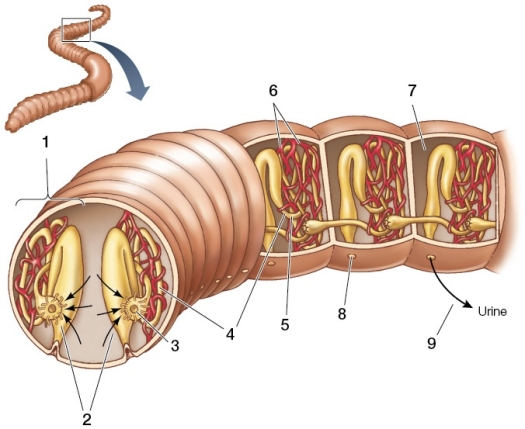 Based on the figure, which statement about the excretory system of annelids is false?
 (Multiple Choice)
4.9/5 (87)
(87) Refer to the figure showing waste products of metabolism. 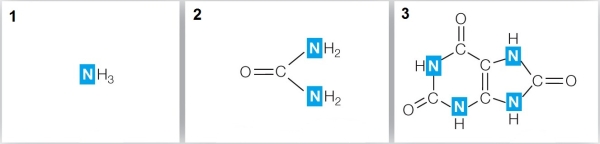 Based on the figure, which statement is false?
 (Multiple Choice)
4.8/5 (74)
(74) 
Filters
- Essay(0)
- Multiple Choice(0)
- Short Answer(0)
- True False(0)
- Matching(0)