



 Chat with AI
Exam 51: Salt and Water Balance and Nitrogen Excretion

Exam 1: Studying Life246 Questions
Exam 2: Small Molecules and the Chemistry of Life246 Questions
Exam 3: Proteins, Carbohydrates, and Lipids246 Questions
Exam 4: Nucleic Acids and the Origin of Life246 Questions
Exam 5: Cells: the Working Units of Life248 Questions
Exam 6: Cell Membranes246 Questions
Exam 7: Cell Communication and Multicellularity246 Questions
Exam 8: Energy, Enzymes, and Metabolism246 Questions
Exam 9: Pathways That Harvest Chemical Energy246 Questions
Exam 10: Photosynthesis: Energy From Sunlight242 Questions
Exam 11: The Cell Cycle and Cell Division260 Questions
Exam 12: Inheritance, Genes, and Chromosomes250 Questions
Exam 13: Dna and Its Role in Heredity257 Questions
Exam 14: From Dna to Protein: Gene Expression252 Questions
Exam 15: Gene Mutation and Molecular Medicine251 Questions
Exam 16: Regulation of Gene Expression245 Questions
Exam 17: Genomes249 Questions
Exam 18: Recombinant Dna and Biotechnology243 Questions
Exam 20: Mechanisms of Evolution243 Questions
Exam 21: Reconstructing and Using Phylogenies246 Questions
Exam 22: Speciation247 Questions
Exam 23: Evolution of Genes and Genomes252 Questions
Exam 24: The History of Life on Earth246 Questions
Exam 25: Bacteria, Archaea, and Viruses262 Questions
Exam 26: The Origin and Diversification of Eukaryotes252 Questions
Exam 27: Plants Without Seeds: From Water to Land251 Questions
Exam 28: The Evolution of Seed Plants259 Questions
Exam 29: The Evolution and Diversity of Fungi261 Questions
Exam 30: Animal Origins and the Evolution of Body Plans248 Questions
Exam 31: Protostome Animals244 Questions
Exam 32: Deuterostome Animals246 Questions
Exam 33: The Plant Body243 Questions
Exam 34: Transport in Plants248 Questions
Exam 35: Plant Nutrition247 Questions
Exam 36: Regulation of Plant Growth246 Questions
Exam 37: Reproduction in Flowering Plants247 Questions
Exam 38: Plant Responses to Environmental Challenges246 Questions
Exam 39: Physiology, Homeostasis, and Temperature Regulation258 Questions
Exam 40: Animal Hormones249 Questions
Exam 41: Immunology: Animal Defense Systems265 Questions
Exam 42: Animal Reproduction261 Questions
Exam 43: Animal Development261 Questions
Exam 44: Neurons, Glia, and Nervous Systems250 Questions
Exam 45: Sensory Systems249 Questions
Exam 46: The Mammalian Nervous System: Structure and Higher Functions254 Questions
Exam 47: Musculoskeletal Systems259 Questions
Exam 48: Gas Exchange247 Questions
Exam 49: Circulatory Systems252 Questions
Exam 50: Nutrition, Digestion, and Absorption259 Questions
Exam 51: Salt and Water Balance and Nitrogen Excretion251 Questions
Exam 52: Animal Behavior249 Questions
Exam 53: The Physical Environment and Biogeography of Life248 Questions
Exam 54: Populations259 Questions
Exam 55: Species Interactions254 Questions
Exam 56: Communities247 Questions
Exam 57: Ecosystems238 Questions
Exam 58: A Changing Biosphere222 Questions
Select questions type


When stretch receptors in the aorta and carotid arteries detect an increase in blood pressure, they inhibit release of _______.
(Short Answer)
4.9/5  (87)
(87) Refer to the figure of the human kidney. 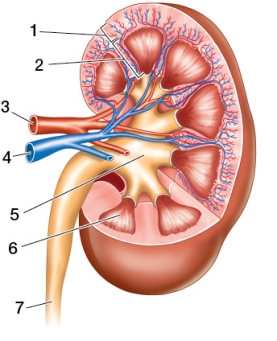 Which region of the kidney is indicated by 1? Which parts of the nephron are in this region?
 (Short Answer)
4.8/5 (85)
(85) Considering the arrangement of blood vessels in the vertebrate kidney bringing blood to and from the glomerulus, a(n) _______ in the diameter of the _______ could result in a decreased rate of filtration.
(Multiple Choice)
4.8/5 (82)
(82) You are a physician and have just diagnosed a male patient with gout.Which symptom would you not expect to see in your patient?
(Multiple Choice)
4.9/5 (85)
(85) The autoregulatory mechanisms of the kidneys ensure that the _______ remains constant when cardiac output or blood pressure decrease.
(Short Answer)
4.8/5 (82)
(82) Refer to the figure of the human kidney. 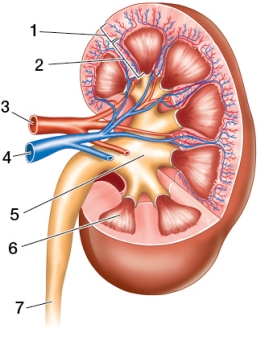 Identify structure 4.Then name the two previous types of vessels that blood flows through before reaching structure 4.
 (Short Answer)
4.9/5 (72)
(72) When a person is undergoing dialysis, the substances that need to be conserved in the blood should be _______, and those that need to be removed from the blood should be _______.
(Multiple Choice)
4.9/5 (77)
(77) The length of the _______ relative to overall kidney size indicates potential maximum urine concentration.
(Multiple Choice)
4.8/5 (81)
(81) A scientist wishing to study a vertebrate animal that is an osmoconformer might choose a study species from which group?
(Multiple Choice)
4.8/5 (77)
(77) Which is the critical feature that enables the mammalian kidney to concentrate urine?
(Multiple Choice)
5.0/5 (83)
(83) Refer to the figure showing the vertebrate nephron. 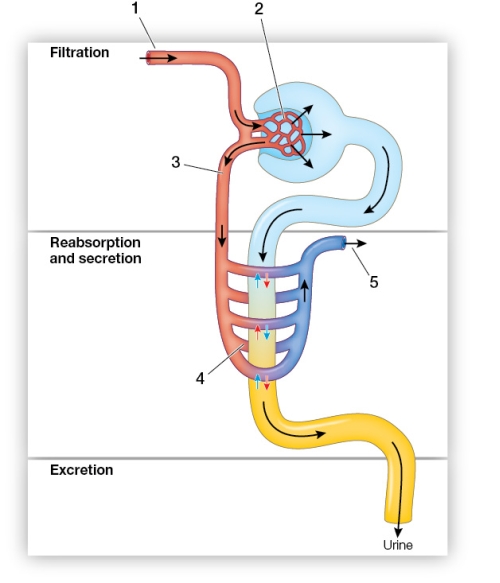 Based on the figure, which statement is false?
 (Multiple Choice)
4.9/5 (75)
(75) When considering the main type of nitrogenous waste excreted, tadpoles are ammonotelic and excrete ammonia across their gills, but adult frogs and toads are _______.
(Short Answer)
4.8/5 (83)
(83) Which statement about humans and nitrogenous waste is false?
(Multiple Choice)
4.8/5 (76)
(76) Each segment of an earthworm has a pair of _______ to process its nitrogenous wastes.
(Short Answer)
4.9/5 (72)
(72) The nitrogenous waste _______, which is less toxic than ammonia, is highly soluble in water, but its excretion can result in large loss of water from the animal.
(Short Answer)
4.9/5 (79)
(79) 
Filters
- Essay(0)
- Multiple Choice(0)
- Short Answer(0)
- True False(0)
- Matching(0)