



 Chat with AI
Exam 49: Circulatory Systems

Exam 1: Studying Life246 Questions
Exam 2: Small Molecules and the Chemistry of Life246 Questions
Exam 3: Proteins, Carbohydrates, and Lipids246 Questions
Exam 4: Nucleic Acids and the Origin of Life246 Questions
Exam 5: Cells: the Working Units of Life248 Questions
Exam 6: Cell Membranes246 Questions
Exam 7: Cell Communication and Multicellularity246 Questions
Exam 8: Energy, Enzymes, and Metabolism246 Questions
Exam 9: Pathways That Harvest Chemical Energy246 Questions
Exam 10: Photosynthesis: Energy From Sunlight242 Questions
Exam 11: The Cell Cycle and Cell Division260 Questions
Exam 12: Inheritance, Genes, and Chromosomes250 Questions
Exam 13: Dna and Its Role in Heredity257 Questions
Exam 14: From Dna to Protein: Gene Expression252 Questions
Exam 15: Gene Mutation and Molecular Medicine251 Questions
Exam 16: Regulation of Gene Expression245 Questions
Exam 17: Genomes249 Questions
Exam 18: Recombinant Dna and Biotechnology243 Questions
Exam 20: Mechanisms of Evolution243 Questions
Exam 21: Reconstructing and Using Phylogenies246 Questions
Exam 22: Speciation247 Questions
Exam 23: Evolution of Genes and Genomes252 Questions
Exam 24: The History of Life on Earth246 Questions
Exam 25: Bacteria, Archaea, and Viruses262 Questions
Exam 26: The Origin and Diversification of Eukaryotes252 Questions
Exam 27: Plants Without Seeds: From Water to Land251 Questions
Exam 28: The Evolution of Seed Plants259 Questions
Exam 29: The Evolution and Diversity of Fungi261 Questions
Exam 30: Animal Origins and the Evolution of Body Plans248 Questions
Exam 31: Protostome Animals244 Questions
Exam 32: Deuterostome Animals246 Questions
Exam 33: The Plant Body243 Questions
Exam 34: Transport in Plants248 Questions
Exam 35: Plant Nutrition247 Questions
Exam 36: Regulation of Plant Growth246 Questions
Exam 37: Reproduction in Flowering Plants247 Questions
Exam 38: Plant Responses to Environmental Challenges246 Questions
Exam 39: Physiology, Homeostasis, and Temperature Regulation258 Questions
Exam 40: Animal Hormones249 Questions
Exam 41: Immunology: Animal Defense Systems265 Questions
Exam 42: Animal Reproduction261 Questions
Exam 43: Animal Development261 Questions
Exam 44: Neurons, Glia, and Nervous Systems250 Questions
Exam 45: Sensory Systems249 Questions
Exam 46: The Mammalian Nervous System: Structure and Higher Functions254 Questions
Exam 47: Musculoskeletal Systems259 Questions
Exam 48: Gas Exchange247 Questions
Exam 49: Circulatory Systems252 Questions
Exam 50: Nutrition, Digestion, and Absorption259 Questions
Exam 51: Salt and Water Balance and Nitrogen Excretion251 Questions
Exam 52: Animal Behavior249 Questions
Exam 53: The Physical Environment and Biogeography of Life248 Questions
Exam 54: Populations259 Questions
Exam 55: Species Interactions254 Questions
Exam 56: Communities247 Questions
Exam 57: Ecosystems238 Questions
Exam 58: A Changing Biosphere222 Questions
Select questions type


A piece of a thrombus breaking loose can travel through the arteries and eventually become lodged in a vessel of small diameter, resulting in a condition called a(n) _______.
(Short Answer)
4.9/5  (70)
(70) Birds and mammals have a _______ circuit in which blood is pumped from the heart to the lungs and back to the heart.
(Short Answer)
4.9/5 (87)
(87) The timing of the spread of the action potential from atrium to ventricle is controlled by the
(Multiple Choice)
4.9/5 (83)
(83) The circulating protein fibrinogen contributes to blood clotting by
(Multiple Choice)
4.8/5 (82)
(82) Arteries are vessels that carry blood away from the heart and _______ are vessels that carry blood back to the heart.
(Short Answer)
4.8/5 (67)
(67) In open circulatory systems, the fluid called _______ leaves the vessels of the circulatory system before flowing over the organs.
(Short Answer)
4.9/5 (85)
(85) Evaluate the following statement for accuracy: Open circulatory systems are found only in inactive, sedentary animals.
(Essay)
4.9/5 (80)
(80) A paleontologist finds a fragment of a fossilized vertebrate that indicates that the animal had a three-chambered heart.The animal could have been a(n)
(Multiple Choice)
4.9/5 (87)
(87) Which statement about ion movements and ventricular muscle cells is false?
(Multiple Choice)
4.8/5 (90)
(90) Which statement about the closed circulatory systems of vertebrates is false?
(Multiple Choice)
4.9/5 (73)
(73) Design a multicellular animal without a gastrovascular cavity that can live without a circulatory system.Include a brief description of its features and explanation of why a circulatory system is unnecessary.
(Essay)
4.9/5 (88)
(88) Refer to the figure, which shows the mammalian circulatory system.The arrow indicates the direction of blood flow. 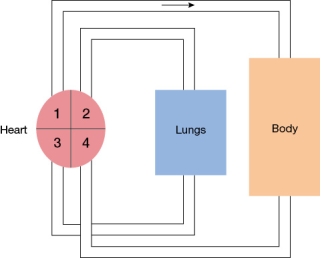 Starting with chamber 4, in what order does blood pass through the four chambers of the heart?
 (Short Answer)
4.9/5 (74)
(74) Turtles can largely bypass the lung circuit and pump blood around the body because of the incomplete division of their _______.
(Short Answer)
4.8/5 (73)
(73) Refer to the table. 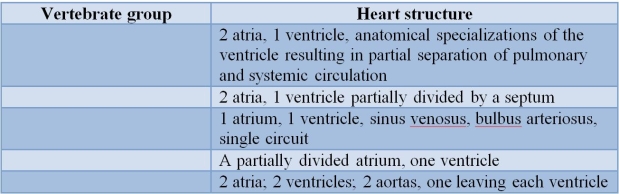 Complete the table by correctly matching adult vertebrate groups to their heart structures, from first row to last row.
 (Multiple Choice)
4.9/5 (86)
(86) Which of the following characterizes an animal that does not have a circulatory system?
(Multiple Choice)
4.7/5 (90)
(90) You are a physician and one of your patients, who smokes and suffers from high blood pressure, presents with chest pain and shortness of breath.What condition might these symptoms indicate? What steps likely led to the condition?
(Essay)
4.9/5 (63)
(63) Which is an incorrect pairing of substance(s) and its/their role in blood clotting?
(Multiple Choice)
4.8/5 (78)
(78) 
Filters
- Essay(0)
- Multiple Choice(0)
- Short Answer(0)
- True False(0)
- Matching(0)