



 Chat with AI
Exam 49: Circulatory Systems

Exam 1: Studying Life246 Questions
Exam 2: Small Molecules and the Chemistry of Life246 Questions
Exam 3: Proteins, Carbohydrates, and Lipids246 Questions
Exam 4: Nucleic Acids and the Origin of Life246 Questions
Exam 5: Cells: the Working Units of Life248 Questions
Exam 6: Cell Membranes246 Questions
Exam 7: Cell Communication and Multicellularity246 Questions
Exam 8: Energy, Enzymes, and Metabolism246 Questions
Exam 9: Pathways That Harvest Chemical Energy246 Questions
Exam 10: Photosynthesis: Energy From Sunlight242 Questions
Exam 11: The Cell Cycle and Cell Division260 Questions
Exam 12: Inheritance, Genes, and Chromosomes250 Questions
Exam 13: Dna and Its Role in Heredity257 Questions
Exam 14: From Dna to Protein: Gene Expression252 Questions
Exam 15: Gene Mutation and Molecular Medicine251 Questions
Exam 16: Regulation of Gene Expression245 Questions
Exam 17: Genomes249 Questions
Exam 18: Recombinant Dna and Biotechnology243 Questions
Exam 20: Mechanisms of Evolution243 Questions
Exam 21: Reconstructing and Using Phylogenies246 Questions
Exam 22: Speciation247 Questions
Exam 23: Evolution of Genes and Genomes252 Questions
Exam 24: The History of Life on Earth246 Questions
Exam 25: Bacteria, Archaea, and Viruses262 Questions
Exam 26: The Origin and Diversification of Eukaryotes252 Questions
Exam 27: Plants Without Seeds: From Water to Land251 Questions
Exam 28: The Evolution of Seed Plants259 Questions
Exam 29: The Evolution and Diversity of Fungi261 Questions
Exam 30: Animal Origins and the Evolution of Body Plans248 Questions
Exam 31: Protostome Animals244 Questions
Exam 32: Deuterostome Animals246 Questions
Exam 33: The Plant Body243 Questions
Exam 34: Transport in Plants248 Questions
Exam 35: Plant Nutrition247 Questions
Exam 36: Regulation of Plant Growth246 Questions
Exam 37: Reproduction in Flowering Plants247 Questions
Exam 38: Plant Responses to Environmental Challenges246 Questions
Exam 39: Physiology, Homeostasis, and Temperature Regulation258 Questions
Exam 40: Animal Hormones249 Questions
Exam 41: Immunology: Animal Defense Systems265 Questions
Exam 42: Animal Reproduction261 Questions
Exam 43: Animal Development261 Questions
Exam 44: Neurons, Glia, and Nervous Systems250 Questions
Exam 45: Sensory Systems249 Questions
Exam 46: The Mammalian Nervous System: Structure and Higher Functions254 Questions
Exam 47: Musculoskeletal Systems259 Questions
Exam 48: Gas Exchange247 Questions
Exam 49: Circulatory Systems252 Questions
Exam 50: Nutrition, Digestion, and Absorption259 Questions
Exam 51: Salt and Water Balance and Nitrogen Excretion251 Questions
Exam 52: Animal Behavior249 Questions
Exam 53: The Physical Environment and Biogeography of Life248 Questions
Exam 54: Populations259 Questions
Exam 55: Species Interactions254 Questions
Exam 56: Communities247 Questions
Exam 57: Ecosystems238 Questions
Exam 58: A Changing Biosphere222 Questions
Select questions type


Which of the following about the circulatory systems of turtles, snakes, and lizards is false?
(Multiple Choice)
5.0/5  (74)
(74) All of the following characterize both crocodilians and turtles except
(Multiple Choice)
4.9/5 (84)
(84) If a researcher is looking for a study organism that possesses a circulatory system, they should choose a
(Multiple Choice)
4.7/5 (75)
(75) In humans the fetal heart has an opening between the right and left atria, called the foramen ovale.This opening normally closes at birth.Failure of the foramen ovale to close can result in so-called "blue babies" when it is associated with other heart defects.What might explain the babies' bluish appearance?
(Multiple Choice)
4.8/5 (75)
(75) Most clotting factors circulate in the blood in an inactive form.Where are most clotting factors produced?
(Multiple Choice)
5.0/5 (81)
(81) A benefit of having at least a partial separation of pulmonary and systemic circulation, as found in amphibians, is that
(Multiple Choice)
4.9/5 (78)
(78) The pulmonary and aortic (semi-lunar) valves open as a direct result of
(Multiple Choice)
4.8/5 (69)
(69) Some relatively large multicellular aquatic animals have no circulatory system.One way that these organisms manage gas exchange is by
(Multiple Choice)
4.8/5 (85)
(85) Which wave pattern of an electrocardiogram represents the return of the ventricles to the electrical state that preceded contraction?
(Multiple Choice)
5.0/5 (81)
(81) Which situation would most likely cause a decrease in ADH (also called vasopressin) secretion?
(Multiple Choice)
4.9/5 (71)
(71) Which statement about open and closed circulatory systems is false?
(Multiple Choice)
4.9/5 (89)
(89) _______ have thin, permeable walls and are the sites for exchange of nutrients, wastes, respiratory gases, and hormones.
(Multiple Choice)
4.9/5 (58)
(58) People who have a strong allergic reaction to a bee sting or other allergen often carry an EpiPen, which delivers a single dose of epinephrine to prevent the reaction.The product carries a warning label from the manufacturer cautioning those users who also have high blood pressure.Why is this warning necessary?
(Multiple Choice)
4.8/5 (88)
(88) You are a physician and one of your patients has cirrhosis, a disease in which scar tissue forms in the liver.Which condition might result from cirrhosis?
(Multiple Choice)
4.9/5 (85)
(85) Which of the following does not occur during increased activity of the sympathetic division of the autonomic nervous system?
(Multiple Choice)
4.8/5 (74)
(74) Refer to the figure, which shows an electrocardiogram (ECG). 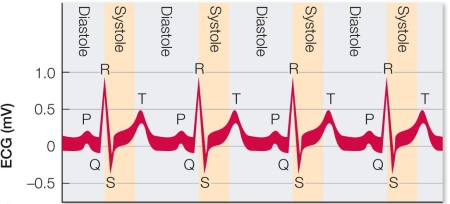 In the (ECG) of a normal cardiac cycle, which peak or trough corresponds to the relaxation of the ventricles?
 (Multiple Choice)
4.7/5 (80)
(80) Which structure or region in or connected to a four-chambered mammalian heart contains blood with the highest O2 concentration?
(Multiple Choice)
4.9/5 (80)
(80) Which feature does not characterize the circulatory system of water-breathing fishes?
(Multiple Choice)
4.8/5 (80)
(80) 
Filters
- Essay(0)
- Multiple Choice(0)
- Short Answer(0)
- True False(0)
- Matching(0)