



 Chat with AI
Exam 50: Nutrition, Digestion, and Absorption

Exam 1: Studying Life246 Questions
Exam 2: Small Molecules and the Chemistry of Life246 Questions
Exam 3: Proteins, Carbohydrates, and Lipids246 Questions
Exam 4: Nucleic Acids and the Origin of Life246 Questions
Exam 5: Cells: the Working Units of Life248 Questions
Exam 6: Cell Membranes246 Questions
Exam 7: Cell Communication and Multicellularity246 Questions
Exam 8: Energy, Enzymes, and Metabolism246 Questions
Exam 9: Pathways That Harvest Chemical Energy246 Questions
Exam 10: Photosynthesis: Energy From Sunlight242 Questions
Exam 11: The Cell Cycle and Cell Division260 Questions
Exam 12: Inheritance, Genes, and Chromosomes250 Questions
Exam 13: Dna and Its Role in Heredity257 Questions
Exam 14: From Dna to Protein: Gene Expression252 Questions
Exam 15: Gene Mutation and Molecular Medicine251 Questions
Exam 16: Regulation of Gene Expression245 Questions
Exam 17: Genomes249 Questions
Exam 18: Recombinant Dna and Biotechnology243 Questions
Exam 20: Mechanisms of Evolution243 Questions
Exam 21: Reconstructing and Using Phylogenies246 Questions
Exam 22: Speciation247 Questions
Exam 23: Evolution of Genes and Genomes252 Questions
Exam 24: The History of Life on Earth246 Questions
Exam 25: Bacteria, Archaea, and Viruses262 Questions
Exam 26: The Origin and Diversification of Eukaryotes252 Questions
Exam 27: Plants Without Seeds: From Water to Land251 Questions
Exam 28: The Evolution of Seed Plants259 Questions
Exam 29: The Evolution and Diversity of Fungi261 Questions
Exam 30: Animal Origins and the Evolution of Body Plans248 Questions
Exam 31: Protostome Animals244 Questions
Exam 32: Deuterostome Animals246 Questions
Exam 33: The Plant Body243 Questions
Exam 34: Transport in Plants248 Questions
Exam 35: Plant Nutrition247 Questions
Exam 36: Regulation of Plant Growth246 Questions
Exam 37: Reproduction in Flowering Plants247 Questions
Exam 38: Plant Responses to Environmental Challenges246 Questions
Exam 39: Physiology, Homeostasis, and Temperature Regulation258 Questions
Exam 40: Animal Hormones249 Questions
Exam 41: Immunology: Animal Defense Systems265 Questions
Exam 42: Animal Reproduction261 Questions
Exam 43: Animal Development261 Questions
Exam 44: Neurons, Glia, and Nervous Systems250 Questions
Exam 45: Sensory Systems249 Questions
Exam 46: The Mammalian Nervous System: Structure and Higher Functions254 Questions
Exam 47: Musculoskeletal Systems259 Questions
Exam 48: Gas Exchange247 Questions
Exam 49: Circulatory Systems252 Questions
Exam 50: Nutrition, Digestion, and Absorption259 Questions
Exam 51: Salt and Water Balance and Nitrogen Excretion251 Questions
Exam 52: Animal Behavior249 Questions
Exam 53: The Physical Environment and Biogeography of Life248 Questions
Exam 54: Populations259 Questions
Exam 55: Species Interactions254 Questions
Exam 56: Communities247 Questions
Exam 57: Ecosystems238 Questions
Exam 58: A Changing Biosphere222 Questions
Select questions type


A newly described species of ungulate (hoofed animal) from Vietnam feeds almost entirely on vegetation.Its set of teeth contains no canines but does have many molars and premolars in the back for _______.
(Short Answer)
4.8/5  (77)
(77) Which feature characterizes the enteric nervous system of the vertebrate gut?
(Multiple Choice)
5.0/5 (87)
(87) When a region of smooth muscle in the esophagus contracts, just beyond that region the _______ muscle _______ and the longitudinal muscle _______, and food moves forward.
(Multiple Choice)
5.0/5 (79)
(79) In an experiment on mice, one group was injected with leptin and a second group was injected with ghrelin.The control group was injected with saline only.Following the injections, the ghrelin-injected group was observed to eat _______ than the control group.
(Short Answer)
4.9/5 (80)
(80) Which statement about the regulation of food intake is true?
(Multiple Choice)
5.0/5 (84)
(84) Vitamins are essential nutrients for cells because they cannot be synthesized by the animal itself, and most
(Multiple Choice)
4.9/5 (78)
(78) In an experiment with wild-type rats, you inject an experimental group of rats with ghrelin dissolved in a solvent, and the control group with just the solvent.In subsequent observations of the two groups, you would expect the control group's behavior to remain the same and the experimental group to _______ than the control group.
(Multiple Choice)
4.9/5 (74)
(74) What are some of the likely reasons that basal metabolic rate is typically higher in human males than females?
(Short Answer)
4.8/5 (76)
(76) Refer to the figure showing the intestinal surface area of various organisms. 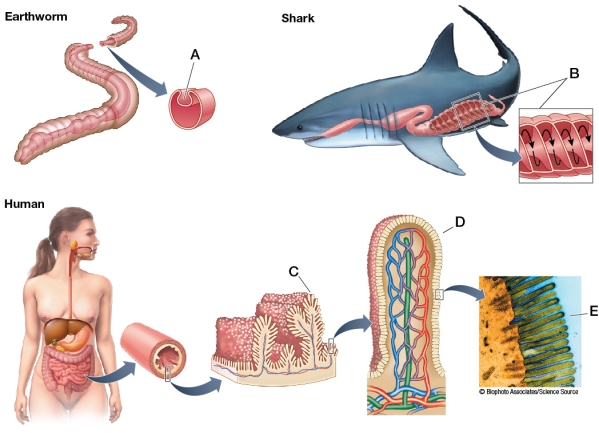 All of the structures labeled in the figure function to increase the surface area available for absorption.Which structure is correctly matched with its name?
 (Multiple Choice)
5.0/5 (85)
(85) The major form of stored energy in animal bodies is _______ because it _______.
(Multiple Choice)
4.9/5 (81)
(81) Identify the incorrect pairing of a micronutrient with its major function.
(Multiple Choice)
4.9/5 (76)
(76) _______ are organisms such as protists and fungi that absorb nutrients from dead organic matter.
(Short Answer)
4.9/5 (80)
(80) The root of a typical mammalian tooth contains _______, but not _______.
(Multiple Choice)
4.9/5 (78)
(78) 
Filters
- Essay(0)
- Multiple Choice(0)
- Short Answer(0)
- True False(0)
- Matching(0)