



 Chat with AI
Exam 50: Nutrition, Digestion, and Absorption

Exam 1: Studying Life246 Questions
Exam 2: Small Molecules and the Chemistry of Life246 Questions
Exam 3: Proteins, Carbohydrates, and Lipids246 Questions
Exam 4: Nucleic Acids and the Origin of Life246 Questions
Exam 5: Cells: the Working Units of Life248 Questions
Exam 6: Cell Membranes246 Questions
Exam 7: Cell Communication and Multicellularity246 Questions
Exam 8: Energy, Enzymes, and Metabolism246 Questions
Exam 9: Pathways That Harvest Chemical Energy246 Questions
Exam 10: Photosynthesis: Energy From Sunlight242 Questions
Exam 11: The Cell Cycle and Cell Division260 Questions
Exam 12: Inheritance, Genes, and Chromosomes250 Questions
Exam 13: Dna and Its Role in Heredity257 Questions
Exam 14: From Dna to Protein: Gene Expression252 Questions
Exam 15: Gene Mutation and Molecular Medicine251 Questions
Exam 16: Regulation of Gene Expression245 Questions
Exam 17: Genomes249 Questions
Exam 18: Recombinant Dna and Biotechnology243 Questions
Exam 20: Mechanisms of Evolution243 Questions
Exam 21: Reconstructing and Using Phylogenies246 Questions
Exam 22: Speciation247 Questions
Exam 23: Evolution of Genes and Genomes252 Questions
Exam 24: The History of Life on Earth246 Questions
Exam 25: Bacteria, Archaea, and Viruses262 Questions
Exam 26: The Origin and Diversification of Eukaryotes252 Questions
Exam 27: Plants Without Seeds: From Water to Land251 Questions
Exam 28: The Evolution of Seed Plants259 Questions
Exam 29: The Evolution and Diversity of Fungi261 Questions
Exam 30: Animal Origins and the Evolution of Body Plans248 Questions
Exam 31: Protostome Animals244 Questions
Exam 32: Deuterostome Animals246 Questions
Exam 33: The Plant Body243 Questions
Exam 34: Transport in Plants248 Questions
Exam 35: Plant Nutrition247 Questions
Exam 36: Regulation of Plant Growth246 Questions
Exam 37: Reproduction in Flowering Plants247 Questions
Exam 38: Plant Responses to Environmental Challenges246 Questions
Exam 39: Physiology, Homeostasis, and Temperature Regulation258 Questions
Exam 40: Animal Hormones249 Questions
Exam 41: Immunology: Animal Defense Systems265 Questions
Exam 42: Animal Reproduction261 Questions
Exam 43: Animal Development261 Questions
Exam 44: Neurons, Glia, and Nervous Systems250 Questions
Exam 45: Sensory Systems249 Questions
Exam 46: The Mammalian Nervous System: Structure and Higher Functions254 Questions
Exam 47: Musculoskeletal Systems259 Questions
Exam 48: Gas Exchange247 Questions
Exam 49: Circulatory Systems252 Questions
Exam 50: Nutrition, Digestion, and Absorption259 Questions
Exam 51: Salt and Water Balance and Nitrogen Excretion251 Questions
Exam 52: Animal Behavior249 Questions
Exam 53: The Physical Environment and Biogeography of Life248 Questions
Exam 54: Populations259 Questions
Exam 55: Species Interactions254 Questions
Exam 56: Communities247 Questions
Exam 57: Ecosystems238 Questions
Exam 58: A Changing Biosphere222 Questions
Select questions type


Refer to the figure showing a mammalian tooth. 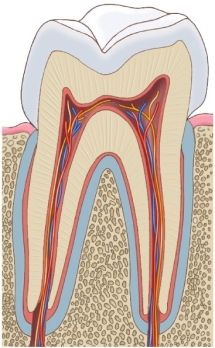 Based on the figure, which statement about mammalian teeth is true?
 (Multiple Choice)
4.7/5  (83)
(83) The pancreatic duct cells and the parietal cells of the stomach both express high levels of carbonic anhydrase.Explain how the actions of this enzyme are similar in both cases, but how the consequences in terms of influences on the pH of the blood are different.
(Essay)
4.8/5 (82)
(82) After being on an antibiotic for an extended period, your doctor checks various nutrient levels in your blood.Not surprisingly, your levels of _______ are low, which would explain why you have been bruising easily lately.Your doctor recommends that you start adding _______ to your diet.
(Multiple Choice)
4.9/5 (81)
(81) Prior to migration, a hummingbird consumes large amounts of nectar and insects, nearly doubling its weight.The added weight is stored primarily as
(Multiple Choice)
4.8/5 (67)
(67) A strictly vegan diet with no vitamin B12 supplements can lead to
(Multiple Choice)
4.8/5 (72)
(72) The initial digestion of protein in the vertebrate digestive tract begins in the _______.
(Short Answer)
4.9/5 (78)
(78) A scientist doing research on a mouse measures insulin levels in its blood, glycogen synthase levels in its liver, and lipase levels in its fat tissue.She takes these measurements before and after feeding the mouse a starchy meal.Following the starchy meal, it is likely that the insulin levels in the blood
(Multiple Choice)
4.7/5 (83)
(83) Which vitamin is most likely deficient in a person who eats liver regularly, yet presents with anemia?
(Multiple Choice)
5.0/5 (70)
(70) Refer to the figure showing the digestive systems of an earthworm and a cockroach. 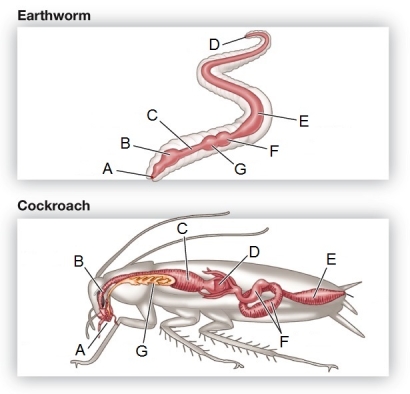 Identify the structure in each organism used for food storage and some minimal, initial digestion.
 (Multiple Choice)
5.0/5 (86)
(86) The nutritional deficiency disease rickets is caused by an inadequate supply of the fat-soluble vitamin
(Multiple Choice)
4.8/5 (93)
(93) Numerous organisms in deep-sea thermal vents, far below the surface and away from any light, survive by harvesting the chemical energy stored in the bonds of inorganic molecules that rise from the interior of Earth.These organisms can be described as
(Multiple Choice)
4.8/5 (84)
(84) The first hormone ever discovered was _______, which is released by the small intestine and acts on the pancreas.
(Multiple Choice)
4.9/5 (73)
(73) If a cow were given a broad spectrum of antibiotics for an infection, digestion of which nutrient(s) would be most directly affected?
(Multiple Choice)
4.9/5 (71)
(71) Refer to the figure showing the intestinal surface area of various organisms. 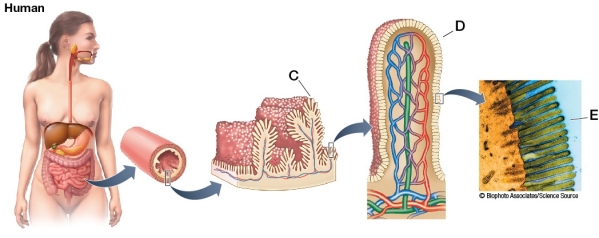 In the figure of the human intestine, what is the structure labeled E, and what is its function?
 (Multiple Choice)
4.9/5 (77)
(77) While humans gain vitamins, such as _______, from their intestinal microbiome, they do not depend on their microbiome for major breakdown of plant materials in their stomachs, as _______ do.
(Multiple Choice)
4.8/5 (79)
(79) Most animals process their food through (extracellular or intracellular) _______ digestion within a gut.
(Short Answer)
4.9/5 (86)
(86) Food intake behavior is regulated by the region of the brain known as the _______.
(Short Answer)
4.8/5 (79)
(79) Refer to the figure showing the digestive systems of two animals. 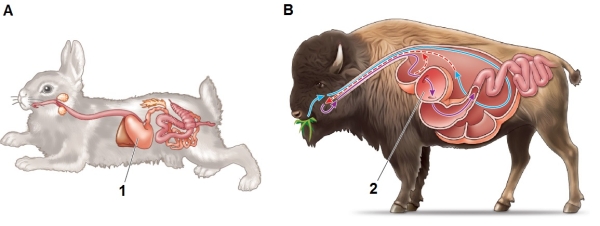 How do the structures marked 1 and 2 compare with each other?
 (Multiple Choice)
4.9/5 (82)
(82) 
Filters
- Essay(0)
- Multiple Choice(0)
- Short Answer(0)
- True False(0)
- Matching(0)