



 Chat with AI
Exam 50: Nutrition, Digestion, and Absorption

Exam 1: Studying Life246 Questions
Exam 2: Small Molecules and the Chemistry of Life246 Questions
Exam 3: Proteins, Carbohydrates, and Lipids246 Questions
Exam 4: Nucleic Acids and the Origin of Life246 Questions
Exam 5: Cells: the Working Units of Life248 Questions
Exam 6: Cell Membranes246 Questions
Exam 7: Cell Communication and Multicellularity246 Questions
Exam 8: Energy, Enzymes, and Metabolism246 Questions
Exam 9: Pathways That Harvest Chemical Energy246 Questions
Exam 10: Photosynthesis: Energy From Sunlight242 Questions
Exam 11: The Cell Cycle and Cell Division260 Questions
Exam 12: Inheritance, Genes, and Chromosomes250 Questions
Exam 13: Dna and Its Role in Heredity257 Questions
Exam 14: From Dna to Protein: Gene Expression252 Questions
Exam 15: Gene Mutation and Molecular Medicine251 Questions
Exam 16: Regulation of Gene Expression245 Questions
Exam 17: Genomes249 Questions
Exam 18: Recombinant Dna and Biotechnology243 Questions
Exam 20: Mechanisms of Evolution243 Questions
Exam 21: Reconstructing and Using Phylogenies246 Questions
Exam 22: Speciation247 Questions
Exam 23: Evolution of Genes and Genomes252 Questions
Exam 24: The History of Life on Earth246 Questions
Exam 25: Bacteria, Archaea, and Viruses262 Questions
Exam 26: The Origin and Diversification of Eukaryotes252 Questions
Exam 27: Plants Without Seeds: From Water to Land251 Questions
Exam 28: The Evolution of Seed Plants259 Questions
Exam 29: The Evolution and Diversity of Fungi261 Questions
Exam 30: Animal Origins and the Evolution of Body Plans248 Questions
Exam 31: Protostome Animals244 Questions
Exam 32: Deuterostome Animals246 Questions
Exam 33: The Plant Body243 Questions
Exam 34: Transport in Plants248 Questions
Exam 35: Plant Nutrition247 Questions
Exam 36: Regulation of Plant Growth246 Questions
Exam 37: Reproduction in Flowering Plants247 Questions
Exam 38: Plant Responses to Environmental Challenges246 Questions
Exam 39: Physiology, Homeostasis, and Temperature Regulation258 Questions
Exam 40: Animal Hormones249 Questions
Exam 41: Immunology: Animal Defense Systems265 Questions
Exam 42: Animal Reproduction261 Questions
Exam 43: Animal Development261 Questions
Exam 44: Neurons, Glia, and Nervous Systems250 Questions
Exam 45: Sensory Systems249 Questions
Exam 46: The Mammalian Nervous System: Structure and Higher Functions254 Questions
Exam 47: Musculoskeletal Systems259 Questions
Exam 48: Gas Exchange247 Questions
Exam 49: Circulatory Systems252 Questions
Exam 50: Nutrition, Digestion, and Absorption259 Questions
Exam 51: Salt and Water Balance and Nitrogen Excretion251 Questions
Exam 52: Animal Behavior249 Questions
Exam 53: The Physical Environment and Biogeography of Life248 Questions
Exam 54: Populations259 Questions
Exam 55: Species Interactions254 Questions
Exam 56: Communities247 Questions
Exam 57: Ecosystems238 Questions
Exam 58: A Changing Biosphere222 Questions
Select questions type


When fat reserves are depleted, plasma proteins are used for energy.Metabolism of plasma proteins _______ the osmotic concentration of the plasma, causing _______ movement of fluid to the _______.
(Multiple Choice)
4.8/5  (71)
(71) Jerry has not eaten for several hours.His blood glucose levels have fallen below normal, so Jerry's body releases the hormone _______ to bring his body back to homeostasis.
(Short Answer)
4.8/5 (73)
(73) Which feature protects the walls of the stomach against the action of its own digestive juices?
(Multiple Choice)
5.0/5 (93)
(93) Adventurers attempting to recreate the Polynesians' months- or years-long trips across the ocean would likely carry _______ with them to avoid the ascorbic acid deficiency called _______.
(Multiple Choice)
4.8/5 (75)
(75) A high level of glucose in the bloodstream would trigger secretion of
(Multiple Choice)
4.7/5 (66)
(66) Which feature characterizes the submucosa layer of the vertebrate gut?
(Multiple Choice)
4.8/5 (81)
(81) You have two cages of mice that have been allowed to feed at will.One cage contains mice lacking leptin receptors, and the other contains mice lacking ghrelin receptors.The tags on the cages have been lost, but you reason that the cage of obese mice must be the ones lacking _______ receptors.
(Short Answer)
4.9/5 (63)
(63) Create a flow chart of the following organs, indicating the order in which they occur from the start to the end of the human gut: small intestine, anus, esophagus, large intestine, mouth, and stomach.Indicate in which of these organs chemical digestion occurs, and the particular nutrient (e.g., fat, protein) being broken down.Also, indicate in which of the organs absorption occurs, and the particular nutrient or substance absorbed.
(Essay)
4.9/5 (79)
(79) The organ that controls most of the balance between circulating and storing nutrients is the _______.
(Short Answer)
4.8/5 (72)
(72) Refer to the figure showing a shark. 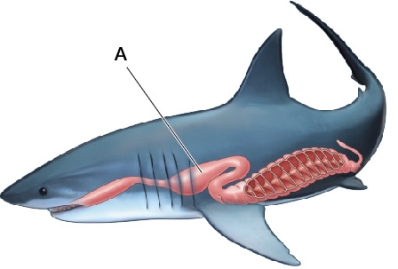 In area A of the digestive tract of this shark, you would expect to find enzymes, primarily _______, which hydrolyze bonds between amino acids.
 (Short Answer)
4.8/5 (88)
(88) Which action is part of the reflexes that occur during swallowing?
(Multiple Choice)
4.9/5 (86)
(86) Choose the correct pairing between vitamin or mineral and the associated deficiency disease.
(Multiple Choice)
4.8/5 (77)
(77) Refer to the table.In mice, a single-gene mutation can lead to obesity.The Ob gene codes for the protein leptin.The recessive ob allele is a loss-of-function allele, so ob/ob mice do not produce leptin.In an experiment, leptin was injected into ob/ob and Ob/Ob (wild-type) mice daily.The data in the table below were collected before the injections began (baseline) and 10 days later.(Assume that the Ob allele is dominant.) 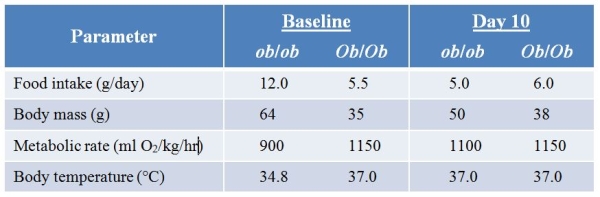 Suppose that on day 11 of the study, the leptin injections are halted and measurements on the mice are taken again at day 20.What values for food intake, body mass, metabolic rate, and body temperature might one reasonably expect to observe at day 20?
 (Short Answer)
4.9/5 (83)
(83) We can synthesize almost all the lipids required by our bodies from acetyl units obtained from carbohydrates or fats, but we must have a dietary source of essential _______, notably linoleic acid.
(Short Answer)
4.9/5 (78)
(78) Why would taking megadoses of vitamin A be more risky for your health than taking megadoses of niacin?
(Essay)
4.8/5 (79)
(79) The gut of a vertebrate is often described as an elongated tube consisting of four layers of different cell types.Which represents the correct order of those layers, from innermost (lumen-facing) to outermost?
(Multiple Choice)
4.8/5 (72)
(72) How does cotransport of sodium in a symporter facilitate glucose absorption?
(Multiple Choice)
4.9/5 (73)
(73) You get up late and rush to class without eating breakfast.You have the energy to make it through to lunch because
(Multiple Choice)
4.8/5 (87)
(87) 
Filters
- Essay(0)
- Multiple Choice(0)
- Short Answer(0)
- True False(0)
- Matching(0)