



 Chat with AI
Exam 50: Nutrition, Digestion, and Absorption

Exam 1: Studying Life246 Questions
Exam 2: Small Molecules and the Chemistry of Life246 Questions
Exam 3: Proteins, Carbohydrates, and Lipids246 Questions
Exam 4: Nucleic Acids and the Origin of Life246 Questions
Exam 5: Cells: the Working Units of Life248 Questions
Exam 6: Cell Membranes246 Questions
Exam 7: Cell Communication and Multicellularity246 Questions
Exam 8: Energy, Enzymes, and Metabolism246 Questions
Exam 9: Pathways That Harvest Chemical Energy246 Questions
Exam 10: Photosynthesis: Energy From Sunlight242 Questions
Exam 11: The Cell Cycle and Cell Division260 Questions
Exam 12: Inheritance, Genes, and Chromosomes250 Questions
Exam 13: Dna and Its Role in Heredity257 Questions
Exam 14: From Dna to Protein: Gene Expression252 Questions
Exam 15: Gene Mutation and Molecular Medicine251 Questions
Exam 16: Regulation of Gene Expression245 Questions
Exam 17: Genomes249 Questions
Exam 18: Recombinant Dna and Biotechnology243 Questions
Exam 20: Mechanisms of Evolution243 Questions
Exam 21: Reconstructing and Using Phylogenies246 Questions
Exam 22: Speciation247 Questions
Exam 23: Evolution of Genes and Genomes252 Questions
Exam 24: The History of Life on Earth246 Questions
Exam 25: Bacteria, Archaea, and Viruses262 Questions
Exam 26: The Origin and Diversification of Eukaryotes252 Questions
Exam 27: Plants Without Seeds: From Water to Land251 Questions
Exam 28: The Evolution of Seed Plants259 Questions
Exam 29: The Evolution and Diversity of Fungi261 Questions
Exam 30: Animal Origins and the Evolution of Body Plans248 Questions
Exam 31: Protostome Animals244 Questions
Exam 32: Deuterostome Animals246 Questions
Exam 33: The Plant Body243 Questions
Exam 34: Transport in Plants248 Questions
Exam 35: Plant Nutrition247 Questions
Exam 36: Regulation of Plant Growth246 Questions
Exam 37: Reproduction in Flowering Plants247 Questions
Exam 38: Plant Responses to Environmental Challenges246 Questions
Exam 39: Physiology, Homeostasis, and Temperature Regulation258 Questions
Exam 40: Animal Hormones249 Questions
Exam 41: Immunology: Animal Defense Systems265 Questions
Exam 42: Animal Reproduction261 Questions
Exam 43: Animal Development261 Questions
Exam 44: Neurons, Glia, and Nervous Systems250 Questions
Exam 45: Sensory Systems249 Questions
Exam 46: The Mammalian Nervous System: Structure and Higher Functions254 Questions
Exam 47: Musculoskeletal Systems259 Questions
Exam 48: Gas Exchange247 Questions
Exam 49: Circulatory Systems252 Questions
Exam 50: Nutrition, Digestion, and Absorption259 Questions
Exam 51: Salt and Water Balance and Nitrogen Excretion251 Questions
Exam 52: Animal Behavior249 Questions
Exam 53: The Physical Environment and Biogeography of Life248 Questions
Exam 54: Populations259 Questions
Exam 55: Species Interactions254 Questions
Exam 56: Communities247 Questions
Exam 57: Ecosystems238 Questions
Exam 58: A Changing Biosphere222 Questions
Select questions type


If you eat a sugary snack, the release of insulin from your pancreas will cause your liver cells to synthesize _______ from the glucose and will prevent your adipose cells from breaking down stored lipids (or fats).
(Short Answer)
4.9/5  (68)
(68) Colonies of _______ microorganisms live within the rumen and reticulum of ruminants, where they break down cellulose by fermentation.
(Short Answer)
4.8/5 (86)
(86) Refer to the figure showing hormonal control of digestion. 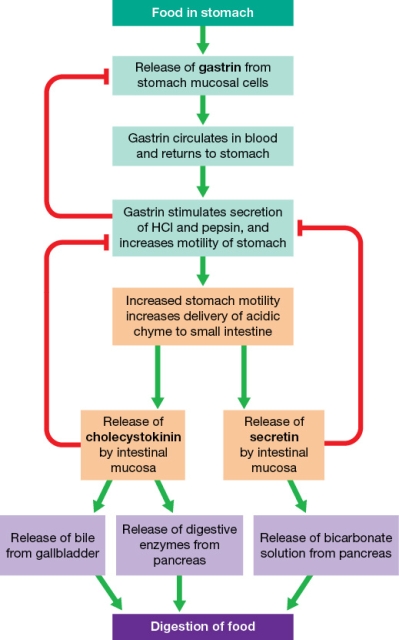 Using the figure, determine what will happen after a person who is unable to produce normal levels of cholecystokinin eats a fatty meal.
 (Multiple Choice)
4.8/5 (73)
(73) Supplementation with _______ helps prevent the nutritional deficiency disease called goiter.
(Multiple Choice)
4.8/5 (70)
(70) Choose the correct order (and major function) for the three sections of the human small intestine.
(Multiple Choice)
4.7/5 (75)
(75) Refer to the table.In mice, a single-gene mutation can lead to obesity.The Ob gene codes for the protein leptin.The recessive ob allele is a loss-of-function allele, so ob/ob mice do not produce leptin.In an experiment, leptin was injected into ob/ob and Ob/Ob (wild-type) mice daily.The data in the table below were collected before the injections began (baseline) and 10 days later.(Assume that the Ob allele is dominant.) 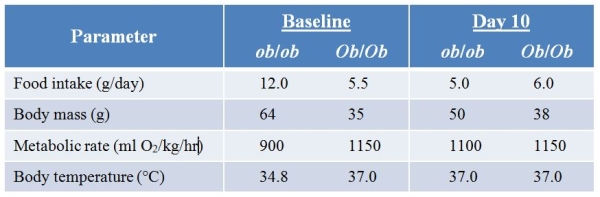 What baseline values would you expect from mice with the heterozygous genotype Ob/ob?
 (Short Answer)
4.7/5 (69)
(69) Refer to the figure showing the esophagus and stomach. 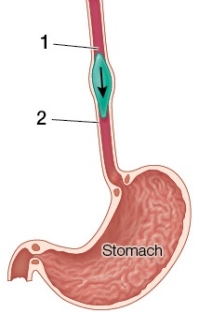 The food bolus (green) is pushed down the esophagus because
 (Multiple Choice)
4.8/5 (76)
(76) _______ reduces appetite, and _______ stimulates appetite.
(Multiple Choice)
4.9/5 (67)
(67) A person who consumes a diet high in whole grains but exhibits pernicious anemia most likely is deficient in
(Multiple Choice)
4.9/5 (74)
(74) People who take antacids on a regular basis are likely to impair their absorption of protein nutrients, primarily because
(Multiple Choice)
5.0/5 (96)
(96) _______ ingest both plant and animal food and process their food through _______ digestion.
(Multiple Choice)
4.9/5 (72)
(72) Which function is served by the HCl secreted in the stomach?
(Multiple Choice)
4.8/5 (86)
(86) What is the key adaptation of most vertebrates that serves to increase absorptive area?
(Multiple Choice)
4.9/5 (75)
(75) Which molecules contain mostly triglycerides and transport them to fat cells in tissues?
(Multiple Choice)
4.8/5 (62)
(62) Movement of food from the stomach into the esophagus is normally prevented by
(Multiple Choice)
4.9/5 (76)
(76) 
Filters
- Essay(0)
- Multiple Choice(0)
- Short Answer(0)
- True False(0)
- Matching(0)