



 Chat with AI
Exam 32: Deuterostome Animals

Exam 1: Studying Life246 Questions
Exam 2: Small Molecules and the Chemistry of Life246 Questions
Exam 3: Proteins, Carbohydrates, and Lipids246 Questions
Exam 4: Nucleic Acids and the Origin of Life246 Questions
Exam 5: Cells: the Working Units of Life248 Questions
Exam 6: Cell Membranes246 Questions
Exam 7: Cell Communication and Multicellularity246 Questions
Exam 8: Energy, Enzymes, and Metabolism246 Questions
Exam 9: Pathways That Harvest Chemical Energy246 Questions
Exam 10: Photosynthesis: Energy From Sunlight242 Questions
Exam 11: The Cell Cycle and Cell Division260 Questions
Exam 12: Inheritance, Genes, and Chromosomes250 Questions
Exam 13: Dna and Its Role in Heredity257 Questions
Exam 14: From Dna to Protein: Gene Expression252 Questions
Exam 15: Gene Mutation and Molecular Medicine251 Questions
Exam 16: Regulation of Gene Expression245 Questions
Exam 17: Genomes249 Questions
Exam 18: Recombinant Dna and Biotechnology243 Questions
Exam 20: Mechanisms of Evolution243 Questions
Exam 21: Reconstructing and Using Phylogenies246 Questions
Exam 22: Speciation247 Questions
Exam 23: Evolution of Genes and Genomes252 Questions
Exam 24: The History of Life on Earth246 Questions
Exam 25: Bacteria, Archaea, and Viruses262 Questions
Exam 26: The Origin and Diversification of Eukaryotes252 Questions
Exam 27: Plants Without Seeds: From Water to Land251 Questions
Exam 28: The Evolution of Seed Plants259 Questions
Exam 29: The Evolution and Diversity of Fungi261 Questions
Exam 30: Animal Origins and the Evolution of Body Plans248 Questions
Exam 31: Protostome Animals244 Questions
Exam 32: Deuterostome Animals246 Questions
Exam 33: The Plant Body243 Questions
Exam 34: Transport in Plants248 Questions
Exam 35: Plant Nutrition247 Questions
Exam 36: Regulation of Plant Growth246 Questions
Exam 37: Reproduction in Flowering Plants247 Questions
Exam 38: Plant Responses to Environmental Challenges246 Questions
Exam 39: Physiology, Homeostasis, and Temperature Regulation258 Questions
Exam 40: Animal Hormones249 Questions
Exam 41: Immunology: Animal Defense Systems265 Questions
Exam 42: Animal Reproduction261 Questions
Exam 43: Animal Development261 Questions
Exam 44: Neurons, Glia, and Nervous Systems250 Questions
Exam 45: Sensory Systems249 Questions
Exam 46: The Mammalian Nervous System: Structure and Higher Functions254 Questions
Exam 47: Musculoskeletal Systems259 Questions
Exam 48: Gas Exchange247 Questions
Exam 49: Circulatory Systems252 Questions
Exam 50: Nutrition, Digestion, and Absorption259 Questions
Exam 51: Salt and Water Balance and Nitrogen Excretion251 Questions
Exam 52: Animal Behavior249 Questions
Exam 53: The Physical Environment and Biogeography of Life248 Questions
Exam 54: Populations259 Questions
Exam 55: Species Interactions254 Questions
Exam 56: Communities247 Questions
Exam 57: Ecosystems238 Questions
Exam 58: A Changing Biosphere222 Questions
Select questions type


The body plans of most vertebrates are based on four appendages.What are the varied forms that these appendages take, and how are they used? In which lineages have two or more of these appendages been lost?
(Essay)
4.8/5  (79)
(79) Which group of living eutherian mammals has the most species?
(Multiple Choice)
4.9/5 (73)
(73) The fossil record, morphology, and molecular data all support the theory that birds are
(Multiple Choice)
4.9/5 (75)
(75) Along a rocky tide pool, you discover an animal with a hemisphere-shaped body covered with spines that move when you touch them.This animal belongs to the _______ group.
(Multiple Choice)
4.7/5 (83)
(83) Genetic analysis suggests that hagfishes and lampreys may be sister groups.Which statement best supports the idea that hagfishes are vertebrates?
(Multiple Choice)
4.9/5 (72)
(72) Which of the following is not one of the hypotheses for the global decline in amphibian diversity?
(Multiple Choice)
4.9/5 (67)
(67) The _______ are likely closely related to the most recent common ancestors of all deuterostomes.
(Multiple Choice)
4.9/5 (84)
(84) Which of the following is found in all major groups of vertebrates?
(Multiple Choice)
4.7/5 (78)
(78) Refer to the figure. 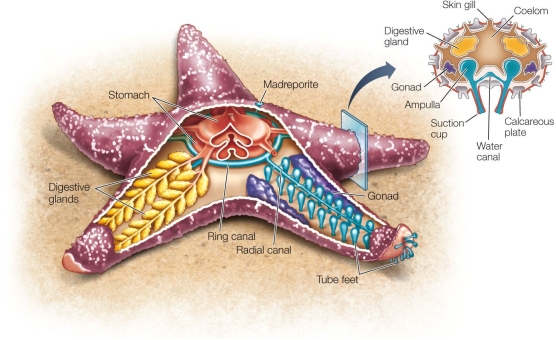 The figure shows the cross section (at right) of a sea star are.Within the arm are tube feet with two parts: an ampulla and a suction cup.The ampulla is connected to a tube.When muscles in the ampulla contract, they push water into the tube, resulting in
 (Multiple Choice)
4.9/5 (61)
(61) A sea star feeding on a living bivalve pulls the shell open with its _______ and push its _______ into the space between the shells.
(Multiple Choice)
4.9/5 (75)
(75) Which adaptation allowed lepidosaurs to shift completely from water to land?
(Multiple Choice)
4.9/5 (78)
(78) Construct a phylogeny that shows the position of the birds within the reptiles.Include the following groups in your phylogeny: birds, crocodilians, turtles, mammals, and lepidosaurs.Label the following characteristics (A-G) on your phylogeny:
A.Bipedal stance
B.Feathers
C.Hollow bones
D.Scales
E.Amniote egg
F.Archosaurs
G.Theropods
(Essay)
4.8/5 (76)
(76) A marine fish that lays many small, sinking eggs would most likely lay them _______ because these locations are _______.
(Multiple Choice)
4.9/5 (79)
(79) In a pond, frog eggs are attached to vegetation and are physically supported by the water.Which structure in an amniote egg contains material that provides similar physical support?
(Multiple Choice)
4.8/5 (76)
(76) 
Filters
- Essay(0)
- Multiple Choice(0)
- Short Answer(0)
- True False(0)
- Matching(0)