



 Chat with AI
Exam 32: Deuterostome Animals

Exam 1: Studying Life246 Questions
Exam 2: Small Molecules and the Chemistry of Life246 Questions
Exam 3: Proteins, Carbohydrates, and Lipids246 Questions
Exam 4: Nucleic Acids and the Origin of Life246 Questions
Exam 5: Cells: the Working Units of Life248 Questions
Exam 6: Cell Membranes246 Questions
Exam 7: Cell Communication and Multicellularity246 Questions
Exam 8: Energy, Enzymes, and Metabolism246 Questions
Exam 9: Pathways That Harvest Chemical Energy246 Questions
Exam 10: Photosynthesis: Energy From Sunlight242 Questions
Exam 11: The Cell Cycle and Cell Division260 Questions
Exam 12: Inheritance, Genes, and Chromosomes250 Questions
Exam 13: Dna and Its Role in Heredity257 Questions
Exam 14: From Dna to Protein: Gene Expression252 Questions
Exam 15: Gene Mutation and Molecular Medicine251 Questions
Exam 16: Regulation of Gene Expression245 Questions
Exam 17: Genomes249 Questions
Exam 18: Recombinant Dna and Biotechnology243 Questions
Exam 20: Mechanisms of Evolution243 Questions
Exam 21: Reconstructing and Using Phylogenies246 Questions
Exam 22: Speciation247 Questions
Exam 23: Evolution of Genes and Genomes252 Questions
Exam 24: The History of Life on Earth246 Questions
Exam 25: Bacteria, Archaea, and Viruses262 Questions
Exam 26: The Origin and Diversification of Eukaryotes252 Questions
Exam 27: Plants Without Seeds: From Water to Land251 Questions
Exam 28: The Evolution of Seed Plants259 Questions
Exam 29: The Evolution and Diversity of Fungi261 Questions
Exam 30: Animal Origins and the Evolution of Body Plans248 Questions
Exam 31: Protostome Animals244 Questions
Exam 32: Deuterostome Animals246 Questions
Exam 33: The Plant Body243 Questions
Exam 34: Transport in Plants248 Questions
Exam 35: Plant Nutrition247 Questions
Exam 36: Regulation of Plant Growth246 Questions
Exam 37: Reproduction in Flowering Plants247 Questions
Exam 38: Plant Responses to Environmental Challenges246 Questions
Exam 39: Physiology, Homeostasis, and Temperature Regulation258 Questions
Exam 40: Animal Hormones249 Questions
Exam 41: Immunology: Animal Defense Systems265 Questions
Exam 42: Animal Reproduction261 Questions
Exam 43: Animal Development261 Questions
Exam 44: Neurons, Glia, and Nervous Systems250 Questions
Exam 45: Sensory Systems249 Questions
Exam 46: The Mammalian Nervous System: Structure and Higher Functions254 Questions
Exam 47: Musculoskeletal Systems259 Questions
Exam 48: Gas Exchange247 Questions
Exam 49: Circulatory Systems252 Questions
Exam 50: Nutrition, Digestion, and Absorption259 Questions
Exam 51: Salt and Water Balance and Nitrogen Excretion251 Questions
Exam 52: Animal Behavior249 Questions
Exam 53: The Physical Environment and Biogeography of Life248 Questions
Exam 54: Populations259 Questions
Exam 55: Species Interactions254 Questions
Exam 56: Communities247 Questions
Exam 57: Ecosystems238 Questions
Exam 58: A Changing Biosphere222 Questions
Select questions type


_______ females have ventral pouches in which they carry and feed their offspring.
(Short Answer)
4.7/5  (84)
(84) Refer to the figure. 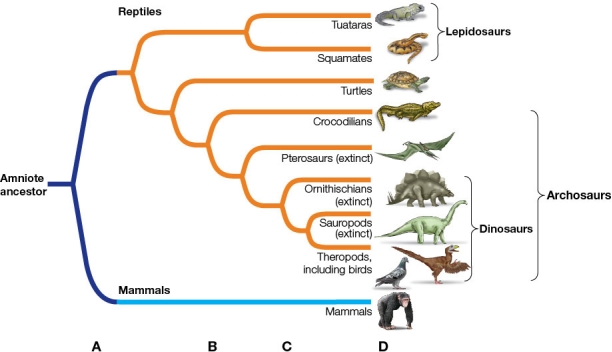 The Mesozoic era marked the breakup of the major continents.Using the phylogeny shown, propose the likely geological and climatic changes that occurred at each letter (A-D).Provide evolutionary evidence to support your justifications.
 (Essay)
4.8/5 (72)
(72) The expanded mental abilities of humans are largely responsible for the development of _______, which is defined as the process by which knowledge and traditions are passed from one generation to the next.
(Short Answer)
5.0/5 (88)
(88) Refer to the figure showing a Petromyzon marinus. 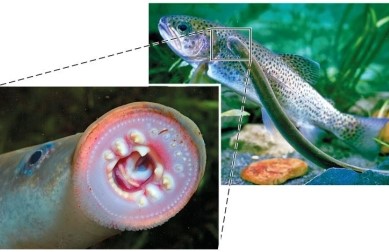 This lamprey shown obtains nutrients by
 (Multiple Choice)
4.7/5 (80)
(80) Refer to the figure. 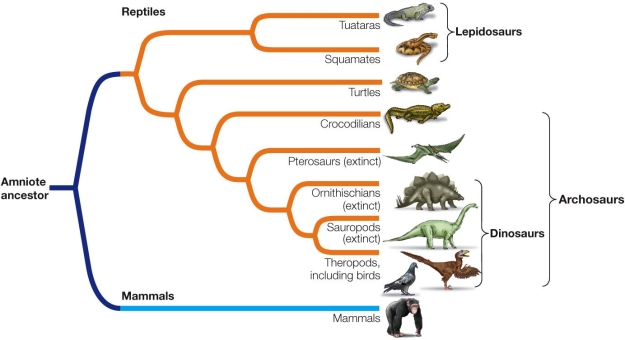 In which two groups of amniotes did endothermy convergently evolve?
 (Multiple Choice)
4.7/5 (74)
(74) Alongside a rocky tide pool, you discover an animal with a spherical body covered with spines that move when you touch it.This animal is most likely a(n)
(Multiple Choice)
4.9/5 (91)
(91) Refer to the figure showing a larval and an adult lancelet. 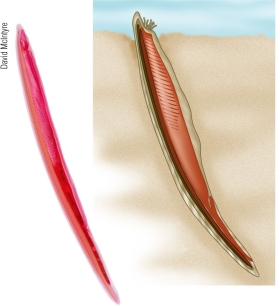 In the lancelet, which features are not chordate synapomorphies?
 (Multiple Choice)
4.7/5 (91)
(91) The evolution of primitive _______ in the sister group of the ray-finned fishes provided an alternative method of gas exchange, thus setting the stage for the invasion of land.
(Short Answer)
4.9/5 (68)
(68) The species of hominid that was widespread between 500,000 and 28,000 years ago was _______.
(Short Answer)
4.8/5 (78)
(78) Morphological, fossil, and molecular evidence support phylogenetic placement of birds among the reptiles, specifically in a specialized group of predatory dinosaurs called theropods.Which statement does not support this assertion?
(Multiple Choice)
4.9/5 (72)
(72) Refer to the figure. 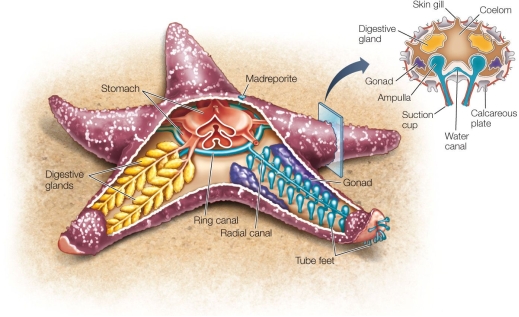 Which statement about the sea star shown in the figure is true?
 (Multiple Choice)
4.8/5 (81)
(81) The muscular pharynx of an acorn worm (a hemichordate) opens to the outside with a number of _______ through which water can exit.
(Short Answer)
4.8/5 (76)
(76) Which of the following features are associated with a chondrichthyan that settles on sediments and feeds on the ocean floor?
(Multiple Choice)
4.9/5 (85)
(85) 
Filters
- Essay(0)
- Multiple Choice(0)
- Short Answer(0)
- True False(0)
- Matching(0)