



 Chat with AI
Exam 32: Deuterostome Animals

Exam 1: Studying Life246 Questions
Exam 2: Small Molecules and the Chemistry of Life246 Questions
Exam 3: Proteins, Carbohydrates, and Lipids246 Questions
Exam 4: Nucleic Acids and the Origin of Life246 Questions
Exam 5: Cells: the Working Units of Life248 Questions
Exam 6: Cell Membranes246 Questions
Exam 7: Cell Communication and Multicellularity246 Questions
Exam 8: Energy, Enzymes, and Metabolism246 Questions
Exam 9: Pathways That Harvest Chemical Energy246 Questions
Exam 10: Photosynthesis: Energy From Sunlight242 Questions
Exam 11: The Cell Cycle and Cell Division260 Questions
Exam 12: Inheritance, Genes, and Chromosomes250 Questions
Exam 13: Dna and Its Role in Heredity257 Questions
Exam 14: From Dna to Protein: Gene Expression252 Questions
Exam 15: Gene Mutation and Molecular Medicine251 Questions
Exam 16: Regulation of Gene Expression245 Questions
Exam 17: Genomes249 Questions
Exam 18: Recombinant Dna and Biotechnology243 Questions
Exam 20: Mechanisms of Evolution243 Questions
Exam 21: Reconstructing and Using Phylogenies246 Questions
Exam 22: Speciation247 Questions
Exam 23: Evolution of Genes and Genomes252 Questions
Exam 24: The History of Life on Earth246 Questions
Exam 25: Bacteria, Archaea, and Viruses262 Questions
Exam 26: The Origin and Diversification of Eukaryotes252 Questions
Exam 27: Plants Without Seeds: From Water to Land251 Questions
Exam 28: The Evolution of Seed Plants259 Questions
Exam 29: The Evolution and Diversity of Fungi261 Questions
Exam 30: Animal Origins and the Evolution of Body Plans248 Questions
Exam 31: Protostome Animals244 Questions
Exam 32: Deuterostome Animals246 Questions
Exam 33: The Plant Body243 Questions
Exam 34: Transport in Plants248 Questions
Exam 35: Plant Nutrition247 Questions
Exam 36: Regulation of Plant Growth246 Questions
Exam 37: Reproduction in Flowering Plants247 Questions
Exam 38: Plant Responses to Environmental Challenges246 Questions
Exam 39: Physiology, Homeostasis, and Temperature Regulation258 Questions
Exam 40: Animal Hormones249 Questions
Exam 41: Immunology: Animal Defense Systems265 Questions
Exam 42: Animal Reproduction261 Questions
Exam 43: Animal Development261 Questions
Exam 44: Neurons, Glia, and Nervous Systems250 Questions
Exam 45: Sensory Systems249 Questions
Exam 46: The Mammalian Nervous System: Structure and Higher Functions254 Questions
Exam 47: Musculoskeletal Systems259 Questions
Exam 48: Gas Exchange247 Questions
Exam 49: Circulatory Systems252 Questions
Exam 50: Nutrition, Digestion, and Absorption259 Questions
Exam 51: Salt and Water Balance and Nitrogen Excretion251 Questions
Exam 52: Animal Behavior249 Questions
Exam 53: The Physical Environment and Biogeography of Life248 Questions
Exam 54: Populations259 Questions
Exam 55: Species Interactions254 Questions
Exam 56: Communities247 Questions
Exam 57: Ecosystems238 Questions
Exam 58: A Changing Biosphere222 Questions
Select questions type


Primates include the prosimians (lemurs and lorises), New World monkeys, Old World monkeys, gibbons, orangutans, African apes, and humans.Which of the following statements about the primates is false?
(Multiple Choice)
4.9/5  (65)
(65) In an amniote egg, the contents of the _______ become smaller in size as the embryo grows.
(Multiple Choice)
4.7/5 (87)
(87) What are the distinguishing characteristics of deuterostomes? Are these all exclusive to deuterostomes? What is the evidence for monophyly of the group we call deuterostomes?
(Essay)
4.9/5 (90)
(90) Pharyngeal slits are not a chordate synapomorphy because they
(Multiple Choice)
4.8/5 (79)
(79) Living deuterostomes comprise three clades: the echinoderms, the chordates, and the
(Multiple Choice)
4.7/5 (85)
(85) A group that is often considered among the vertebrates but is thought by some scientists to be a sister group to the vertebrates includes the _______, which produces large amounts of slime as a defense mechanism, has three small accessory hearts, and does not possess stomach or jaws.
(Multiple Choice)
4.9/5 (73)
(73) You find a fossil deuterostome in marine deposits, that has several feathery arms at the end of a long stalk.The stalk is composed of tiny discs that resemble a five-pointed star in cross section.This animal is likely a
(Multiple Choice)
4.8/5 (91)
(91) The first hominin to leave Africa less than 1.6 mya was _______, most likely followed much later by _______.
(Multiple Choice)
4.7/5 (64)
(64) Neoteny in primates includes which of the following traits? (Note: At birth, human and chimpanzee skulls have similar proportions.)
(Multiple Choice)
4.9/5 (74)
(74) Refer to the figure showing an acorn worm (top) and pterobranchs (bottom). 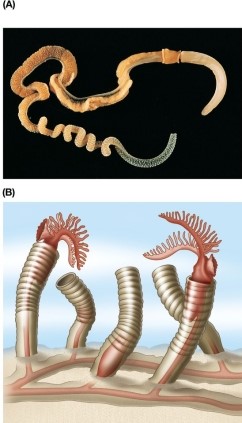 Which of the following is a feature or features of pterobranchs but not of acorn worms?
 (Multiple Choice)
4.9/5 (80)
(80) Refer to the figure showing a phylogenetic tree of hominins. 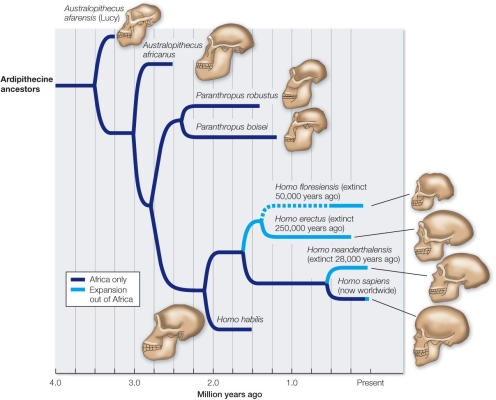 Suppose there are 50 ancestral traits (not derived) present in Homo erectus.According to the figure, which of the following pairs would be equally likely to possess these same 50 traits?
 (Multiple Choice)
4.9/5 (71)
(71) Primates likely descended from small, arboreal, _______ mammals.
(Multiple Choice)
4.8/5 (69)
(69) What name is given to the group consisting of echinoderms and hemichordates?
(Multiple Choice)
4.9/5 (76)
(76) Which chordate features in the sea squirt (tunicate) larva do not appear in the adult sea squirt?
(Multiple Choice)
4.8/5 (80)
(80) 
Filters
- Essay(0)
- Multiple Choice(0)
- Short Answer(0)
- True False(0)
- Matching(0)