



 Chat with AI
Exam 32: Deuterostome Animals

Exam 1: Studying Life246 Questions
Exam 2: Small Molecules and the Chemistry of Life246 Questions
Exam 3: Proteins, Carbohydrates, and Lipids246 Questions
Exam 4: Nucleic Acids and the Origin of Life246 Questions
Exam 5: Cells: the Working Units of Life248 Questions
Exam 6: Cell Membranes246 Questions
Exam 7: Cell Communication and Multicellularity246 Questions
Exam 8: Energy, Enzymes, and Metabolism246 Questions
Exam 9: Pathways That Harvest Chemical Energy246 Questions
Exam 10: Photosynthesis: Energy From Sunlight242 Questions
Exam 11: The Cell Cycle and Cell Division260 Questions
Exam 12: Inheritance, Genes, and Chromosomes250 Questions
Exam 13: Dna and Its Role in Heredity257 Questions
Exam 14: From Dna to Protein: Gene Expression252 Questions
Exam 15: Gene Mutation and Molecular Medicine251 Questions
Exam 16: Regulation of Gene Expression245 Questions
Exam 17: Genomes249 Questions
Exam 18: Recombinant Dna and Biotechnology243 Questions
Exam 20: Mechanisms of Evolution243 Questions
Exam 21: Reconstructing and Using Phylogenies246 Questions
Exam 22: Speciation247 Questions
Exam 23: Evolution of Genes and Genomes252 Questions
Exam 24: The History of Life on Earth246 Questions
Exam 25: Bacteria, Archaea, and Viruses262 Questions
Exam 26: The Origin and Diversification of Eukaryotes252 Questions
Exam 27: Plants Without Seeds: From Water to Land251 Questions
Exam 28: The Evolution of Seed Plants259 Questions
Exam 29: The Evolution and Diversity of Fungi261 Questions
Exam 30: Animal Origins and the Evolution of Body Plans248 Questions
Exam 31: Protostome Animals244 Questions
Exam 32: Deuterostome Animals246 Questions
Exam 33: The Plant Body243 Questions
Exam 34: Transport in Plants248 Questions
Exam 35: Plant Nutrition247 Questions
Exam 36: Regulation of Plant Growth246 Questions
Exam 37: Reproduction in Flowering Plants247 Questions
Exam 38: Plant Responses to Environmental Challenges246 Questions
Exam 39: Physiology, Homeostasis, and Temperature Regulation258 Questions
Exam 40: Animal Hormones249 Questions
Exam 41: Immunology: Animal Defense Systems265 Questions
Exam 42: Animal Reproduction261 Questions
Exam 43: Animal Development261 Questions
Exam 44: Neurons, Glia, and Nervous Systems250 Questions
Exam 45: Sensory Systems249 Questions
Exam 46: The Mammalian Nervous System: Structure and Higher Functions254 Questions
Exam 47: Musculoskeletal Systems259 Questions
Exam 48: Gas Exchange247 Questions
Exam 49: Circulatory Systems252 Questions
Exam 50: Nutrition, Digestion, and Absorption259 Questions
Exam 51: Salt and Water Balance and Nitrogen Excretion251 Questions
Exam 52: Animal Behavior249 Questions
Exam 53: The Physical Environment and Biogeography of Life248 Questions
Exam 54: Populations259 Questions
Exam 55: Species Interactions254 Questions
Exam 56: Communities247 Questions
Exam 57: Ecosystems238 Questions
Exam 58: A Changing Biosphere222 Questions
Select questions type


Refer to the figure. 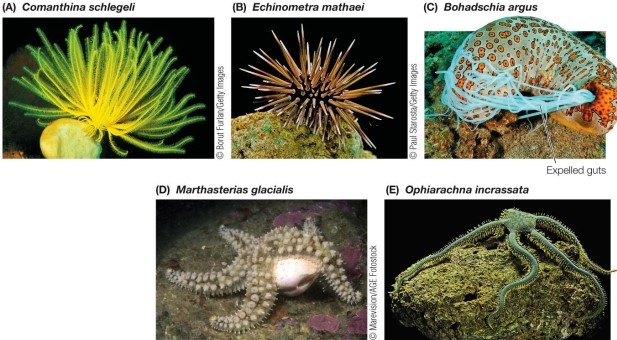 Which animal shown in the figure has an anterior-posterior rather than an oral-aboral orientation of the mouth and anus?
 (Multiple Choice)
4.9/5  (85)
(85) Refer to the figure. 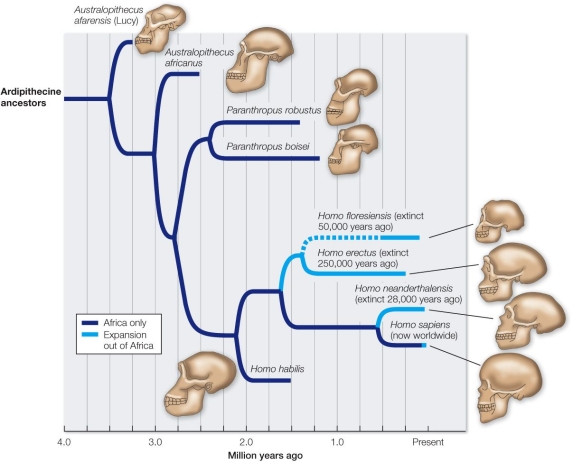 From the figure, what can you conclude about the relationship between Homo erectus and H.sapiens?
 (Multiple Choice)
4.9/5 (67)
(67) Part of the extraordinary success of the reptiles can be attributed to the evolution of the _______, which made embryonic development outside of water possible.
(Short Answer)
4.8/5 (68)
(68) Which of the following was not a change that accompanied the transition from the australopithecines to Homo habilis?
(Multiple Choice)
4.7/5 (85)
(85) The rattlesnake, fence lizard, some caecilians, and eutherian mammals are all _______ when it comes to reproduction, but not all of them belong members of the group called _______.
(Short Answer)
4.9/5 (85)
(85) A _______ that develops from mesodermal pockets that bud off from the cavity of the gastrula is a characteristic of _______.
(Multiple Choice)
4.8/5 (88)
(88) Which of the following was an adaptation in lobe-finned vertebrates that was instrumental in the transition to life on land and therefore important in the evolution of the amphibians?
(Multiple Choice)
4.7/5 (82)
(82) In _______, the coelom arises from _______ and the _______ arises from the blastopore.
(Multiple Choice)
4.8/5 (71)
(71) Which of the following is not a characteristic of deuterostomes?
(Multiple Choice)
4.9/5 (71)
(71) Refer to the figure. 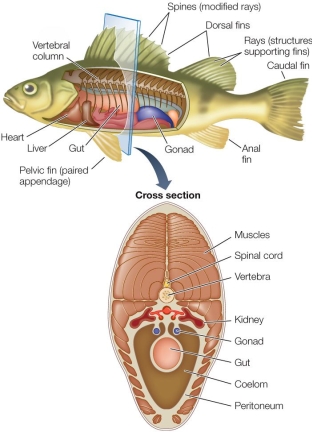 The figure illustrates the vertebrate body plan.Which of the following is not a feature of all vertebrates?
 (Multiple Choice)
4.9/5 (69)
(69) Refer to the figure. 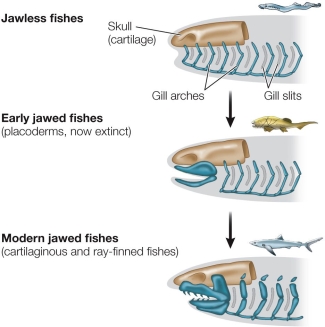 What modification in jaw structure has occurred in modern jawed fishes that was not present in early jawed fishes?
 (Multiple Choice)
4.9/5 (81)
(81) _______ propel themselves by means of vertical undulating movements of their greatly enlarged pectoral fins.
(Multiple Choice)
4.9/5 (93)
(93) Which of the following is a major trait distinguishing the primates from other mammals?
(Multiple Choice)
4.8/5 (69)
(69) Refer to the figure showing a phylogenetic tree of hominins. 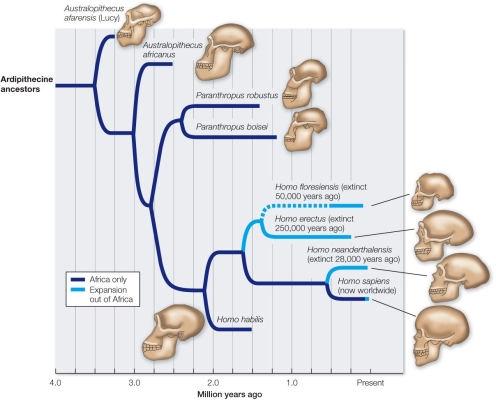 According to the figure, Homo habilis is least likely to have been alive at the same time as
 (Multiple Choice)
4.9/5 (78)
(78) Most of the major groups of mammals arose at the end of the Cretaceous period.This most likely occurred because
(Multiple Choice)
4.8/5 (89)
(89) Frogs are unique among the vertebrates because they possess, at some stage of development,
(Multiple Choice)
4.8/5 (78)
(78) The archosaur clade of reptiles includes crocodiles, birds, and the extinct dinosaurs and pterosaurs.What evidence suggests that some extinct theropods may be endothermic?
(Essay)
4.9/5 (80)
(80) 
Filters
- Essay(0)
- Multiple Choice(0)
- Short Answer(0)
- True False(0)
- Matching(0)