



 Chat with AI
Exam 32: Deuterostome Animals

Exam 1: Studying Life246 Questions
Exam 2: Small Molecules and the Chemistry of Life246 Questions
Exam 3: Proteins, Carbohydrates, and Lipids246 Questions
Exam 4: Nucleic Acids and the Origin of Life246 Questions
Exam 5: Cells: the Working Units of Life248 Questions
Exam 6: Cell Membranes246 Questions
Exam 7: Cell Communication and Multicellularity246 Questions
Exam 8: Energy, Enzymes, and Metabolism246 Questions
Exam 9: Pathways That Harvest Chemical Energy246 Questions
Exam 10: Photosynthesis: Energy From Sunlight242 Questions
Exam 11: The Cell Cycle and Cell Division260 Questions
Exam 12: Inheritance, Genes, and Chromosomes250 Questions
Exam 13: Dna and Its Role in Heredity257 Questions
Exam 14: From Dna to Protein: Gene Expression252 Questions
Exam 15: Gene Mutation and Molecular Medicine251 Questions
Exam 16: Regulation of Gene Expression245 Questions
Exam 17: Genomes249 Questions
Exam 18: Recombinant Dna and Biotechnology243 Questions
Exam 20: Mechanisms of Evolution243 Questions
Exam 21: Reconstructing and Using Phylogenies246 Questions
Exam 22: Speciation247 Questions
Exam 23: Evolution of Genes and Genomes252 Questions
Exam 24: The History of Life on Earth246 Questions
Exam 25: Bacteria, Archaea, and Viruses262 Questions
Exam 26: The Origin and Diversification of Eukaryotes252 Questions
Exam 27: Plants Without Seeds: From Water to Land251 Questions
Exam 28: The Evolution of Seed Plants259 Questions
Exam 29: The Evolution and Diversity of Fungi261 Questions
Exam 30: Animal Origins and the Evolution of Body Plans248 Questions
Exam 31: Protostome Animals244 Questions
Exam 32: Deuterostome Animals246 Questions
Exam 33: The Plant Body243 Questions
Exam 34: Transport in Plants248 Questions
Exam 35: Plant Nutrition247 Questions
Exam 36: Regulation of Plant Growth246 Questions
Exam 37: Reproduction in Flowering Plants247 Questions
Exam 38: Plant Responses to Environmental Challenges246 Questions
Exam 39: Physiology, Homeostasis, and Temperature Regulation258 Questions
Exam 40: Animal Hormones249 Questions
Exam 41: Immunology: Animal Defense Systems265 Questions
Exam 42: Animal Reproduction261 Questions
Exam 43: Animal Development261 Questions
Exam 44: Neurons, Glia, and Nervous Systems250 Questions
Exam 45: Sensory Systems249 Questions
Exam 46: The Mammalian Nervous System: Structure and Higher Functions254 Questions
Exam 47: Musculoskeletal Systems259 Questions
Exam 48: Gas Exchange247 Questions
Exam 49: Circulatory Systems252 Questions
Exam 50: Nutrition, Digestion, and Absorption259 Questions
Exam 51: Salt and Water Balance and Nitrogen Excretion251 Questions
Exam 52: Animal Behavior249 Questions
Exam 53: The Physical Environment and Biogeography of Life248 Questions
Exam 54: Populations259 Questions
Exam 55: Species Interactions254 Questions
Exam 56: Communities247 Questions
Exam 57: Ecosystems238 Questions
Exam 58: A Changing Biosphere222 Questions
Select questions type


In chordates, the _______ is composed of a core of large cells with turgid, fluid-filled vacuoles, which make it rigid but flexible.
(Multiple Choice)
4.9/5  (84)
(84) Which of the following is an example of how an echinoderm uses its tube feet to feed?
(Multiple Choice)
4.9/5 (72)
(72) You are in a tropical forest and find an organism that has bony vertebrae and no legs.It lays eggs in moist patches and uses its skin for gaseous exchange.You have found a(n)
(Multiple Choice)
4.8/5 (85)
(85) Fossil evidence indicates that the earliest deuterostomes were bilaterally symmetrical, segmented animals with a pharynx that had slits through which water flowed.Adult echinoderms have pentaradial (five-radial) symmetry.Therefore,
(Multiple Choice)
5.0/5 (87)
(87) In the not-too-distant past, the idea that birds were reptiles met with skepticism.Explain how fossils, morphology, and molecular evidence now support the position of birds among the reptiles.
(Essay)
4.8/5 (83)
(83) Which of the following groups has a water vascular system?
(Multiple Choice)
4.8/5 (79)
(79) Which group of organisms is associated with the evolutionary innovation of an operculum over the gill slits?
(Multiple Choice)
4.8/5 (82)
(82) Refer to the figure showing an acorn worm (top) and pterobranchs (bottom). 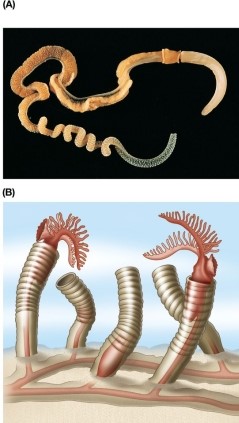 Which statement regarding structure and function of body parts in the hemichordates shown is false?
 (Multiple Choice)
4.7/5 (71)
(71) The cartilaginous fishes control their movement with pairs of unjointed appendages called _______.
(Short Answer)
4.7/5 (80)
(80) Vertebrates have a jointed dorsal _______, which replaced the notochord as their primary support.
(Short Answer)
4.7/5 (69)
(69) Lungfishes were important shallow-water predators during the Devonian period, but their diversity has declined significantly, most likely as a result of
(Multiple Choice)
4.9/5 (77)
(77) Amphibians are dependent on water and moist environments for their life cycle.Which stages require an aquatic environment, and why is such an environment necessary? Do any amphibians have strategies that allow them to avoid the aquatic stage? If so, describe them.
(Essay)
4.8/5 (82)
(82) What advantage did the evolution of a swim bladder provide to aquatic gnathostomes?
(Multiple Choice)
4.9/5 (75)
(75) How do hemichordates and echinoderms differ in the way they feed?
(Multiple Choice)
4.8/5 (70)
(70) The term "cyclostome" means "circle mouth." The term "agnathan" refers to jawless fishes.According to this information, which of the following is true?
(Multiple Choice)
4.8/5 (76)
(76) The living species Latimeria chalumnae belongs to a group that is an important link in evolution because it was the first group of
(Multiple Choice)
4.8/5 (67)
(67) As deuterostomes, chordates possess pharyngeal slits at some stage of development.Which of the following chordates presents an example of why caution is needed when phylogenetic relationships are assessed using only adult structures?
(Multiple Choice)
4.9/5 (72)
(72) Large, active predators, such as sharks, owe their success, in part, to possession of a _______, which supports an internal skeleton and an extensive muscular system.
(Short Answer)
4.7/5 (78)
(78) 
Filters
- Essay(0)
- Multiple Choice(0)
- Short Answer(0)
- True False(0)
- Matching(0)