



 Chat with AI
Exam 27: Plants Without Seeds: From Water to Land

Exam 1: Studying Life246 Questions
Exam 2: Small Molecules and the Chemistry of Life246 Questions
Exam 3: Proteins, Carbohydrates, and Lipids246 Questions
Exam 4: Nucleic Acids and the Origin of Life246 Questions
Exam 5: Cells: the Working Units of Life248 Questions
Exam 6: Cell Membranes246 Questions
Exam 7: Cell Communication and Multicellularity246 Questions
Exam 8: Energy, Enzymes, and Metabolism246 Questions
Exam 9: Pathways That Harvest Chemical Energy246 Questions
Exam 10: Photosynthesis: Energy From Sunlight242 Questions
Exam 11: The Cell Cycle and Cell Division260 Questions
Exam 12: Inheritance, Genes, and Chromosomes250 Questions
Exam 13: Dna and Its Role in Heredity257 Questions
Exam 14: From Dna to Protein: Gene Expression252 Questions
Exam 15: Gene Mutation and Molecular Medicine251 Questions
Exam 16: Regulation of Gene Expression245 Questions
Exam 17: Genomes249 Questions
Exam 18: Recombinant Dna and Biotechnology243 Questions
Exam 20: Mechanisms of Evolution243 Questions
Exam 21: Reconstructing and Using Phylogenies246 Questions
Exam 22: Speciation247 Questions
Exam 23: Evolution of Genes and Genomes252 Questions
Exam 24: The History of Life on Earth246 Questions
Exam 25: Bacteria, Archaea, and Viruses262 Questions
Exam 26: The Origin and Diversification of Eukaryotes252 Questions
Exam 27: Plants Without Seeds: From Water to Land251 Questions
Exam 28: The Evolution of Seed Plants259 Questions
Exam 29: The Evolution and Diversity of Fungi261 Questions
Exam 30: Animal Origins and the Evolution of Body Plans248 Questions
Exam 31: Protostome Animals244 Questions
Exam 32: Deuterostome Animals246 Questions
Exam 33: The Plant Body243 Questions
Exam 34: Transport in Plants248 Questions
Exam 35: Plant Nutrition247 Questions
Exam 36: Regulation of Plant Growth246 Questions
Exam 37: Reproduction in Flowering Plants247 Questions
Exam 38: Plant Responses to Environmental Challenges246 Questions
Exam 39: Physiology, Homeostasis, and Temperature Regulation258 Questions
Exam 40: Animal Hormones249 Questions
Exam 41: Immunology: Animal Defense Systems265 Questions
Exam 42: Animal Reproduction261 Questions
Exam 43: Animal Development261 Questions
Exam 44: Neurons, Glia, and Nervous Systems250 Questions
Exam 45: Sensory Systems249 Questions
Exam 46: The Mammalian Nervous System: Structure and Higher Functions254 Questions
Exam 47: Musculoskeletal Systems259 Questions
Exam 48: Gas Exchange247 Questions
Exam 49: Circulatory Systems252 Questions
Exam 50: Nutrition, Digestion, and Absorption259 Questions
Exam 51: Salt and Water Balance and Nitrogen Excretion251 Questions
Exam 52: Animal Behavior249 Questions
Exam 53: The Physical Environment and Biogeography of Life248 Questions
Exam 54: Populations259 Questions
Exam 55: Species Interactions254 Questions
Exam 56: Communities247 Questions
Exam 57: Ecosystems238 Questions
Exam 58: A Changing Biosphere222 Questions
Select questions type


_______ are water-absorbing filaments present on the lower surfaces of the simplest liverwort gametophytes.
(Short Answer)
4.8/5  (66)
(66) Refer to the figure. 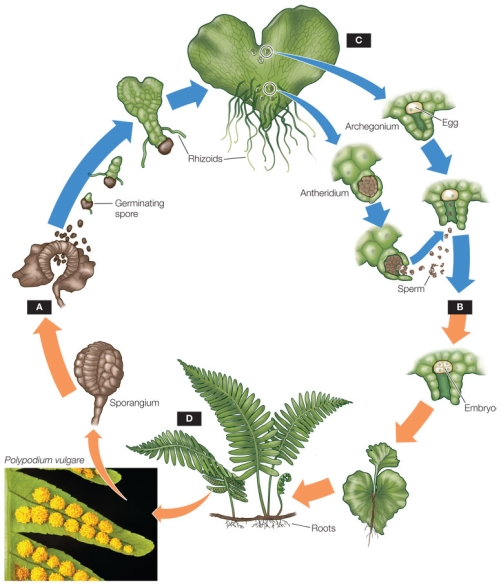 Are the gametes in the diagram haploid or diploid?
 (Short Answer)
4.9/5 (91)
(91) A property shared by the sporophyte of mosses and ferns is
(Multiple Choice)
4.8/5 (80)
(80) Discuss the challenges of terrestrial life that land plants have addressed in order to survive.
(Essay)
4.7/5 (80)
(80) A megasporangium has the same relationship to a megaspore as a microsporangium has to a
(Multiple Choice)
4.8/5 (71)
(71) Which feature is universal in the life cycles of land plants?
(Multiple Choice)
4.7/5 (77)
(77) Which synapomorphy of the plant clade is shared by coleochaetophytes (a group of green algae) and glaucophytes (the group most similar to the unicellular ancestor of Plantae)?
(Multiple Choice)
5.0/5 (65)
(65) Which of the following is not a characteristic that is present in all groups of land plants?
(Multiple Choice)
4.9/5 (81)
(81) Refer to the figure. 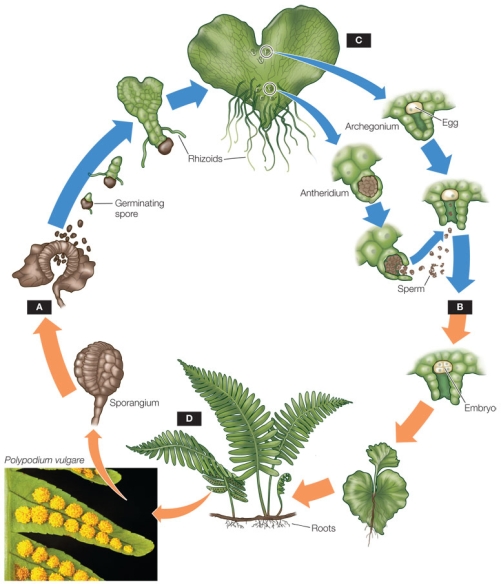 Which letter in the diagram indicates the process of meiosis?
 (Short Answer)
4.9/5 (70)
(70) Hydrocarbons play two roles in algae: an energy reserve and a way to increase bouancy.The latter is important because it maximizes exposure to _______, providing energy for the algae to fix CO2.
(Short Answer)
4.8/5 (79)
(79) Which set of clades correctly describes the tracheophytes?
(Multiple Choice)
4.9/5 (82)
(82) How can nonvascular plants survive on land without true leaves, stems, and roots?
(Multiple Choice)
4.9/5 (83)
(83) Morphological structures, both micro- and macroscopic, have been used as evidence to support the idea that land plants arose from a green algae clade.Of these structures, the one that contributed most to the success of plants on land was
(Multiple Choice)
4.9/5 (72)
(72) The evolutionary importance of plant tissue composed of tracheids is that it provides
(Multiple Choice)
4.8/5 (91)
(91) Haploid unicellular spores are produced in the sporangia via
(Multiple Choice)
4.8/5 (69)
(69) Hornworts (Anthocerophyta) may be distinguished from liverworts (Hepatophyta) and mosses (Bryophyta) by the fact that
(Multiple Choice)
4.8/5 (78)
(78) 
Filters
- Essay(0)
- Multiple Choice(0)
- Short Answer(0)
- True False(0)
- Matching(0)