



 Chat with AI
Exam 27: Plants Without Seeds: From Water to Land

Exam 1: Studying Life246 Questions
Exam 2: Small Molecules and the Chemistry of Life246 Questions
Exam 3: Proteins, Carbohydrates, and Lipids246 Questions
Exam 4: Nucleic Acids and the Origin of Life246 Questions
Exam 5: Cells: the Working Units of Life248 Questions
Exam 6: Cell Membranes246 Questions
Exam 7: Cell Communication and Multicellularity246 Questions
Exam 8: Energy, Enzymes, and Metabolism246 Questions
Exam 9: Pathways That Harvest Chemical Energy246 Questions
Exam 10: Photosynthesis: Energy From Sunlight242 Questions
Exam 11: The Cell Cycle and Cell Division260 Questions
Exam 12: Inheritance, Genes, and Chromosomes250 Questions
Exam 13: Dna and Its Role in Heredity257 Questions
Exam 14: From Dna to Protein: Gene Expression252 Questions
Exam 15: Gene Mutation and Molecular Medicine251 Questions
Exam 16: Regulation of Gene Expression245 Questions
Exam 17: Genomes249 Questions
Exam 18: Recombinant Dna and Biotechnology243 Questions
Exam 20: Mechanisms of Evolution243 Questions
Exam 21: Reconstructing and Using Phylogenies246 Questions
Exam 22: Speciation247 Questions
Exam 23: Evolution of Genes and Genomes252 Questions
Exam 24: The History of Life on Earth246 Questions
Exam 25: Bacteria, Archaea, and Viruses262 Questions
Exam 26: The Origin and Diversification of Eukaryotes252 Questions
Exam 27: Plants Without Seeds: From Water to Land251 Questions
Exam 28: The Evolution of Seed Plants259 Questions
Exam 29: The Evolution and Diversity of Fungi261 Questions
Exam 30: Animal Origins and the Evolution of Body Plans248 Questions
Exam 31: Protostome Animals244 Questions
Exam 32: Deuterostome Animals246 Questions
Exam 33: The Plant Body243 Questions
Exam 34: Transport in Plants248 Questions
Exam 35: Plant Nutrition247 Questions
Exam 36: Regulation of Plant Growth246 Questions
Exam 37: Reproduction in Flowering Plants247 Questions
Exam 38: Plant Responses to Environmental Challenges246 Questions
Exam 39: Physiology, Homeostasis, and Temperature Regulation258 Questions
Exam 40: Animal Hormones249 Questions
Exam 41: Immunology: Animal Defense Systems265 Questions
Exam 42: Animal Reproduction261 Questions
Exam 43: Animal Development261 Questions
Exam 44: Neurons, Glia, and Nervous Systems250 Questions
Exam 45: Sensory Systems249 Questions
Exam 46: The Mammalian Nervous System: Structure and Higher Functions254 Questions
Exam 47: Musculoskeletal Systems259 Questions
Exam 48: Gas Exchange247 Questions
Exam 49: Circulatory Systems252 Questions
Exam 50: Nutrition, Digestion, and Absorption259 Questions
Exam 51: Salt and Water Balance and Nitrogen Excretion251 Questions
Exam 52: Animal Behavior249 Questions
Exam 53: The Physical Environment and Biogeography of Life248 Questions
Exam 54: Populations259 Questions
Exam 55: Species Interactions254 Questions
Exam 56: Communities247 Questions
Exam 57: Ecosystems238 Questions
Exam 58: A Changing Biosphere222 Questions
Select questions type


Your lab group is interested in exploring how the addition of agricultural runoff from a nearby dairy farm will affect the growth of a green algal species being investigated for biofuel production.Design an experiment that would reveal the effect this additive would have on algal growth.
(Essay)
4.8/5  (77)
(77) Match the description below with the correct group of seedless vascular plants from the list that follows. They are sometimes called the scouring rushes because the silica deposits in their cell walls make them useful for cleaning; their reduced true leaves form distinct whorls around the stem.
(Multiple Choice)
4.8/5 (80)
(80) In an attempt to classify an herbarium sample from the 1960s, you collect a small tissue plug and determine the sample has tracheids as well as silica.From this information you determine the specimen is a _______.
(Short Answer)
4.9/5 (81)
(81) Which innovation in land plants addressed the challenges of reproduction rather than mere survival?
(Multiple Choice)
4.8/5 (78)
(78) Evolution of lignified cell walls contributed to the increased abilities of plants to
(Multiple Choice)
4.8/5 (77)
(77) Refer to the figure. 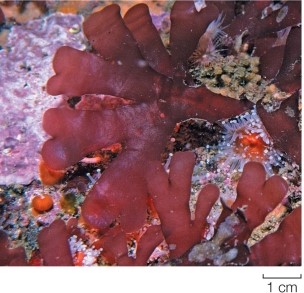 Shown is an alga from the Rhodymenia genus.Based on its appearance, which of the following is true?
 (Multiple Choice)
4.9/5 (77)
(77) Which clade is not considered a member of the "green plants"?
(Multiple Choice)
4.8/5 (84)
(84) "Green plants" include the algal groups of the _______ as well as the members of the streptophyte clade.Certain groups of the streptophyte clade share with land plants the trait of having cytoplasmic linkages called _______.In the past this synapomorphy led researchers to believe they shared a close evolutionary history.
(Short Answer)
4.8/5 (70)
(70) The sporophyte of a vascular plant is nutritionally _______; the sporophyte of a nonvascular plant is nutritionally _______.
(Multiple Choice)
4.9/5 (66)
(66) How does the alternation of generations of plants differ from the typical animal life cycle?
(Multiple Choice)
4.9/5 (72)
(72) Refer to the figure, which shows alternation of generations in the life cycle of a land plant. 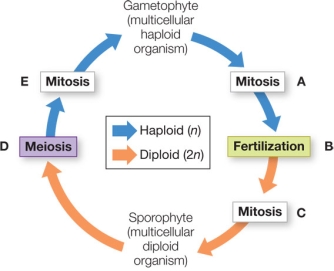 In a fern, the structure being formed at step C in the diagram would be
 (Multiple Choice)
4.9/5 (82)
(82) Which statement about alternation of generations in land plants is true?
(Multiple Choice)
4.8/5 (84)
(84) Refer to the figure. 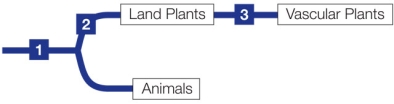 Which of the taxa listed below fit the criteria of "land plants" in the diagram? Be sure to include all possible taxa in your answer.
A.Angiosperms
B.Horsetails
C.Bryophytes
D.Gymnosperms
E.Hornworts
F.Lycophytes
G.Monilophytes
H.Stoneworts
Which of the taxa listed below fit the criteria of "land plants" in the diagram? Be sure to include all possible taxa in your answer.
A.Angiosperms
B.Horsetails
C.Bryophytes
D.Gymnosperms
E.Hornworts
F.Lycophytes
G.Monilophytes
H.Stoneworts
(Multiple Choice)
4.7/5 (85)
(85) One important benefit of the evolution of xylem was the development of a mechanism for
(Multiple Choice)
4.7/5 (78)
(78) 
Filters
- Essay(0)
- Multiple Choice(0)
- Short Answer(0)
- True False(0)
- Matching(0)