



 Chat with AI
Exam 27: Plants Without Seeds: From Water to Land

Exam 1: Studying Life246 Questions
Exam 2: Small Molecules and the Chemistry of Life246 Questions
Exam 3: Proteins, Carbohydrates, and Lipids246 Questions
Exam 4: Nucleic Acids and the Origin of Life246 Questions
Exam 5: Cells: the Working Units of Life248 Questions
Exam 6: Cell Membranes246 Questions
Exam 7: Cell Communication and Multicellularity246 Questions
Exam 8: Energy, Enzymes, and Metabolism246 Questions
Exam 9: Pathways That Harvest Chemical Energy246 Questions
Exam 10: Photosynthesis: Energy From Sunlight242 Questions
Exam 11: The Cell Cycle and Cell Division260 Questions
Exam 12: Inheritance, Genes, and Chromosomes250 Questions
Exam 13: Dna and Its Role in Heredity257 Questions
Exam 14: From Dna to Protein: Gene Expression252 Questions
Exam 15: Gene Mutation and Molecular Medicine251 Questions
Exam 16: Regulation of Gene Expression245 Questions
Exam 17: Genomes249 Questions
Exam 18: Recombinant Dna and Biotechnology243 Questions
Exam 20: Mechanisms of Evolution243 Questions
Exam 21: Reconstructing and Using Phylogenies246 Questions
Exam 22: Speciation247 Questions
Exam 23: Evolution of Genes and Genomes252 Questions
Exam 24: The History of Life on Earth246 Questions
Exam 25: Bacteria, Archaea, and Viruses262 Questions
Exam 26: The Origin and Diversification of Eukaryotes252 Questions
Exam 27: Plants Without Seeds: From Water to Land251 Questions
Exam 28: The Evolution of Seed Plants259 Questions
Exam 29: The Evolution and Diversity of Fungi261 Questions
Exam 30: Animal Origins and the Evolution of Body Plans248 Questions
Exam 31: Protostome Animals244 Questions
Exam 32: Deuterostome Animals246 Questions
Exam 33: The Plant Body243 Questions
Exam 34: Transport in Plants248 Questions
Exam 35: Plant Nutrition247 Questions
Exam 36: Regulation of Plant Growth246 Questions
Exam 37: Reproduction in Flowering Plants247 Questions
Exam 38: Plant Responses to Environmental Challenges246 Questions
Exam 39: Physiology, Homeostasis, and Temperature Regulation258 Questions
Exam 40: Animal Hormones249 Questions
Exam 41: Immunology: Animal Defense Systems265 Questions
Exam 42: Animal Reproduction261 Questions
Exam 43: Animal Development261 Questions
Exam 44: Neurons, Glia, and Nervous Systems250 Questions
Exam 45: Sensory Systems249 Questions
Exam 46: The Mammalian Nervous System: Structure and Higher Functions254 Questions
Exam 47: Musculoskeletal Systems259 Questions
Exam 48: Gas Exchange247 Questions
Exam 49: Circulatory Systems252 Questions
Exam 50: Nutrition, Digestion, and Absorption259 Questions
Exam 51: Salt and Water Balance and Nitrogen Excretion251 Questions
Exam 52: Animal Behavior249 Questions
Exam 53: The Physical Environment and Biogeography of Life248 Questions
Exam 54: Populations259 Questions
Exam 55: Species Interactions254 Questions
Exam 56: Communities247 Questions
Exam 57: Ecosystems238 Questions
Exam 58: A Changing Biosphere222 Questions
Select questions type


Suppose you find a new eukaryotic organism with the life cycle shown in the figure. 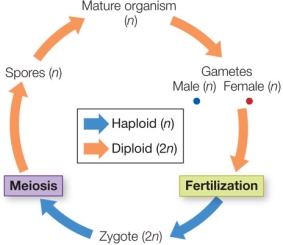 The observation that chloroplasts of this organism have phycoerythrin would lead to the hypothesis that it is related to the
 (Multiple Choice)
4.8/5  (80)
(80) Unlike the other groups of nonvascular plants, the _______ sporophyte has no stalk and is persistently green-a trait shared with vascular plants.
(Short Answer)
4.8/5 (82)
(82) Refer to the figure, which shows alternation of generations in plants. 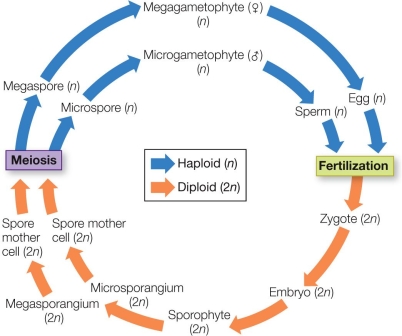 In a plant with this type of alternation of generations, the zygote develops on a
 (Multiple Choice)
4.8/5 (89)
(89) Plants that produce one kind of spore are called ______, and those that produce two kinds of spores are called _______.
(Multiple Choice)
4.9/5 (71)
(71) Which is the correct order of development in a moss gametophyte?
(Multiple Choice)
4.9/5 (83)
(83) Which part of the moss life cycle is paired with an incorrect description?
(Multiple Choice)
4.8/5 (66)
(66) An abundant type of coal is formed almost entirely from plant material buried during the Carboniferous period.Which plant group was most likely a major contributor to these coal deposits?
(Multiple Choice)
4.8/5 (90)
(90) In addition to strobili, one of the unique features to first appear in the _______ were true _______, a synapomorphy shared with vascular plants.
(Short Answer)
4.7/5 (86)
(86) Match the description below with the correct group of seedless vascular plants from the list that follows. Their vascular tissue includes xylem and phloem, they have megaphylls, and there is a differentiation between the main stem and side branches rather than dichotomous branching.
(Multiple Choice)
4.9/5 (62)
(62) Which of the following is a synapomorphy specific to stoneworts and land plants?
(Multiple Choice)
4.8/5 (72)
(72) Cells contained within the _______ of a sporophyte undergo meiosis to create haploid cells.
(Short Answer)
4.8/5 (75)
(75) Which is the correct order of appearance of features during plant evolution?
(Multiple Choice)
4.7/5 (79)
(79) A field biologist has brought you a plant fossil to analyze.To determine whether it is a vascular plant, you would look for the presence of fossilized
(Multiple Choice)
4.9/5 (77)
(77) Though _______ contain true roots, they differ from other members of the tracheophytes because of the arrangement of their vasculature.
(Short Answer)
4.8/5 (72)
(72) These multicellular green algae retain their eggs in the parental organism, and their growth pattern is both branching and apical.
(Multiple Choice)
4.9/5 (71)
(71) 
Filters
- Essay(0)
- Multiple Choice(0)
- Short Answer(0)
- True False(0)
- Matching(0)