



 Chat with AI
Exam 27: Plants Without Seeds: From Water to Land

Exam 1: Studying Life246 Questions
Exam 2: Small Molecules and the Chemistry of Life246 Questions
Exam 3: Proteins, Carbohydrates, and Lipids246 Questions
Exam 4: Nucleic Acids and the Origin of Life246 Questions
Exam 5: Cells: the Working Units of Life248 Questions
Exam 6: Cell Membranes246 Questions
Exam 7: Cell Communication and Multicellularity246 Questions
Exam 8: Energy, Enzymes, and Metabolism246 Questions
Exam 9: Pathways That Harvest Chemical Energy246 Questions
Exam 10: Photosynthesis: Energy From Sunlight242 Questions
Exam 11: The Cell Cycle and Cell Division260 Questions
Exam 12: Inheritance, Genes, and Chromosomes250 Questions
Exam 13: Dna and Its Role in Heredity257 Questions
Exam 14: From Dna to Protein: Gene Expression252 Questions
Exam 15: Gene Mutation and Molecular Medicine251 Questions
Exam 16: Regulation of Gene Expression245 Questions
Exam 17: Genomes249 Questions
Exam 18: Recombinant Dna and Biotechnology243 Questions
Exam 20: Mechanisms of Evolution243 Questions
Exam 21: Reconstructing and Using Phylogenies246 Questions
Exam 22: Speciation247 Questions
Exam 23: Evolution of Genes and Genomes252 Questions
Exam 24: The History of Life on Earth246 Questions
Exam 25: Bacteria, Archaea, and Viruses262 Questions
Exam 26: The Origin and Diversification of Eukaryotes252 Questions
Exam 27: Plants Without Seeds: From Water to Land251 Questions
Exam 28: The Evolution of Seed Plants259 Questions
Exam 29: The Evolution and Diversity of Fungi261 Questions
Exam 30: Animal Origins and the Evolution of Body Plans248 Questions
Exam 31: Protostome Animals244 Questions
Exam 32: Deuterostome Animals246 Questions
Exam 33: The Plant Body243 Questions
Exam 34: Transport in Plants248 Questions
Exam 35: Plant Nutrition247 Questions
Exam 36: Regulation of Plant Growth246 Questions
Exam 37: Reproduction in Flowering Plants247 Questions
Exam 38: Plant Responses to Environmental Challenges246 Questions
Exam 39: Physiology, Homeostasis, and Temperature Regulation258 Questions
Exam 40: Animal Hormones249 Questions
Exam 41: Immunology: Animal Defense Systems265 Questions
Exam 42: Animal Reproduction261 Questions
Exam 43: Animal Development261 Questions
Exam 44: Neurons, Glia, and Nervous Systems250 Questions
Exam 45: Sensory Systems249 Questions
Exam 46: The Mammalian Nervous System: Structure and Higher Functions254 Questions
Exam 47: Musculoskeletal Systems259 Questions
Exam 48: Gas Exchange247 Questions
Exam 49: Circulatory Systems252 Questions
Exam 50: Nutrition, Digestion, and Absorption259 Questions
Exam 51: Salt and Water Balance and Nitrogen Excretion251 Questions
Exam 52: Animal Behavior249 Questions
Exam 53: The Physical Environment and Biogeography of Life248 Questions
Exam 54: Populations259 Questions
Exam 55: Species Interactions254 Questions
Exam 56: Communities247 Questions
Exam 57: Ecosystems238 Questions
Exam 58: A Changing Biosphere222 Questions
Select questions type


Which characteristic represents an evolutionary link between the "green algae" and the land plants?
(Multiple Choice)
4.8/5  (77)
(77) The sporophytes of the mosses and vascular plants grow by _______ cell division (a synapomorphy of these two groups), in which a region at the growing tip provides an organized pattern of cell division, elongation, and differentiation.
(Short Answer)
4.8/5 (88)
(88) Hornworts can be distinguished from the other nonvascular plants by their
(Multiple Choice)
4.7/5 (72)
(72) Discuss how the relationship between sporophytes and gametophytes is different in nonvascular plants than in seedless vascular plants.
(Essay)
4.9/5 (75)
(75) Refer to the figure, which shows alternation of generations in plants. 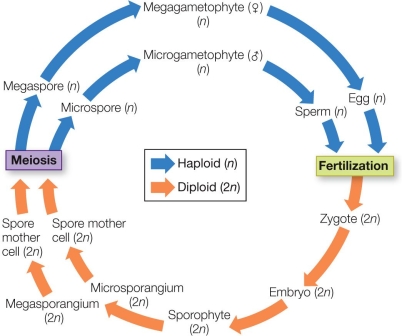 Which statement regarding a plant with this type of alternation of generations is true?
 (Multiple Choice)
4.8/5 (77)
(77) True roots are a synapomorphy of which of the following groups of plants?
(Multiple Choice)
5.0/5 (71)
(71) The waxy coating on leaves that reduces evaporation of water from the plant body is called the _______.
(Short Answer)
4.9/5 (81)
(81) Draw a phylogenetic tree showing the evolutionary relationships among the nonvascular plants and seedless vascular plants.Label the major differentiating characteristics at each branch of your tree.
(Essay)
4.8/5 (83)
(83) Liverworts, hornworts, and mosses are found on all seven continents.Their survival in harsh environments is aided by
(Multiple Choice)
4.8/5 (77)
(77) Though resembling filamentous green algae, the _______ of mosses contains filaments that either are photosynthetic or can act to anchor the moss to a substrate.The latter are called _______.
(Short Answer)
4.8/5 (80)
(80) How would you determine whether an unknown plant stem had microphylls or small megaphylls?
(Multiple Choice)
4.9/5 (78)
(78) Refer to the figure, which shows alternation of generations in plants. 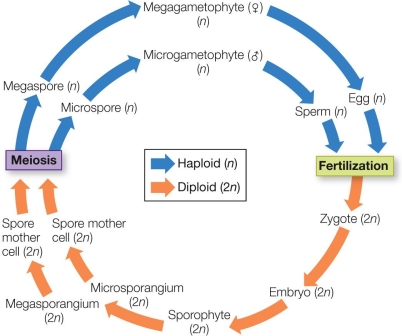 This plant is _______ because it produces _______.
 (Multiple Choice)
4.9/5 (79)
(79) Lycophyte-fern forests arose in the Devonian period and persisted for _______ years.
(Multiple Choice)
4.9/5 (80)
(80) In a liverwort in nature, the larger, more visible plant is the _______, whereas in horsetails, the larger, more visible plant is the _______.
(Multiple Choice)
4.8/5 (90)
(90) Based on the figure below, which conclusion can you make about the evolution of vascular plants? 
(Multiple Choice)
4.8/5 (64)
(64) These multicellular green algae grow in the form of an unbranched thallus and retain their eggs in the parental organism.
(Multiple Choice)
5.0/5 (74)
(74) _______ are believed to have evolved from sterile sporangia.Evidence that supports this claim includes the organization of the vasculature found in these structures.
(Short Answer)
5.0/5 (79)
(79) Refer to the figure. 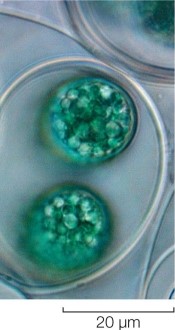 The organism shown is thought to be similar in form to the ancestor of the Plantae.With this in mind, which description best summarizes the ancestor of plants?
 (Multiple Choice)
5.0/5 (74)
(74) The plants classified as embryophytes include which of the following groups?
(Multiple Choice)
4.9/5 (72)
(72) 
Filters
- Essay(0)
- Multiple Choice(0)
- Short Answer(0)
- True False(0)
- Matching(0)