



 Chat with AI
Exam 27: Plants Without Seeds: From Water to Land

Exam 1: Studying Life246 Questions
Exam 2: Small Molecules and the Chemistry of Life246 Questions
Exam 3: Proteins, Carbohydrates, and Lipids246 Questions
Exam 4: Nucleic Acids and the Origin of Life246 Questions
Exam 5: Cells: the Working Units of Life248 Questions
Exam 6: Cell Membranes246 Questions
Exam 7: Cell Communication and Multicellularity246 Questions
Exam 8: Energy, Enzymes, and Metabolism246 Questions
Exam 9: Pathways That Harvest Chemical Energy246 Questions
Exam 10: Photosynthesis: Energy From Sunlight242 Questions
Exam 11: The Cell Cycle and Cell Division260 Questions
Exam 12: Inheritance, Genes, and Chromosomes250 Questions
Exam 13: Dna and Its Role in Heredity257 Questions
Exam 14: From Dna to Protein: Gene Expression252 Questions
Exam 15: Gene Mutation and Molecular Medicine251 Questions
Exam 16: Regulation of Gene Expression245 Questions
Exam 17: Genomes249 Questions
Exam 18: Recombinant Dna and Biotechnology243 Questions
Exam 20: Mechanisms of Evolution243 Questions
Exam 21: Reconstructing and Using Phylogenies246 Questions
Exam 22: Speciation247 Questions
Exam 23: Evolution of Genes and Genomes252 Questions
Exam 24: The History of Life on Earth246 Questions
Exam 25: Bacteria, Archaea, and Viruses262 Questions
Exam 26: The Origin and Diversification of Eukaryotes252 Questions
Exam 27: Plants Without Seeds: From Water to Land251 Questions
Exam 28: The Evolution of Seed Plants259 Questions
Exam 29: The Evolution and Diversity of Fungi261 Questions
Exam 30: Animal Origins and the Evolution of Body Plans248 Questions
Exam 31: Protostome Animals244 Questions
Exam 32: Deuterostome Animals246 Questions
Exam 33: The Plant Body243 Questions
Exam 34: Transport in Plants248 Questions
Exam 35: Plant Nutrition247 Questions
Exam 36: Regulation of Plant Growth246 Questions
Exam 37: Reproduction in Flowering Plants247 Questions
Exam 38: Plant Responses to Environmental Challenges246 Questions
Exam 39: Physiology, Homeostasis, and Temperature Regulation258 Questions
Exam 40: Animal Hormones249 Questions
Exam 41: Immunology: Animal Defense Systems265 Questions
Exam 42: Animal Reproduction261 Questions
Exam 43: Animal Development261 Questions
Exam 44: Neurons, Glia, and Nervous Systems250 Questions
Exam 45: Sensory Systems249 Questions
Exam 46: The Mammalian Nervous System: Structure and Higher Functions254 Questions
Exam 47: Musculoskeletal Systems259 Questions
Exam 48: Gas Exchange247 Questions
Exam 49: Circulatory Systems252 Questions
Exam 50: Nutrition, Digestion, and Absorption259 Questions
Exam 51: Salt and Water Balance and Nitrogen Excretion251 Questions
Exam 52: Animal Behavior249 Questions
Exam 53: The Physical Environment and Biogeography of Life248 Questions
Exam 54: Populations259 Questions
Exam 55: Species Interactions254 Questions
Exam 56: Communities247 Questions
Exam 57: Ecosystems238 Questions
Exam 58: A Changing Biosphere222 Questions
Select questions type


You find a mat of short green plants growing on your neighbor's front lawn.You look at them through a microscope and see that they lack vascular tissue and are dispersing lots of spores from small brown stalks.The plants are most likely a colony of
(Multiple Choice)
4.8/5  (77)
(77) Describe a likely scenario for how megaphylls developed from overtopping.
(Essay)
4.9/5 (89)
(89) Fossilized remains of a rhyniophyte show that these extinct plants lacked
(Multiple Choice)
4.9/5 (87)
(87) As land plants evolved, the sporophyte generation became larger and less dependent on the gametophyte generation.Which statement provides an accurate example of this trend?
(Multiple Choice)
4.8/5 (83)
(83) Refer to the figure, which shows alternation of generations in the life cycle of a land plant. 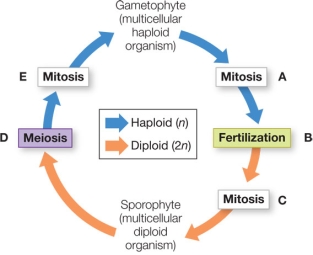 In the life cycle of a plant, the spores are _______, the gametes are _______, and the zygote is _______.
 (Multiple Choice)
4.8/5 (86)
(86) If lignin-containing cell walls had not evolved in land plants, we might now have
(Multiple Choice)
4.7/5 (83)
(83) The addition of tracheid cells strengthened with lignin allowed early land plants to do all of the following except
(Multiple Choice)
4.8/5 (90)
(90) Refer to the figure, which shows hornworts. 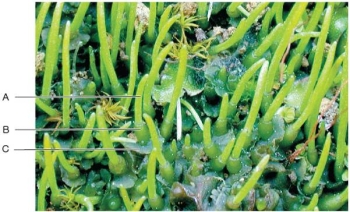 In which order did this hornwort plant develop, from oldest to newest growth?
 (Multiple Choice)
4.9/5 (89)
(89) Mosses are dependent on external water for sexual reproduction because
(Multiple Choice)
4.8/5 (82)
(82) The vascular system in land plants consists of specialized tissues.The _______ transports water and minerals from soil to aerial parts and contains the structural substance called _______.
(Short Answer)
4.7/5 (77)
(77) The branched filamentous structure of the moss gametophyte that develops after spore germination is the
(Multiple Choice)
4.9/5 (75)
(75) Match the description below with the correct group of seedless vascular plants from the list that follows. This ancient group lacked roots and leaves but had a central column of xylem running through its stems.It had dichotomously branching aerial stems that were occasionally topped by sporangia.
(Multiple Choice)
4.8/5 (78)
(78) Protection of the embryo by parental tissue was a defining step in the evolution of
(Multiple Choice)
4.8/5 (65)
(65) In nonvascular plants, the _______ is usually nonphotosynthetic and is _______ dependent on the _______.
(Multiple Choice)
4.9/5 (79)
(79) Horsetails share with club mosses all of the following characteristics except
(Multiple Choice)
4.8/5 (83)
(83) Refer to the figure, which shows a nonvascular plant. 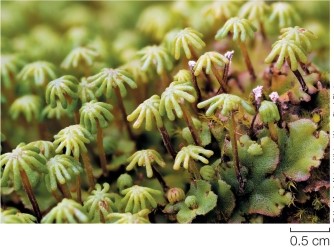 The underside of the starlike structure of the plant body is the location of the _______ generation.
 (Multiple Choice)
4.8/5 (81)
(81) The evolution of heterospory occurred independently several times in the course of vascular plant evolution.Which statement best explains the possible selective advantages of heterospory in land plants?
(Multiple Choice)
4.9/5 (77)
(77) 
Filters
- Essay(0)
- Multiple Choice(0)
- Short Answer(0)
- True False(0)
- Matching(0)