



 Chat with AI
Exam 14: From Dna to Protein: Gene Expression

Exam 1: Studying Life246 Questions
Exam 2: Small Molecules and the Chemistry of Life246 Questions
Exam 3: Proteins, Carbohydrates, and Lipids246 Questions
Exam 4: Nucleic Acids and the Origin of Life246 Questions
Exam 5: Cells: the Working Units of Life248 Questions
Exam 6: Cell Membranes246 Questions
Exam 7: Cell Communication and Multicellularity246 Questions
Exam 8: Energy, Enzymes, and Metabolism246 Questions
Exam 9: Pathways That Harvest Chemical Energy246 Questions
Exam 10: Photosynthesis: Energy From Sunlight242 Questions
Exam 11: The Cell Cycle and Cell Division260 Questions
Exam 12: Inheritance, Genes, and Chromosomes250 Questions
Exam 13: Dna and Its Role in Heredity257 Questions
Exam 14: From Dna to Protein: Gene Expression252 Questions
Exam 15: Gene Mutation and Molecular Medicine251 Questions
Exam 16: Regulation of Gene Expression245 Questions
Exam 17: Genomes249 Questions
Exam 18: Recombinant Dna and Biotechnology243 Questions
Exam 20: Mechanisms of Evolution243 Questions
Exam 21: Reconstructing and Using Phylogenies246 Questions
Exam 22: Speciation247 Questions
Exam 23: Evolution of Genes and Genomes252 Questions
Exam 24: The History of Life on Earth246 Questions
Exam 25: Bacteria, Archaea, and Viruses262 Questions
Exam 26: The Origin and Diversification of Eukaryotes252 Questions
Exam 27: Plants Without Seeds: From Water to Land251 Questions
Exam 28: The Evolution of Seed Plants259 Questions
Exam 29: The Evolution and Diversity of Fungi261 Questions
Exam 30: Animal Origins and the Evolution of Body Plans248 Questions
Exam 31: Protostome Animals244 Questions
Exam 32: Deuterostome Animals246 Questions
Exam 33: The Plant Body243 Questions
Exam 34: Transport in Plants248 Questions
Exam 35: Plant Nutrition247 Questions
Exam 36: Regulation of Plant Growth246 Questions
Exam 37: Reproduction in Flowering Plants247 Questions
Exam 38: Plant Responses to Environmental Challenges246 Questions
Exam 39: Physiology, Homeostasis, and Temperature Regulation258 Questions
Exam 40: Animal Hormones249 Questions
Exam 41: Immunology: Animal Defense Systems265 Questions
Exam 42: Animal Reproduction261 Questions
Exam 43: Animal Development261 Questions
Exam 44: Neurons, Glia, and Nervous Systems250 Questions
Exam 45: Sensory Systems249 Questions
Exam 46: The Mammalian Nervous System: Structure and Higher Functions254 Questions
Exam 47: Musculoskeletal Systems259 Questions
Exam 48: Gas Exchange247 Questions
Exam 49: Circulatory Systems252 Questions
Exam 50: Nutrition, Digestion, and Absorption259 Questions
Exam 51: Salt and Water Balance and Nitrogen Excretion251 Questions
Exam 52: Animal Behavior249 Questions
Exam 53: The Physical Environment and Biogeography of Life248 Questions
Exam 54: Populations259 Questions
Exam 55: Species Interactions254 Questions
Exam 56: Communities247 Questions
Exam 57: Ecosystems238 Questions
Exam 58: A Changing Biosphere222 Questions
Select questions type


Har Gobind Khorana at the University of Wisconsin synthesized artificial mRNAs such as poly CA (CACA … ) and poly CAA (CAACAACAA … ).He found that poly CA codes for a polypeptide consisting of alternating threonine (Thr) and histidine (His) residues.There are two possible codons in poly CA: CAC and ACA.One of these must encode histidine and the other threonine-but which is which? The answer comes from results with poly CAA, which produces three different polypeptides: poly Thr, poly Gln (glutamine), and poly Asn (asparagine).(An artificial mRNA can be read, inefficiently, beginning at any point in the chain; there is no specific initiation signal.Thus poly CAA can be read as a polymer of CAA, of ACA, or of AAC.) Compare the results of the poly CA and poly CAA experiments, and determine which codon corresponds with threonine and which with histidine.
(Essay)
4.8/5  (89)
(89) Refer to the figure. 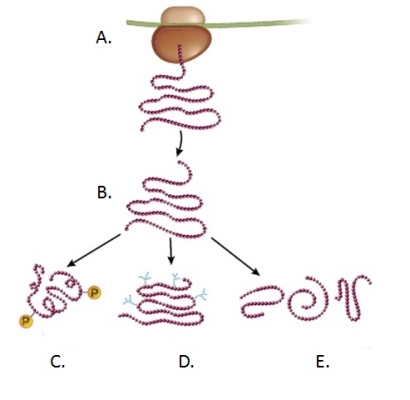 The protein insulin, which plays a role in blood glucose regulation, is first synthesized as proinsulin, a single polypeptide chain with three domains, designated A, B, and C.Domain C connects domains A and B, which bind to one another through intramolecular disulfide bonds.Insulin is secreted as a polypeptide without domain C.In the figure, _______ represents the process that modifies proinsulin to yield insulin.
 (Multiple Choice)
4.8/5 (83)
(83) Heterozygotes for the defective enzyme _______ alkaptonuria, which means that the trait is _______.
(Multiple Choice)
4.8/5 (80)
(80) If A, B, C, D, and E represent (in that order) sequence blocks in a pre-mRNA molecule, and B and D are introns, the sequence of the mature mRNA molecule is _______.
(Short Answer)
4.9/5 (86)
(86) When eukaryotic DNA is hybridized with mRNA, the hybrid molecules contain loops of DNA, which are
(Multiple Choice)
4.9/5 (76)
(76) An mRNA molecule has 540 codons.How many nucleotides does it have in the coding region?
(Multiple Choice)
4.9/5 (69)
(69) In eukaryotic cells, sugar residues are covalently attached to proteins through the process of glycosylation.This posttranslational modification occurs
(Multiple Choice)
4.8/5 (78)
(78) Proteins are synthesized from _______ terminus to _______terminus in the _______ direction along the mRNA.
(Multiple Choice)
4.9/5 (94)
(94) Mapping studies have showed that within a group of mutants with the same growth requirements (i.e., the same overt phenotype), individual mutations are on different chromosomes.This indicates that
(Multiple Choice)
4.7/5 (96)
(96) The start codon is near the _______ end of the mRNA, and this corresponds with the _______ terminus of the polypeptide.
(Multiple Choice)
4.7/5 (76)
(76) The transfer of information from DNA to RNA occurs during _______, while the transfer of information from RNA to protein occurs during _______.
(Multiple Choice)
4.9/5 (89)
(89) Translation is the process by which information in _______ is propagated into information in _______.
(Multiple Choice)
5.0/5 (85)
(85) Biologists often describe organisms that are easy to manipulate as _______ organisms.
(Short Answer)
4.9/5 (75)
(75) The promoter region of a gene has undergone an inversion with the 3′ end break point within the initiation site.This will affect the transcription of this gene in all of the following ways except
(Multiple Choice)
4.8/5 (82)
(82) Suppose the 5ʹ-to-3ʹ coding strand of DNA is GTCTATGCATTA. What is the template DNA strand that would be used for transcription?
(Multiple Choice)
4.8/5 (79)
(79) 
Filters
- Essay(0)
- Multiple Choice(0)
- Short Answer(0)
- True False(0)
- Matching(0)