



 Chat with AI
Exam 14: From Dna to Protein: Gene Expression

Exam 1: Studying Life246 Questions
Exam 2: Small Molecules and the Chemistry of Life246 Questions
Exam 3: Proteins, Carbohydrates, and Lipids246 Questions
Exam 4: Nucleic Acids and the Origin of Life246 Questions
Exam 5: Cells: the Working Units of Life248 Questions
Exam 6: Cell Membranes246 Questions
Exam 7: Cell Communication and Multicellularity246 Questions
Exam 8: Energy, Enzymes, and Metabolism246 Questions
Exam 9: Pathways That Harvest Chemical Energy246 Questions
Exam 10: Photosynthesis: Energy From Sunlight242 Questions
Exam 11: The Cell Cycle and Cell Division260 Questions
Exam 12: Inheritance, Genes, and Chromosomes250 Questions
Exam 13: Dna and Its Role in Heredity257 Questions
Exam 14: From Dna to Protein: Gene Expression252 Questions
Exam 15: Gene Mutation and Molecular Medicine251 Questions
Exam 16: Regulation of Gene Expression245 Questions
Exam 17: Genomes249 Questions
Exam 18: Recombinant Dna and Biotechnology243 Questions
Exam 20: Mechanisms of Evolution243 Questions
Exam 21: Reconstructing and Using Phylogenies246 Questions
Exam 22: Speciation247 Questions
Exam 23: Evolution of Genes and Genomes252 Questions
Exam 24: The History of Life on Earth246 Questions
Exam 25: Bacteria, Archaea, and Viruses262 Questions
Exam 26: The Origin and Diversification of Eukaryotes252 Questions
Exam 27: Plants Without Seeds: From Water to Land251 Questions
Exam 28: The Evolution of Seed Plants259 Questions
Exam 29: The Evolution and Diversity of Fungi261 Questions
Exam 30: Animal Origins and the Evolution of Body Plans248 Questions
Exam 31: Protostome Animals244 Questions
Exam 32: Deuterostome Animals246 Questions
Exam 33: The Plant Body243 Questions
Exam 34: Transport in Plants248 Questions
Exam 35: Plant Nutrition247 Questions
Exam 36: Regulation of Plant Growth246 Questions
Exam 37: Reproduction in Flowering Plants247 Questions
Exam 38: Plant Responses to Environmental Challenges246 Questions
Exam 39: Physiology, Homeostasis, and Temperature Regulation258 Questions
Exam 40: Animal Hormones249 Questions
Exam 41: Immunology: Animal Defense Systems265 Questions
Exam 42: Animal Reproduction261 Questions
Exam 43: Animal Development261 Questions
Exam 44: Neurons, Glia, and Nervous Systems250 Questions
Exam 45: Sensory Systems249 Questions
Exam 46: The Mammalian Nervous System: Structure and Higher Functions254 Questions
Exam 47: Musculoskeletal Systems259 Questions
Exam 48: Gas Exchange247 Questions
Exam 49: Circulatory Systems252 Questions
Exam 50: Nutrition, Digestion, and Absorption259 Questions
Exam 51: Salt and Water Balance and Nitrogen Excretion251 Questions
Exam 52: Animal Behavior249 Questions
Exam 53: The Physical Environment and Biogeography of Life248 Questions
Exam 54: Populations259 Questions
Exam 55: Species Interactions254 Questions
Exam 56: Communities247 Questions
Exam 57: Ecosystems238 Questions
Exam 58: A Changing Biosphere222 Questions
Select questions type


A researcher is interested in determining the kinetics of synthesis and secretion of a protein that is known to be produced by kidney cells.The researcher modifies the gene by inserting a sequence encoding a region of a protein that can be visualized in the electron microscope.The marker is inserted just after the codon for the initiating methionine, within a region of hydrophobic amino acid residues.To determine the kinetics, the researcher will track the green-labeled proteins as they are synthesized in the RER, pass through the Golgi apparatus, and arrive at the cell surface in secretory vesicles.To the researcher's surprise, the green-labeled protein accumulates in the cytoplasm of the kidney cells and none appears in the RER, Golgi apparatus, or secretory vesicles.When the researcher repeats the experiment, but with the genetic marker inserted at the 3′ end of the gene just before the stop codon, the experiment proceeds as expected.These results indicate that, unintentionally, the researcher has confirmed that
(Multiple Choice)
5.0/5  (88)
(88) Imagine that a novel life-form is found deep within Earth's crust.Although its DNA is composed of the same four nucleotides as other life-forms, its codons are four bases in length.This organism could therefore be composed of _______ different amino acids.
(Multiple Choice)
4.8/5 (91)
(91) Wild-type Neurospora was treated with X rays to induce heritable mutations.Treated Neurospora cultures were grown on minimal medium ("no addition" in the table) and minimal medium supplemented with the indicated compounds.Growth is indicated as dry weight of fungal material after 5 days.The table shows the results of three mutated strains that were linked to the metabolic pathway that generates arginine. 
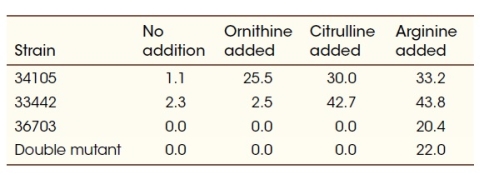 Without arginine production, Neurospora cannot grow.Considering the biochemical pathway of arginine production and experimental outcomes shown, which two strains are represented by the double mutant? Explain the evidence for your answer and why the other combinations cannot be correct.
 (Essay)
4.8/5 (81)
(81) The enzyme that charges the tRNA molecules with appropriate amino acids is
(Multiple Choice)
4.7/5 (69)
(69) What would happen if the tRNA synthetase for tryptophan added a phenylalanine instead of tryptophan to the tryptophan tRNAs?
(Essay)
4.8/5 (96)
(96) Suppose the DNA of a gene contains five regions-A, B, C, D, and E, in that order.Regions A, B, and D are located in introns, while regions C and E are located in exons.What is the order of the regions in the mature mRNA transcribed from that sequence?
(Multiple Choice)
4.9/5 (76)
(76) There are _______ different codons in the genetic code, and each codon is _______ nucleotides long.
(Multiple Choice)
4.8/5 (78)
(78) Gene X encodes an enzyme subunit.A researcher is studying an allele of gene X that does not produce a protein product.Experiments show that the pre-mRNA transcript undergoes RNA processing and is successfully transported out of the nucleus.However, in the cytoplasm, the mRNAs accumulate without binding to ribosomes.These results suggest a problem with the addition of the _______ to the pre-mRNA.
(Short Answer)
4.9/5 (78)
(78) A researcher has created a gene construct that is expressed in a cell line.The researcher has evidence that the gene is being fully translated but is quickly degraded, resulting in low production of the gene's protein product.Evaluating the gene construct, the researcher realizes that the poor mRNA stability is probably due to the absence of a _______ sequence at the gene's 3′ end.
(Short Answer)
4.8/5 (73)
(73) Where would you most likely find partially translated polypeptides that are undergoing processing?
(Multiple Choice)
4.8/5 (84)
(84) In the experiments by Benzer and colleagues, the cysteine in a cys-tRNA molecule was converted into alanine.Suppose, instead, that the cysteine had appeared in the synthesized protein where it normally does.The most likely conclusion would have been that the protein synthesis system
(Multiple Choice)
4.8/5 (79)
(79) Benzer and his group modified the amino acid part of a charged tRNA molecule.This experiment demonstrated
(Multiple Choice)
4.8/5 (85)
(85) Suppose that two different mutant strains of a bacterium are unable to grow on a minimal medium without the addition of the amino acid lysine.Explain how this phenotype might be caused by different mutations in each strain, perhaps in the same gene and perhaps in two different genes.
(Essay)
4.9/5 (98)
(98) Normally, Neurospora can synthesize all 20 amino acids specified by the genetic code.A certain strain of this mold cannot grow in minimal nutritional medium but grows only when the amino acid leucine is added to the medium.This strain
(Multiple Choice)
4.8/5 (71)
(71) Refer to the figure. 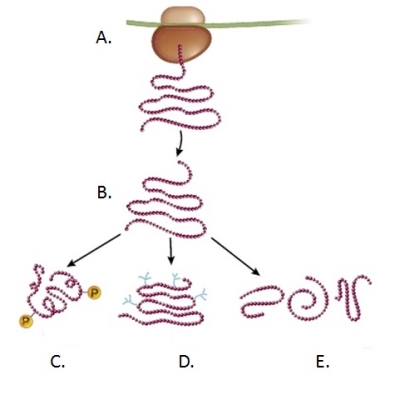 In the figure, ________ represents a protein whose tertiary conformation has been altered by the activity of one or more protein kinases.
 (Multiple Choice)
4.8/5 (81)
(81) After nucleic acid hybridization with the DNA from a eukaryotic gene as the target and mRNA as the probe, you observe a 1:1 complementarity between the RNA and the DNA.From this result, you can infer that
(Multiple Choice)
4.8/5 (77)
(77) 
Filters
- Essay(0)
- Multiple Choice(0)
- Short Answer(0)
- True False(0)
- Matching(0)