



 Chat with AI
Exam 14: From Dna to Protein: Gene Expression

Exam 1: Studying Life246 Questions
Exam 2: Small Molecules and the Chemistry of Life246 Questions
Exam 3: Proteins, Carbohydrates, and Lipids246 Questions
Exam 4: Nucleic Acids and the Origin of Life246 Questions
Exam 5: Cells: the Working Units of Life248 Questions
Exam 6: Cell Membranes246 Questions
Exam 7: Cell Communication and Multicellularity246 Questions
Exam 8: Energy, Enzymes, and Metabolism246 Questions
Exam 9: Pathways That Harvest Chemical Energy246 Questions
Exam 10: Photosynthesis: Energy From Sunlight242 Questions
Exam 11: The Cell Cycle and Cell Division260 Questions
Exam 12: Inheritance, Genes, and Chromosomes250 Questions
Exam 13: Dna and Its Role in Heredity257 Questions
Exam 14: From Dna to Protein: Gene Expression252 Questions
Exam 15: Gene Mutation and Molecular Medicine251 Questions
Exam 16: Regulation of Gene Expression245 Questions
Exam 17: Genomes249 Questions
Exam 18: Recombinant Dna and Biotechnology243 Questions
Exam 20: Mechanisms of Evolution243 Questions
Exam 21: Reconstructing and Using Phylogenies246 Questions
Exam 22: Speciation247 Questions
Exam 23: Evolution of Genes and Genomes252 Questions
Exam 24: The History of Life on Earth246 Questions
Exam 25: Bacteria, Archaea, and Viruses262 Questions
Exam 26: The Origin and Diversification of Eukaryotes252 Questions
Exam 27: Plants Without Seeds: From Water to Land251 Questions
Exam 28: The Evolution of Seed Plants259 Questions
Exam 29: The Evolution and Diversity of Fungi261 Questions
Exam 30: Animal Origins and the Evolution of Body Plans248 Questions
Exam 31: Protostome Animals244 Questions
Exam 32: Deuterostome Animals246 Questions
Exam 33: The Plant Body243 Questions
Exam 34: Transport in Plants248 Questions
Exam 35: Plant Nutrition247 Questions
Exam 36: Regulation of Plant Growth246 Questions
Exam 37: Reproduction in Flowering Plants247 Questions
Exam 38: Plant Responses to Environmental Challenges246 Questions
Exam 39: Physiology, Homeostasis, and Temperature Regulation258 Questions
Exam 40: Animal Hormones249 Questions
Exam 41: Immunology: Animal Defense Systems265 Questions
Exam 42: Animal Reproduction261 Questions
Exam 43: Animal Development261 Questions
Exam 44: Neurons, Glia, and Nervous Systems250 Questions
Exam 45: Sensory Systems249 Questions
Exam 46: The Mammalian Nervous System: Structure and Higher Functions254 Questions
Exam 47: Musculoskeletal Systems259 Questions
Exam 48: Gas Exchange247 Questions
Exam 49: Circulatory Systems252 Questions
Exam 50: Nutrition, Digestion, and Absorption259 Questions
Exam 51: Salt and Water Balance and Nitrogen Excretion251 Questions
Exam 52: Animal Behavior249 Questions
Exam 53: The Physical Environment and Biogeography of Life248 Questions
Exam 54: Populations259 Questions
Exam 55: Species Interactions254 Questions
Exam 56: Communities247 Questions
Exam 57: Ecosystems238 Questions
Exam 58: A Changing Biosphere222 Questions
Select questions type


An mRNA sequence is 5-CAGUUACGA...UAAGC-3 ([…] denotes intervening sequences).What is the sequence of the template strand of DNA?
(Multiple Choice)
5.0/5  (70)
(70) Refer to the figure, which shows the standard genetic code. 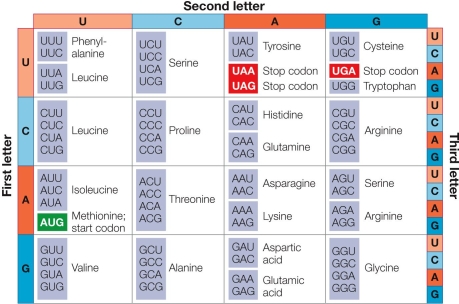 Which amino acid will the anticodon 5-TCC-3 recruit to the growing polypeptide chain?
 (Multiple Choice)
4.8/5 (76)
(76) During transcription, by what molecule(s) is the DNA unwound?
(Multiple Choice)
4.8/5 (86)
(86) In eukaryotic cells, translation occurs in the _______ and transcription occurs _______.
(Multiple Choice)
4.9/5 (87)
(87) Proteins that will go to different locations will likely have different _______ sequences.
(Multiple Choice)
4.9/5 (88)
(88) Which statement about the flow of genetic information is true?
(Multiple Choice)
4.7/5 (79)
(79) In eukaryotes, the first amino acid in a growing polypeptide chain is always _______ because the only codon for this amino acid is also the _______ codon.This amino acid is not always the first amino acid in a processed protein because of _______.
(Multiple Choice)
4.7/5 (82)
(82) The amino acids in proteins are encoded by _______ different codons.
(Multiple Choice)
5.0/5 (87)
(87) How is it possible for single-stranded RNA to fold into complex shapes?
(Multiple Choice)
4.9/5 (78)
(78) The anticodon 3ʹ-GCI-5ʹ cannot pair with which of the following codons?
(Multiple Choice)
4.9/5 (83)
(83) The guanosine triphosphate (GTP) cap that is added to the 5ʹ end of primary mRNA
(Multiple Choice)
4.9/5 (78)
(78) Refer to the figure. 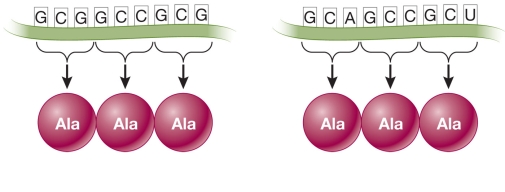 If the base inosine is available, the smallest number of hypothetically possible tRNAs that could be used to translate these two sequences would be
 (Multiple Choice)
4.7/5 (91)
(91) RNA differs from DNA in its base composition in that it contains _______ instead of thymine.
(Short Answer)
4.9/5 (75)
(75) A posttranslational modification commonly used by signal transduction pathways to regulate the activity of proteins is _______ of specific amino acid residues.This modification often changes the conformation of enzymes, resulting in activation (or inactivation) of the enzyme's catalytic activity.
(Multiple Choice)
4.8/5 (82)
(82) Wild-type bacteria can synthesize substance D, but various mutant strains cannot.We know that substance D is synthesized from substance X in a pathway that involves three intermediate substances (A, B, and C), but we do not know the order of the steps in the pathway.The table shows four different mutant strains that have been tested for their ability to grow on the various substances.A "+" means that the strain can grow on that substance; a "-" means that the strain cannot grow on that substance. 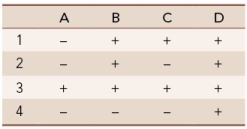 Based on these data, what is the most likely order of the pathway? (A, B, C, D means that substance A is converted to substance B, which is converted to substance C, which is converted to substance D.)
 (Multiple Choice)
4.9/5 (77)
(77) 
Filters
- Essay(0)
- Multiple Choice(0)
- Short Answer(0)
- True False(0)
- Matching(0)