



 Chat with AI
Exam 14: From Dna to Protein: Gene Expression

Exam 1: Studying Life246 Questions
Exam 2: Small Molecules and the Chemistry of Life246 Questions
Exam 3: Proteins, Carbohydrates, and Lipids246 Questions
Exam 4: Nucleic Acids and the Origin of Life246 Questions
Exam 5: Cells: the Working Units of Life248 Questions
Exam 6: Cell Membranes246 Questions
Exam 7: Cell Communication and Multicellularity246 Questions
Exam 8: Energy, Enzymes, and Metabolism246 Questions
Exam 9: Pathways That Harvest Chemical Energy246 Questions
Exam 10: Photosynthesis: Energy From Sunlight242 Questions
Exam 11: The Cell Cycle and Cell Division260 Questions
Exam 12: Inheritance, Genes, and Chromosomes250 Questions
Exam 13: Dna and Its Role in Heredity257 Questions
Exam 14: From Dna to Protein: Gene Expression252 Questions
Exam 15: Gene Mutation and Molecular Medicine251 Questions
Exam 16: Regulation of Gene Expression245 Questions
Exam 17: Genomes249 Questions
Exam 18: Recombinant Dna and Biotechnology243 Questions
Exam 20: Mechanisms of Evolution243 Questions
Exam 21: Reconstructing and Using Phylogenies246 Questions
Exam 22: Speciation247 Questions
Exam 23: Evolution of Genes and Genomes252 Questions
Exam 24: The History of Life on Earth246 Questions
Exam 25: Bacteria, Archaea, and Viruses262 Questions
Exam 26: The Origin and Diversification of Eukaryotes252 Questions
Exam 27: Plants Without Seeds: From Water to Land251 Questions
Exam 28: The Evolution of Seed Plants259 Questions
Exam 29: The Evolution and Diversity of Fungi261 Questions
Exam 30: Animal Origins and the Evolution of Body Plans248 Questions
Exam 31: Protostome Animals244 Questions
Exam 32: Deuterostome Animals246 Questions
Exam 33: The Plant Body243 Questions
Exam 34: Transport in Plants248 Questions
Exam 35: Plant Nutrition247 Questions
Exam 36: Regulation of Plant Growth246 Questions
Exam 37: Reproduction in Flowering Plants247 Questions
Exam 38: Plant Responses to Environmental Challenges246 Questions
Exam 39: Physiology, Homeostasis, and Temperature Regulation258 Questions
Exam 40: Animal Hormones249 Questions
Exam 41: Immunology: Animal Defense Systems265 Questions
Exam 42: Animal Reproduction261 Questions
Exam 43: Animal Development261 Questions
Exam 44: Neurons, Glia, and Nervous Systems250 Questions
Exam 45: Sensory Systems249 Questions
Exam 46: The Mammalian Nervous System: Structure and Higher Functions254 Questions
Exam 47: Musculoskeletal Systems259 Questions
Exam 48: Gas Exchange247 Questions
Exam 49: Circulatory Systems252 Questions
Exam 50: Nutrition, Digestion, and Absorption259 Questions
Exam 51: Salt and Water Balance and Nitrogen Excretion251 Questions
Exam 52: Animal Behavior249 Questions
Exam 53: The Physical Environment and Biogeography of Life248 Questions
Exam 54: Populations259 Questions
Exam 55: Species Interactions254 Questions
Exam 56: Communities247 Questions
Exam 57: Ecosystems238 Questions
Exam 58: A Changing Biosphere222 Questions
Select questions type


Before the details of transcription and translation were worked out, Crick hypothesized a unidirectional flow of information from DNA to protein.He called this model the_______.
(Short Answer)
4.8/5  (95)
(95) A researcher purifies numerous different eukaryotic mRNA species and carries out nucleic acid hybridization to identify the genes encoding the various mRNAs.As expected, the presence of exons within the genomic DNA creates regions in which there is no mRNA sequence to hybridize with the DNA.The researcher also notes that at the 3′ end of all of the mRNA species, there are RNA sequences that fails to anneal with the DNA.The researcher concludes that these RNA sequences must correspond to _______.
(Short Answer)
4.8/5 (74)
(74) The portion of the tRNA molecule that works with the mRNA to accomplish complementary base pairing is called the _______.
(Short Answer)
4.7/5 (78)
(78) Consider the experiments by Noller and colleagues.If removal of proteins from the large subunit of the ribosome had destroyed peptidyl transferase activity, then one could infer that
(Multiple Choice)
4.8/5 (90)
(90) DNA is composed of two strands, only one of which is typically used as a template for RNA synthesis.By what mechanism is the correct strand chosen?
(Multiple Choice)
4.8/5 (75)
(75) Refer to the figure, which shows the standard genetic code. 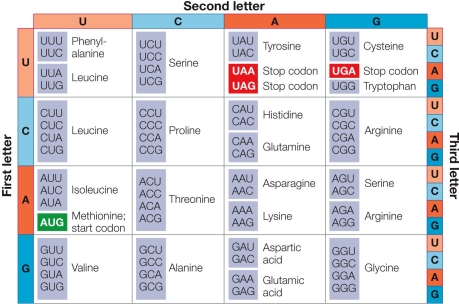 If the anticodon is 3-GAG-5, then the associated amino acid is
 (Multiple Choice)
4.8/5 (79)
(79) Given that a 5-to-3 strand of DNA is AGCTCGATCGA, what is the resulting transcribed RNA?
(Multiple Choice)
4.8/5 (81)
(81) During translation elongation, the growing polypeptide chain moves to
(Multiple Choice)
4.9/5 (72)
(72) An individual has a metabolic disease that is traced to one nonfunctional enzyme.Protein analysis reveals that the protein is larger than normal and fails to assemble into the proper tertiary structure.Analysis of the gene sequence will most likely reveal that the mutation
(Multiple Choice)
4.8/5 (92)
(92) The antibiotic tetracycline exploits the differences between the _______ of prokaryotes and eukaryotes.
(Multiple Choice)
4.9/5 (76)
(76) The regions of DNA in a eukaryotic gene that contain noncoding base sequences are called
(Multiple Choice)
4.7/5 (81)
(81) Which statement does not support Garrod's hypothesis that inborn errors of metabolism cause disease?
(Multiple Choice)
4.8/5 (74)
(74) Beadle and Tatum's experiments showed that a biochemical pathway could be deduced from mutant strains.In bacteria, the biosynthesis of the amino acid tryptophan (T) from the precursor chorismate (C) involves four intermediate chemical compounds, which we will call D, E, F, and G.The phenotypes of various mutant strains are shown in the table.Each strain has a mutation in a gene for a different enzyme; "+" means growth with the indicated compound added to the medium, and "0" means no growth. 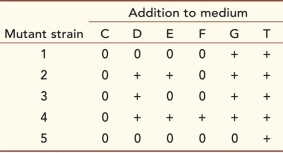 Based on these data, order the compounds (C, D, E, F, G, and T) and enzymes (1, 2, 3, 4, and 5) in a biochemical pathway.
 (Short Answer)
5.0/5 (78)
(78) Translation of messenger RNA into protein occurs in mRNA in a _______ direction, and the protein is built from _______ terminus to _______ terminus.
(Multiple Choice)
4.8/5 (88)
(88) Refer to the figure showing the process of gene expression in eukaryotes. 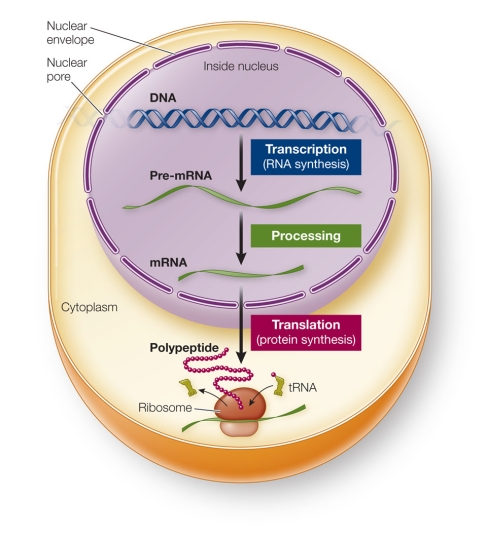 Which arrow in the indicates RNA processing?
 (Short Answer)
4.8/5 (78)
(78) The excess in the number of codons needed to code for amino acids indicates that the genetic code is _______.
(Short Answer)
4.7/5 (70)
(70) The initiation of transcription of the glycogen synthase gene occurs when RNA polymerase binds to the _______ of the glycogen synthase gene DNA.
(Short Answer)
4.8/5 (79)
(79) What characteristic of newly synthesized mRNA that provides mRNA stability could be used in the lab to separate it from other RNAs?
(Essay)
4.8/5 (84)
(84) 
Filters
- Essay(0)
- Multiple Choice(0)
- Short Answer(0)
- True False(0)
- Matching(0)