



 Chat with AI
Exam 14: From Dna to Protein: Gene Expression

Exam 1: Studying Life246 Questions
Exam 2: Small Molecules and the Chemistry of Life246 Questions
Exam 3: Proteins, Carbohydrates, and Lipids246 Questions
Exam 4: Nucleic Acids and the Origin of Life246 Questions
Exam 5: Cells: the Working Units of Life248 Questions
Exam 6: Cell Membranes246 Questions
Exam 7: Cell Communication and Multicellularity246 Questions
Exam 8: Energy, Enzymes, and Metabolism246 Questions
Exam 9: Pathways That Harvest Chemical Energy246 Questions
Exam 10: Photosynthesis: Energy From Sunlight242 Questions
Exam 11: The Cell Cycle and Cell Division260 Questions
Exam 12: Inheritance, Genes, and Chromosomes250 Questions
Exam 13: Dna and Its Role in Heredity257 Questions
Exam 14: From Dna to Protein: Gene Expression252 Questions
Exam 15: Gene Mutation and Molecular Medicine251 Questions
Exam 16: Regulation of Gene Expression245 Questions
Exam 17: Genomes249 Questions
Exam 18: Recombinant Dna and Biotechnology243 Questions
Exam 20: Mechanisms of Evolution243 Questions
Exam 21: Reconstructing and Using Phylogenies246 Questions
Exam 22: Speciation247 Questions
Exam 23: Evolution of Genes and Genomes252 Questions
Exam 24: The History of Life on Earth246 Questions
Exam 25: Bacteria, Archaea, and Viruses262 Questions
Exam 26: The Origin and Diversification of Eukaryotes252 Questions
Exam 27: Plants Without Seeds: From Water to Land251 Questions
Exam 28: The Evolution of Seed Plants259 Questions
Exam 29: The Evolution and Diversity of Fungi261 Questions
Exam 30: Animal Origins and the Evolution of Body Plans248 Questions
Exam 31: Protostome Animals244 Questions
Exam 32: Deuterostome Animals246 Questions
Exam 33: The Plant Body243 Questions
Exam 34: Transport in Plants248 Questions
Exam 35: Plant Nutrition247 Questions
Exam 36: Regulation of Plant Growth246 Questions
Exam 37: Reproduction in Flowering Plants247 Questions
Exam 38: Plant Responses to Environmental Challenges246 Questions
Exam 39: Physiology, Homeostasis, and Temperature Regulation258 Questions
Exam 40: Animal Hormones249 Questions
Exam 41: Immunology: Animal Defense Systems265 Questions
Exam 42: Animal Reproduction261 Questions
Exam 43: Animal Development261 Questions
Exam 44: Neurons, Glia, and Nervous Systems250 Questions
Exam 45: Sensory Systems249 Questions
Exam 46: The Mammalian Nervous System: Structure and Higher Functions254 Questions
Exam 47: Musculoskeletal Systems259 Questions
Exam 48: Gas Exchange247 Questions
Exam 49: Circulatory Systems252 Questions
Exam 50: Nutrition, Digestion, and Absorption259 Questions
Exam 51: Salt and Water Balance and Nitrogen Excretion251 Questions
Exam 52: Animal Behavior249 Questions
Exam 53: The Physical Environment and Biogeography of Life248 Questions
Exam 54: Populations259 Questions
Exam 55: Species Interactions254 Questions
Exam 56: Communities247 Questions
Exam 57: Ecosystems238 Questions
Exam 58: A Changing Biosphere222 Questions
Select questions type


Suppose that a certain wild-type bacteria can synthesize substance D, but various mutant strains cannot.We know that substance D is synthesized from substance X in a pathway that involves three intermediate substances (A, B, and C), but we do not know the order of the steps in the pathway.The table shows four different mutant strains that have been tested for their ability to grow on the various substances.The "+" means that the strain can grow on that substance.The "‒" means that the strain cannot grow on that substance. 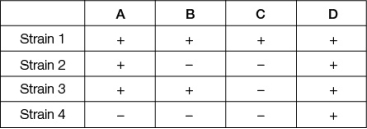 If another strain (say, strain 5) grows on substance B but does not grow on substance C, we can infer that it
 (Multiple Choice)
4.9/5  (81)
(81) The anticodon 3ʹ-UAC-5ʹ will bind to which of the following codons?
(Multiple Choice)
4.9/5 (87)
(87) Consensus sequences (short segments of DNA) appear in the boundaries between introns and exons of various genes.These sequences appear to be involved in
(Multiple Choice)
4.7/5 (74)
(74) Initiation of translation of an mRNA has begun, then suddenly ceases after about 20 _______ amino acids are detected at the N terminus.When the entire complex-mRNA and ribosome-binds to a specific signal recognition particle on the RER, translation resumes.
(Short Answer)
4.9/5 (89)
(89) What in eukaryotes has a role most similar to that of the Shine-Dalgarno sequence in prokaryotes?
(Multiple Choice)
4.7/5 (73)
(73) The direction of synthesis for a new mRNA molecule is _______ from a _______ template strand.
(Multiple Choice)
4.8/5 (82)
(82) Suppose that the coding region of a gene contains 1,800 base pairs, with 570 in exon 1, with 420 in exon 2, and with 810 in exon 3 (not counting the stop codon).A protein in a splice variant of this gene in which exon 2 was spliced out would be composed of _______ amino acids.
(Multiple Choice)
4.8/5 (84)
(84) An mRNA molecule that is 960 nucleotides long can have as many as _______ codons.
(Short Answer)
4.8/5 (91)
(91) The adapters that allow translation of the 4-letter nucleic acid language into the 20-letter protein language are called
(Multiple Choice)
4.8/5 (85)
(85) If a strand of mRNA has the sequence 5ʹ-CUGUCA...ACUC-3ʹ (with […] representing the intervening sequence), what was the template strand of DNA used to produce this mRNA?
(Multiple Choice)
4.8/5 (85)
(85) Protein kinases are involved in the _______ of other proteins.
(Multiple Choice)
4.8/5 (86)
(86) Suppose there is a mutation in one of the small nuclear ribonucleoprotiens (snRNPs) that somewhat reduces its functionality.Which scenario is most likely to occur?
(Multiple Choice)
4.8/5 (78)
(78) Refer to the figure. 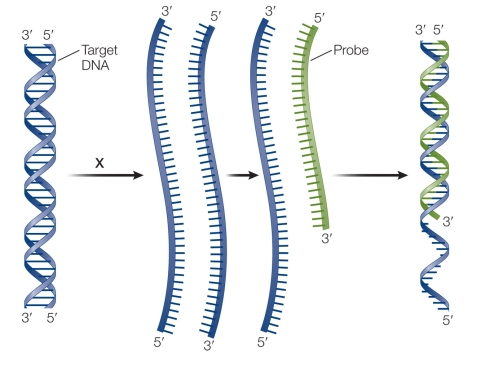 What process is indicated by the letter "X"?
 (Short Answer)
4.9/5 (88)
(88) Greater numbers of base changes are found in mRNA than in replicated DNA from the same gene sequence, because RNA polymerase
(Multiple Choice)
4.9/5 (69)
(69) During _______, the molecule _______ recognizes which amino acid should be added next to a growing polypeptide chain.
(Multiple Choice)
4.8/5 (87)
(87) 
Filters
- Essay(0)
- Multiple Choice(0)
- Short Answer(0)
- True False(0)
- Matching(0)