



 Chat with AI
Exam 14: From Dna to Protein: Gene Expression

Exam 1: Studying Life246 Questions
Exam 2: Small Molecules and the Chemistry of Life246 Questions
Exam 3: Proteins, Carbohydrates, and Lipids246 Questions
Exam 4: Nucleic Acids and the Origin of Life246 Questions
Exam 5: Cells: the Working Units of Life248 Questions
Exam 6: Cell Membranes246 Questions
Exam 7: Cell Communication and Multicellularity246 Questions
Exam 8: Energy, Enzymes, and Metabolism246 Questions
Exam 9: Pathways That Harvest Chemical Energy246 Questions
Exam 10: Photosynthesis: Energy From Sunlight242 Questions
Exam 11: The Cell Cycle and Cell Division260 Questions
Exam 12: Inheritance, Genes, and Chromosomes250 Questions
Exam 13: Dna and Its Role in Heredity257 Questions
Exam 14: From Dna to Protein: Gene Expression252 Questions
Exam 15: Gene Mutation and Molecular Medicine251 Questions
Exam 16: Regulation of Gene Expression245 Questions
Exam 17: Genomes249 Questions
Exam 18: Recombinant Dna and Biotechnology243 Questions
Exam 20: Mechanisms of Evolution243 Questions
Exam 21: Reconstructing and Using Phylogenies246 Questions
Exam 22: Speciation247 Questions
Exam 23: Evolution of Genes and Genomes252 Questions
Exam 24: The History of Life on Earth246 Questions
Exam 25: Bacteria, Archaea, and Viruses262 Questions
Exam 26: The Origin and Diversification of Eukaryotes252 Questions
Exam 27: Plants Without Seeds: From Water to Land251 Questions
Exam 28: The Evolution of Seed Plants259 Questions
Exam 29: The Evolution and Diversity of Fungi261 Questions
Exam 30: Animal Origins and the Evolution of Body Plans248 Questions
Exam 31: Protostome Animals244 Questions
Exam 32: Deuterostome Animals246 Questions
Exam 33: The Plant Body243 Questions
Exam 34: Transport in Plants248 Questions
Exam 35: Plant Nutrition247 Questions
Exam 36: Regulation of Plant Growth246 Questions
Exam 37: Reproduction in Flowering Plants247 Questions
Exam 38: Plant Responses to Environmental Challenges246 Questions
Exam 39: Physiology, Homeostasis, and Temperature Regulation258 Questions
Exam 40: Animal Hormones249 Questions
Exam 41: Immunology: Animal Defense Systems265 Questions
Exam 42: Animal Reproduction261 Questions
Exam 43: Animal Development261 Questions
Exam 44: Neurons, Glia, and Nervous Systems250 Questions
Exam 45: Sensory Systems249 Questions
Exam 46: The Mammalian Nervous System: Structure and Higher Functions254 Questions
Exam 47: Musculoskeletal Systems259 Questions
Exam 48: Gas Exchange247 Questions
Exam 49: Circulatory Systems252 Questions
Exam 50: Nutrition, Digestion, and Absorption259 Questions
Exam 51: Salt and Water Balance and Nitrogen Excretion251 Questions
Exam 52: Animal Behavior249 Questions
Exam 53: The Physical Environment and Biogeography of Life248 Questions
Exam 54: Populations259 Questions
Exam 55: Species Interactions254 Questions
Exam 56: Communities247 Questions
Exam 57: Ecosystems238 Questions
Exam 58: A Changing Biosphere222 Questions
Select questions type


Suppose the 5ʹ-to-3ʹ coding strand of DNA is GTCTATGCATTA. Which sequence represents the resulting transcribed RNA?
(Multiple Choice)
4.8/5  (79)
(79) The disease called branched-chain ketoaciduria is commonly known as maple syrup urine disease, as the urine of a person with the condition has a smell similar to that of maple syrup.Because the disease is rare and most often appears in children whose parents are first cousins, one can conclude that the disease is inherited as an autosomal _______ phenotype.
(Short Answer)
4.9/5 (101)
(101) Errors in transcription occur about 100,000 times as often as errors in DNA replication.Why can this high rate be tolerated in RNA synthesis but not in DNA synthesis?
(Essay)
4.8/5 (73)
(73) Refer to the figure showing the process of gene expression in eukaryotes. 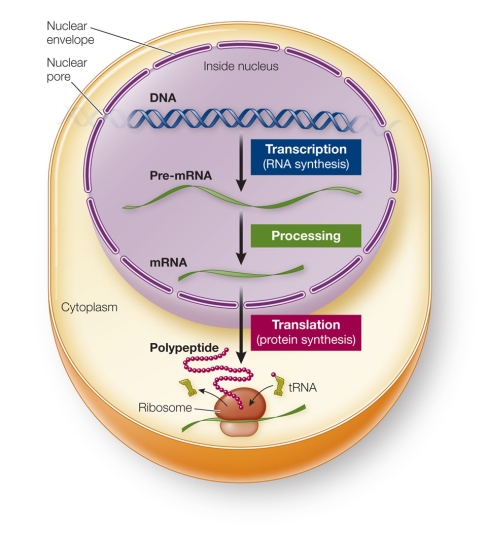 Which arrow in the indicates translation?
 (Short Answer)
4.8/5 (83)
(83) When the introns are removed from pre-mRNA, the exons must be _______ together to form mRNA.
(Short Answer)
4.8/5 (80)
(80) Suppose the DNA of a gene contains five regions-A, B, C, D, and E, in that order.Regions A, B, and D are located in introns, while regions C and E are located in exons.What is the order of the regions in the pre-mRNA transcribed from that sequence?
(Multiple Choice)
4.8/5 (87)
(87) The presence of inosine and other modified bases at the _______ position of the anticodon accounts for the wobble of the genetic code.
(Short Answer)
4.9/5 (78)
(78) Refer to the figure. 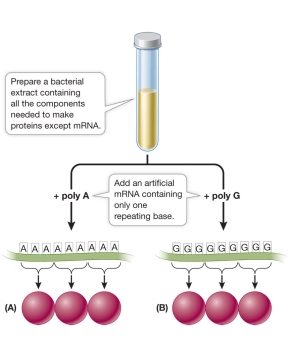 Given the experimental conditions presented, which repeating amino acids would be specified in the polypeptide chains (A and B), respectively?
 (Multiple Choice)
5.0/5 (74)
(74) If the codon is 5-GAA-3, then the corresponding anticodon is
(Multiple Choice)
4.8/5 (73)
(73) If there were only three kinds of nucleotides, how many different types of codons would a genetic code have? (Assume that the codons are three nucleotides long.)
(Multiple Choice)
4.9/5 (87)
(87) Based on the complexity of tRNA's function, one might conclude that the number of different tRNA molecules that exist is surprisingly small.This discrepancy is possible because
(Multiple Choice)
4.9/5 (68)
(68) One can argue that although the existence of retroviruses represents a complication of Crick's central dogma, it does not contradict it.The replication mechanism of retroviruses does not contradict the essence of the central dogma, because
(Multiple Choice)
4.9/5 (85)
(85) Peptidyl transferase activity in ribosomes is catalyzed by
(Multiple Choice)
4.9/5 (84)
(84) Refer to the figure. 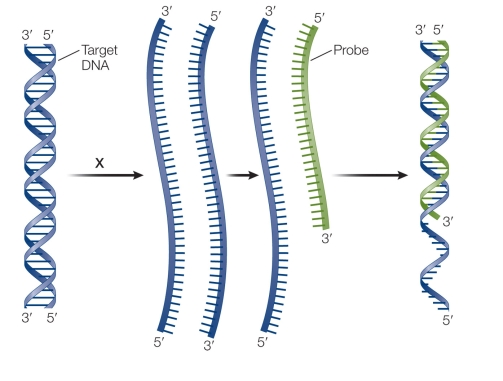 When the technique is used to determine where introns and exons exist, which kind of molecule is used as the probe?
 (Short Answer)
4.8/5 (92)
(92) The addition of sugar residues to the protein after translation is called
(Multiple Choice)
4.8/5 (69)
(69) Compared with DNA replication, transcription is _______ error prone because of differences in _______.
(Multiple Choice)
4.8/5 (80)
(80) An individual has a metabolic disorder that is traced to an enzyme composed of two different subunits, one larger than the other.The patient has an allele of the smaller subunit that produces a protein that is abnormally large, and when it binds to the other subunit of the enzyme, the enzymatic activity is lost.Analysis of the mRNA sequence identifies a mutation in the 3′ region of a gene that has turned a UAA codon to UUA.Based on this modification, the clinical researcher hypothesizes that during the elongation cycle in the patient, there is a failure to recruit the _______ at the correct site in the mRNA sequence.This results in the translation of an abnormally long peptide.
(Short Answer)
4.8/5 (72)
(72) An mRNA molecule with several ribosomes attached to it is called a(n) _______.
(Short Answer)
4.8/5 (77)
(77) Suppose that nucleic acid hybridization experiments revealed that the mRNA-DNA complexes form different loop patterns depending on which cell type is the source of the mRNA.Such data would support
(Multiple Choice)
4.7/5 (87)
(87) 
Filters
- Essay(0)
- Multiple Choice(0)
- Short Answer(0)
- True False(0)
- Matching(0)