



 Chat with AI
Exam 14: From Dna to Protein: Gene Expression

Exam 1: Studying Life246 Questions
Exam 2: Small Molecules and the Chemistry of Life246 Questions
Exam 3: Proteins, Carbohydrates, and Lipids246 Questions
Exam 4: Nucleic Acids and the Origin of Life246 Questions
Exam 5: Cells: the Working Units of Life248 Questions
Exam 6: Cell Membranes246 Questions
Exam 7: Cell Communication and Multicellularity246 Questions
Exam 8: Energy, Enzymes, and Metabolism246 Questions
Exam 9: Pathways That Harvest Chemical Energy246 Questions
Exam 10: Photosynthesis: Energy From Sunlight242 Questions
Exam 11: The Cell Cycle and Cell Division260 Questions
Exam 12: Inheritance, Genes, and Chromosomes250 Questions
Exam 13: Dna and Its Role in Heredity257 Questions
Exam 14: From Dna to Protein: Gene Expression252 Questions
Exam 15: Gene Mutation and Molecular Medicine251 Questions
Exam 16: Regulation of Gene Expression245 Questions
Exam 17: Genomes249 Questions
Exam 18: Recombinant Dna and Biotechnology243 Questions
Exam 20: Mechanisms of Evolution243 Questions
Exam 21: Reconstructing and Using Phylogenies246 Questions
Exam 22: Speciation247 Questions
Exam 23: Evolution of Genes and Genomes252 Questions
Exam 24: The History of Life on Earth246 Questions
Exam 25: Bacteria, Archaea, and Viruses262 Questions
Exam 26: The Origin and Diversification of Eukaryotes252 Questions
Exam 27: Plants Without Seeds: From Water to Land251 Questions
Exam 28: The Evolution of Seed Plants259 Questions
Exam 29: The Evolution and Diversity of Fungi261 Questions
Exam 30: Animal Origins and the Evolution of Body Plans248 Questions
Exam 31: Protostome Animals244 Questions
Exam 32: Deuterostome Animals246 Questions
Exam 33: The Plant Body243 Questions
Exam 34: Transport in Plants248 Questions
Exam 35: Plant Nutrition247 Questions
Exam 36: Regulation of Plant Growth246 Questions
Exam 37: Reproduction in Flowering Plants247 Questions
Exam 38: Plant Responses to Environmental Challenges246 Questions
Exam 39: Physiology, Homeostasis, and Temperature Regulation258 Questions
Exam 40: Animal Hormones249 Questions
Exam 41: Immunology: Animal Defense Systems265 Questions
Exam 42: Animal Reproduction261 Questions
Exam 43: Animal Development261 Questions
Exam 44: Neurons, Glia, and Nervous Systems250 Questions
Exam 45: Sensory Systems249 Questions
Exam 46: The Mammalian Nervous System: Structure and Higher Functions254 Questions
Exam 47: Musculoskeletal Systems259 Questions
Exam 48: Gas Exchange247 Questions
Exam 49: Circulatory Systems252 Questions
Exam 50: Nutrition, Digestion, and Absorption259 Questions
Exam 51: Salt and Water Balance and Nitrogen Excretion251 Questions
Exam 52: Animal Behavior249 Questions
Exam 53: The Physical Environment and Biogeography of Life248 Questions
Exam 54: Populations259 Questions
Exam 55: Species Interactions254 Questions
Exam 56: Communities247 Questions
Exam 57: Ecosystems238 Questions
Exam 58: A Changing Biosphere222 Questions
Select questions type


A codon is _______ nucleotides long, and there are _______ different possible codons in total.
(Multiple Choice)
4.9/5  (80)
(80) Translation of an mRNA transcript generates numerous polypeptide chains.The accumulation of these polypeptide chains is faster than can be accounted for when considering the rate of ribosomal-mediated translation of mRNA transcripts.What accounts for this discrepancy?
(Multiple Choice)
4.7/5 (92)
(92) The mRNA start codon is AUG and codes for the amino acid _______.
(Short Answer)
4.9/5 (80)
(80) Inosine, which is sometimes found at the _______ end of an anticodon, can pair with any of the bases normally seen in RNA except _______.
(Multiple Choice)
4.9/5 (67)
(67) Geneticists would expect alkaptonuria to be _______ common when there is mating between relatives, because the condition is inherited as a _______ phenotype.
(Multiple Choice)
4.8/5 (85)
(85) Consider the typical multicellular eukaryote.In comparison with the DNA made in DNA replication, transcribed mRNAs are made in _______ copies, are _______ error prone, and last _______.
(Multiple Choice)
4.8/5 (86)
(86) Suppose you take the glycine tRNA and modify it so that the glycine is changed to valine.Based on the results of the Benzer experiments, _______, because the protein synthesis machinery recognizes the _______.
(Multiple Choice)
4.7/5 (61)
(61) Refer to the figure. 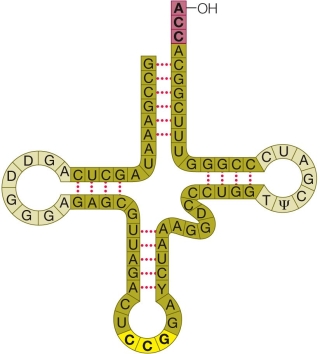 What is the location of the anticodon site of this tRNA molecule?
 (Short Answer)
4.9/5 (80)
(80) Comparison of the same gene and its product in two different animal species revealed that the amino acids are 98 percent identical but the nucleotides are only 86 percent identical.What accounts for the much higher amino acid identity than nucleotide identity?
(Multiple Choice)
4.8/5 (70)
(70) The wobble phenomenon occurs at _______end of the anticodon and helps explain why the _______ end of the codon shows the most redundancy.
(Multiple Choice)
4.8/5 (92)
(92) A mutation in a protein kinase can lead to improper _______ of proteins.
(Multiple Choice)
4.8/5 (81)
(81) The study of Neurospora mutants grown on various supplemented media enabled researchers to identify single genes involved in the arginine synthesis pathway.Why was Neurospora a better model organism than a human cell line for this study?
(Multiple Choice)
4.8/5 (71)
(71) A charged tRNA travels across a ribosome from the _______ site, to the _______ site, and then to the _______ site.
(Multiple Choice)
5.0/5 (77)
(77) 
Filters
- Essay(0)
- Multiple Choice(0)
- Short Answer(0)
- True False(0)
- Matching(0)