



 Chat with AI
Exam 40: Animal Hormones

Exam 1: Studying Life246 Questions
Exam 2: Small Molecules and the Chemistry of Life246 Questions
Exam 3: Proteins, Carbohydrates, and Lipids246 Questions
Exam 4: Nucleic Acids and the Origin of Life246 Questions
Exam 5: Cells: the Working Units of Life248 Questions
Exam 6: Cell Membranes246 Questions
Exam 7: Cell Communication and Multicellularity246 Questions
Exam 8: Energy, Enzymes, and Metabolism246 Questions
Exam 9: Pathways That Harvest Chemical Energy246 Questions
Exam 10: Photosynthesis: Energy From Sunlight242 Questions
Exam 11: The Cell Cycle and Cell Division260 Questions
Exam 12: Inheritance, Genes, and Chromosomes250 Questions
Exam 13: Dna and Its Role in Heredity257 Questions
Exam 14: From Dna to Protein: Gene Expression252 Questions
Exam 15: Gene Mutation and Molecular Medicine251 Questions
Exam 16: Regulation of Gene Expression245 Questions
Exam 17: Genomes249 Questions
Exam 18: Recombinant Dna and Biotechnology243 Questions
Exam 20: Mechanisms of Evolution243 Questions
Exam 21: Reconstructing and Using Phylogenies246 Questions
Exam 22: Speciation247 Questions
Exam 23: Evolution of Genes and Genomes252 Questions
Exam 24: The History of Life on Earth246 Questions
Exam 25: Bacteria, Archaea, and Viruses262 Questions
Exam 26: The Origin and Diversification of Eukaryotes252 Questions
Exam 27: Plants Without Seeds: From Water to Land251 Questions
Exam 28: The Evolution of Seed Plants259 Questions
Exam 29: The Evolution and Diversity of Fungi261 Questions
Exam 30: Animal Origins and the Evolution of Body Plans248 Questions
Exam 31: Protostome Animals244 Questions
Exam 32: Deuterostome Animals246 Questions
Exam 33: The Plant Body243 Questions
Exam 34: Transport in Plants248 Questions
Exam 35: Plant Nutrition247 Questions
Exam 36: Regulation of Plant Growth246 Questions
Exam 37: Reproduction in Flowering Plants247 Questions
Exam 38: Plant Responses to Environmental Challenges246 Questions
Exam 39: Physiology, Homeostasis, and Temperature Regulation258 Questions
Exam 40: Animal Hormones249 Questions
Exam 41: Immunology: Animal Defense Systems265 Questions
Exam 42: Animal Reproduction261 Questions
Exam 43: Animal Development261 Questions
Exam 44: Neurons, Glia, and Nervous Systems250 Questions
Exam 45: Sensory Systems249 Questions
Exam 46: The Mammalian Nervous System: Structure and Higher Functions254 Questions
Exam 47: Musculoskeletal Systems259 Questions
Exam 48: Gas Exchange247 Questions
Exam 49: Circulatory Systems252 Questions
Exam 50: Nutrition, Digestion, and Absorption259 Questions
Exam 51: Salt and Water Balance and Nitrogen Excretion251 Questions
Exam 52: Animal Behavior249 Questions
Exam 53: The Physical Environment and Biogeography of Life248 Questions
Exam 54: Populations259 Questions
Exam 55: Species Interactions254 Questions
Exam 56: Communities247 Questions
Exam 57: Ecosystems238 Questions
Exam 58: A Changing Biosphere222 Questions
Select questions type


The parathyroid glands are involved in regulation of blood levels of
(Multiple Choice)
4.9/5  (75)
(75) Refer to the figure showing the adrenal gland. 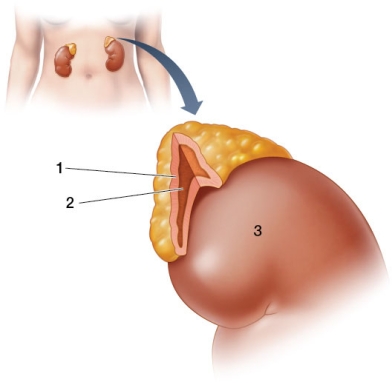 Based on the figure, which structure(s) is/are most directly involved in raising your blood pressure in response to stress?
 (Multiple Choice)
4.9/5 (77)
(77) Like many hormones, growth hormone (GH) participates in a negative feedback loop that regulates its own secretion.Which process is most likely part of this negative feedback loop?
(Multiple Choice)
4.9/5 (87)
(87) Which of the following would cause a reduction in thyrotropin release?
(Multiple Choice)
4.9/5 (90)
(90) Which hormone is responsible for the conversion of glycogen into glucose when serum glucose levels fall?
(Multiple Choice)
4.7/5 (84)
(84) Which hormone stimulates cells to use glucose as a metabolic fuel and to convert excess glucose into fat and glycogen storage?
(Multiple Choice)
4.8/5 (80)
(80) Refer to the figure.In an experiment, two bloodsucking Rhodnius prolixus bugs were decapitated and connected by a glass tube, allowing body fluids to cross between them.Both molted into adults. 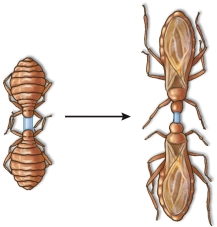 The results shown could occur if, before the two bugs were connected,
 (Multiple Choice)
4.8/5 (77)
(77) Which hormone was discovered by Frederick Banting and Charles Best to reduce symptoms of type I diabetes?
(Multiple Choice)
4.9/5 (88)
(88) Which hormone is released within minutes in response to short-term stress and remains elevated for a longer period than epinephrine does?
(Multiple Choice)
4.7/5 (80)
(80) Which statement about insects with complete metamorphosis is true?
(Multiple Choice)
4.9/5 (83)
(83) Which statement about communication signals in animals is true?
(Multiple Choice)
4.9/5 (82)
(82) Which is most likely to cause a release of oxytocin in a nursing mother?
(Multiple Choice)
4.8/5 (92)
(92) Honey bees build honeycombs from beeswax that they produce.After extracting honey from the combs, beekeepers store the combs until they are needed again as the bees build up their honey reserves.Wax moths lay their eggs in honeycombs.The larvae eat the wax as they go through cycles of molting and growth until they metamorphose into adult moths.Suppose a beekeeper decides to store his honeycombs in a cold room.Months later when he goes to get the spare combs out of the cold room, he finds them full of large holes and gigantic moth larvae, but no adult moths.Hypothesize about what aspect of the moth endocrine system was altered by the low temperature.
(Essay)
4.9/5 (87)
(87) Refer to the figure featuring the anterior pituitary. 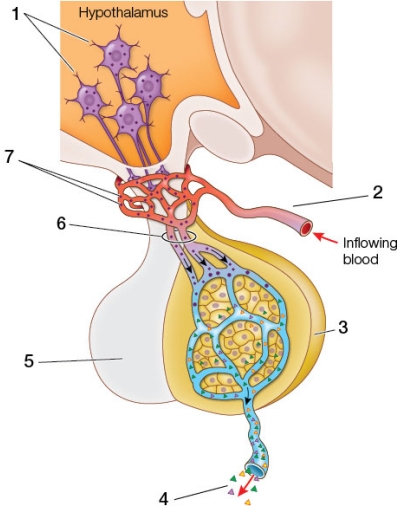 Which label in the figure is incorrectly identified?
 (Multiple Choice)
4.9/5 (83)
(83) Refer to the figure showing two hormones. 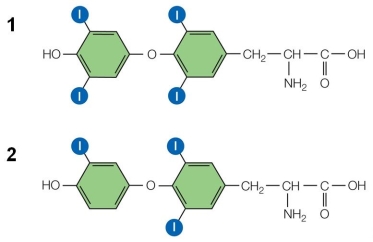 It is most likely that the two hormones are
 (Multiple Choice)
4.7/5 (91)
(91) You are a scientist trying to discover the receptors for a newly discovered peptide hormone that affects fat cells.In what part of the cell will you be looking for these receptors, and why?
(Essay)
4.9/5 (76)
(76) The sex hormones secreted by the gonads (and to a small extent by the adrenal cortex) are synthesized from
(Multiple Choice)
5.0/5 (75)
(75) 
Filters
- Essay(0)
- Multiple Choice(0)
- Short Answer(0)
- True False(0)
- Matching(0)