



 Chat with AI
Exam 40: Animal Hormones

Exam 1: Studying Life246 Questions
Exam 2: Small Molecules and the Chemistry of Life246 Questions
Exam 3: Proteins, Carbohydrates, and Lipids246 Questions
Exam 4: Nucleic Acids and the Origin of Life246 Questions
Exam 5: Cells: the Working Units of Life248 Questions
Exam 6: Cell Membranes246 Questions
Exam 7: Cell Communication and Multicellularity246 Questions
Exam 8: Energy, Enzymes, and Metabolism246 Questions
Exam 9: Pathways That Harvest Chemical Energy246 Questions
Exam 10: Photosynthesis: Energy From Sunlight242 Questions
Exam 11: The Cell Cycle and Cell Division260 Questions
Exam 12: Inheritance, Genes, and Chromosomes250 Questions
Exam 13: Dna and Its Role in Heredity257 Questions
Exam 14: From Dna to Protein: Gene Expression252 Questions
Exam 15: Gene Mutation and Molecular Medicine251 Questions
Exam 16: Regulation of Gene Expression245 Questions
Exam 17: Genomes249 Questions
Exam 18: Recombinant Dna and Biotechnology243 Questions
Exam 20: Mechanisms of Evolution243 Questions
Exam 21: Reconstructing and Using Phylogenies246 Questions
Exam 22: Speciation247 Questions
Exam 23: Evolution of Genes and Genomes252 Questions
Exam 24: The History of Life on Earth246 Questions
Exam 25: Bacteria, Archaea, and Viruses262 Questions
Exam 26: The Origin and Diversification of Eukaryotes252 Questions
Exam 27: Plants Without Seeds: From Water to Land251 Questions
Exam 28: The Evolution of Seed Plants259 Questions
Exam 29: The Evolution and Diversity of Fungi261 Questions
Exam 30: Animal Origins and the Evolution of Body Plans248 Questions
Exam 31: Protostome Animals244 Questions
Exam 32: Deuterostome Animals246 Questions
Exam 33: The Plant Body243 Questions
Exam 34: Transport in Plants248 Questions
Exam 35: Plant Nutrition247 Questions
Exam 36: Regulation of Plant Growth246 Questions
Exam 37: Reproduction in Flowering Plants247 Questions
Exam 38: Plant Responses to Environmental Challenges246 Questions
Exam 39: Physiology, Homeostasis, and Temperature Regulation258 Questions
Exam 40: Animal Hormones249 Questions
Exam 41: Immunology: Animal Defense Systems265 Questions
Exam 42: Animal Reproduction261 Questions
Exam 43: Animal Development261 Questions
Exam 44: Neurons, Glia, and Nervous Systems250 Questions
Exam 45: Sensory Systems249 Questions
Exam 46: The Mammalian Nervous System: Structure and Higher Functions254 Questions
Exam 47: Musculoskeletal Systems259 Questions
Exam 48: Gas Exchange247 Questions
Exam 49: Circulatory Systems252 Questions
Exam 50: Nutrition, Digestion, and Absorption259 Questions
Exam 51: Salt and Water Balance and Nitrogen Excretion251 Questions
Exam 52: Animal Behavior249 Questions
Exam 53: The Physical Environment and Biogeography of Life248 Questions
Exam 54: Populations259 Questions
Exam 55: Species Interactions254 Questions
Exam 56: Communities247 Questions
Exam 57: Ecosystems238 Questions
Exam 58: A Changing Biosphere222 Questions
Select questions type


_______ is produced from cholesterol in skin cells when they are exposed to ultraviolet light.It is converted to an active hormone in the liver and kidneys.
(Short Answer)
4.9/5  (87)
(87) Refer to the figure showing the regulation of blood glucose levels. 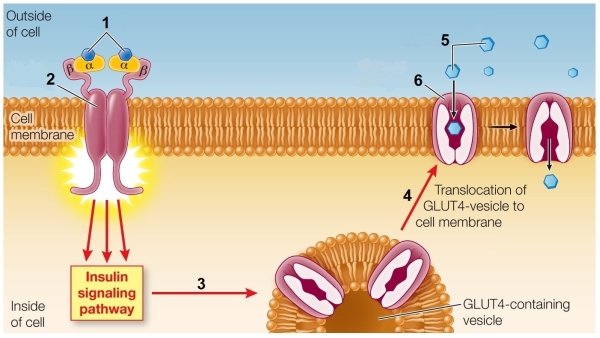 If a person has type II diabetes, she is likely to have
 (Multiple Choice)
4.8/5 (78)
(78) Parathyroid cells are inhibited from synthesizing and releasing parathyroid hormone (PTH) when circulating calcium levels are high.When calcium levels fall, the inhibition is removed, PTH is synthesized and released, and calcium levels rise in the blood until the parathyroid cells are once again inhibited.This process is an example of
(Multiple Choice)
4.7/5 (93)
(93) Which statement characterizes thyrotropin-releasing hormone (TRH)?
(Multiple Choice)
4.8/5 (81)
(81) If an embryo has a mutation that prevents the mouth from forming, it is likely that the _______ gland will not form, and the embryo will lack numerous tropic hormones.
(Short Answer)
4.9/5 (89)
(89) Which type of goiter (enlarged thyroid) can be reduced by the addition of iodine to the diet?
(Multiple Choice)
4.8/5 (70)
(70) Which part of the pituitary makes and secretes its own hormones?
(Multiple Choice)
4.9/5 (76)
(76) A lobed gland located around the front of the windpipe and controlled by a tropic hormone from the anterior pituitary is called the _______.
(Short Answer)
4.8/5 (67)
(67) If the endocrine system is likened to a cell phone system, then the best analogy for representing a receptor on a target cell would be a
(Multiple Choice)
4.7/5 (91)
(91) Refer to the figure featuring the posterior pituitary. 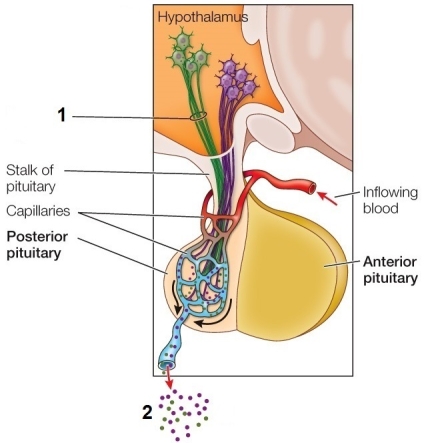 What are the structures labeled 1 in the figure, and what is their function?
 (Short Answer)
4.8/5 (66)
(66) In humans, the hormone _______ has been nicknamed the "cuddle hormone" because it increases with intimate sexual contact.
(Multiple Choice)
4.8/5 (80)
(80) When people fail to get adequate amounts of iodine in their diet, they may develop goiter.The hormone that is nonfunctional in this situation is called _______.
(Short Answer)
4.8/5 (79)
(79) Which statement relating to parathyroid hormone (PTH) and the parathyroid glands is true?
(Multiple Choice)
4.9/5 (73)
(73) If you feel constantly tired, intolerant of cold, and mentally sluggish, you should probably ask your doctor to test your _______ levels, to determine whether they are elevated, indicating you have a thyroid problem.
(Short Answer)
4.9/5 (86)
(86) Refer to the figure featuring the posterior pituitary. 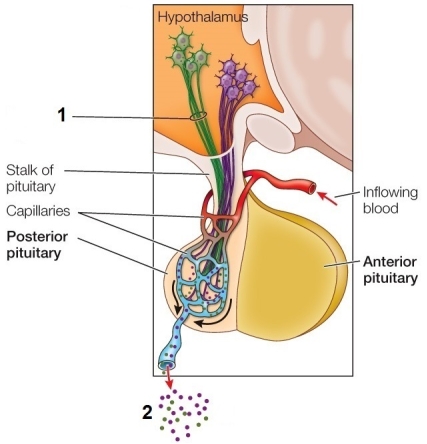 What organs in humans have receptors for the hormones represented by the dots leaving in the bloodstream at point 2?
 (Short Answer)
4.8/5 (71)
(71) Choose the correct sequence of components leading up to cortisol release.
(Multiple Choice)
4.9/5 (90)
(90) If the circulating levels of calcium are high, _______ decreases the activity of osteoclasts and favors removal of calcium from the blood and its deposition in bone by osteoblasts.
(Short Answer)
4.9/5 (73)
(73) 
Filters
- Essay(0)
- Multiple Choice(0)
- Short Answer(0)
- True False(0)
- Matching(0)