



 Chat with AI
Exam 40: Animal Hormones

Exam 1: Studying Life246 Questions
Exam 2: Small Molecules and the Chemistry of Life246 Questions
Exam 3: Proteins, Carbohydrates, and Lipids246 Questions
Exam 4: Nucleic Acids and the Origin of Life246 Questions
Exam 5: Cells: the Working Units of Life248 Questions
Exam 6: Cell Membranes246 Questions
Exam 7: Cell Communication and Multicellularity246 Questions
Exam 8: Energy, Enzymes, and Metabolism246 Questions
Exam 9: Pathways That Harvest Chemical Energy246 Questions
Exam 10: Photosynthesis: Energy From Sunlight242 Questions
Exam 11: The Cell Cycle and Cell Division260 Questions
Exam 12: Inheritance, Genes, and Chromosomes250 Questions
Exam 13: Dna and Its Role in Heredity257 Questions
Exam 14: From Dna to Protein: Gene Expression252 Questions
Exam 15: Gene Mutation and Molecular Medicine251 Questions
Exam 16: Regulation of Gene Expression245 Questions
Exam 17: Genomes249 Questions
Exam 18: Recombinant Dna and Biotechnology243 Questions
Exam 20: Mechanisms of Evolution243 Questions
Exam 21: Reconstructing and Using Phylogenies246 Questions
Exam 22: Speciation247 Questions
Exam 23: Evolution of Genes and Genomes252 Questions
Exam 24: The History of Life on Earth246 Questions
Exam 25: Bacteria, Archaea, and Viruses262 Questions
Exam 26: The Origin and Diversification of Eukaryotes252 Questions
Exam 27: Plants Without Seeds: From Water to Land251 Questions
Exam 28: The Evolution of Seed Plants259 Questions
Exam 29: The Evolution and Diversity of Fungi261 Questions
Exam 30: Animal Origins and the Evolution of Body Plans248 Questions
Exam 31: Protostome Animals244 Questions
Exam 32: Deuterostome Animals246 Questions
Exam 33: The Plant Body243 Questions
Exam 34: Transport in Plants248 Questions
Exam 35: Plant Nutrition247 Questions
Exam 36: Regulation of Plant Growth246 Questions
Exam 37: Reproduction in Flowering Plants247 Questions
Exam 38: Plant Responses to Environmental Challenges246 Questions
Exam 39: Physiology, Homeostasis, and Temperature Regulation258 Questions
Exam 40: Animal Hormones249 Questions
Exam 41: Immunology: Animal Defense Systems265 Questions
Exam 42: Animal Reproduction261 Questions
Exam 43: Animal Development261 Questions
Exam 44: Neurons, Glia, and Nervous Systems250 Questions
Exam 45: Sensory Systems249 Questions
Exam 46: The Mammalian Nervous System: Structure and Higher Functions254 Questions
Exam 47: Musculoskeletal Systems259 Questions
Exam 48: Gas Exchange247 Questions
Exam 49: Circulatory Systems252 Questions
Exam 50: Nutrition, Digestion, and Absorption259 Questions
Exam 51: Salt and Water Balance and Nitrogen Excretion251 Questions
Exam 52: Animal Behavior249 Questions
Exam 53: The Physical Environment and Biogeography of Life248 Questions
Exam 54: Populations259 Questions
Exam 55: Species Interactions254 Questions
Exam 56: Communities247 Questions
Exam 57: Ecosystems238 Questions
Exam 58: A Changing Biosphere222 Questions
Select questions type


All of these hormones are secreted by the anterior pituitary and are hormones that control the activities of other endocrine glands except
(Multiple Choice)
4.7/5  (79)
(79) What is the main conclusion drawn from pioneering experiments with the bloodsucking bug Rhodnius?
(Multiple Choice)
4.9/5 (76)
(76) In cattle, a freemartin is an infertile female with masculinized behavior that shared a placental vascular connection with its male twin.The most likely explanation for how this could occur is that
(Multiple Choice)
4.8/5 (76)
(76) Which response occurs in response to the secretion of cortisol when you are frightened by a snake on your hiking trail?
(Multiple Choice)
4.8/5 (80)
(80) Refer to the figure featuring the anterior pituitary. 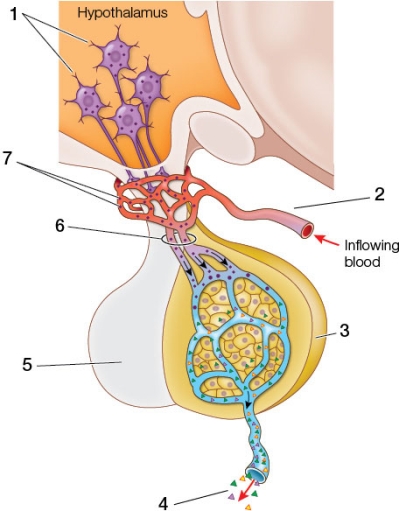 What hormones could the colored triangles at point 4 represent?
 (Essay)
4.9/5 (71)
(71) Refer to the figure showing moth metamorphosis. 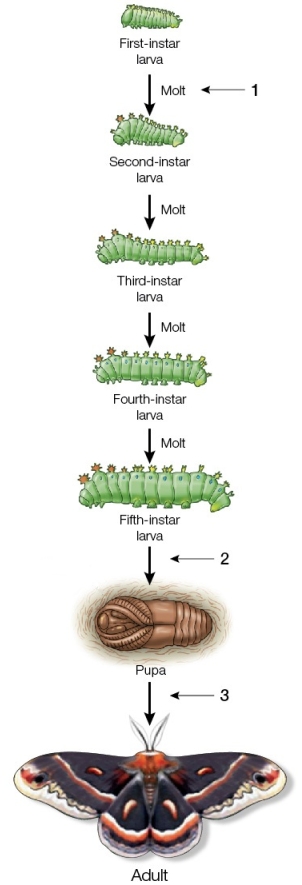 If ecdysone is experimentally blocked at arrow number _______, development will continue.
 (Short Answer)
4.8/5 (89)
(89) The two hormones that control the transition of a moth from an instar larva to an adult are
(Multiple Choice)
4.9/5 (85)
(85) Which substance is a hormone that acts primarily on cells close to the source of the hormone?
(Multiple Choice)
4.9/5 (77)
(77) Refer to the figure showing negative feedback loops regulating hormone secretion. 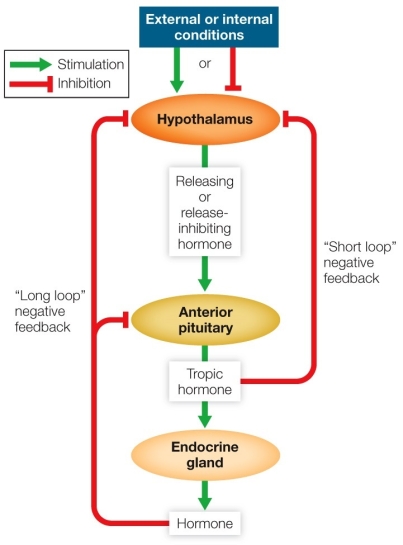 Specify the steps of a single "long-loop" negative feedback system.Identify an appropriate external or internal condition stimulating the hypothalamus.
 (Essay)
4.7/5 (78)
(78) Local or circulating hormones are capable of acting on target cells only if target cells are equipped with response components called _______.
(Short Answer)
4.9/5 (88)
(88) Pioneering experiments with Rhodnius showed that the target for a hormone produced in the Rhodnius brain is the
(Multiple Choice)
4.8/5 (76)
(76) Refer to the figure showing the thyroid gland. 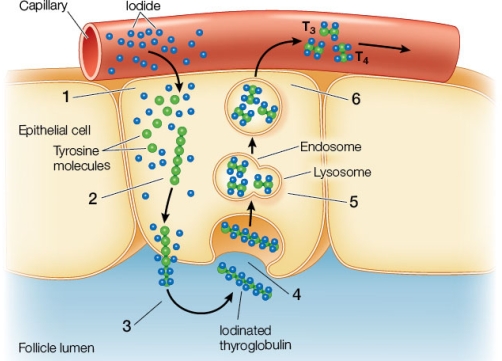 Based on the figure, what can you conclude about the synthesis of thyroxine?
 (Multiple Choice)
4.8/5 (61)
(61) Which statement about peptide and protein hormones is true?
(Multiple Choice)
4.8/5 (90)
(90) Juvenile hormone can be used as an effective control of insect populations because its continued presence causes
(Multiple Choice)
4.9/5 (73)
(73) 
Filters
- Essay(0)
- Multiple Choice(0)
- Short Answer(0)
- True False(0)
- Matching(0)