



 Chat with AI
Exam 40: Animal Hormones

Exam 1: Studying Life246 Questions
Exam 2: Small Molecules and the Chemistry of Life246 Questions
Exam 3: Proteins, Carbohydrates, and Lipids246 Questions
Exam 4: Nucleic Acids and the Origin of Life246 Questions
Exam 5: Cells: the Working Units of Life248 Questions
Exam 6: Cell Membranes246 Questions
Exam 7: Cell Communication and Multicellularity246 Questions
Exam 8: Energy, Enzymes, and Metabolism246 Questions
Exam 9: Pathways That Harvest Chemical Energy246 Questions
Exam 10: Photosynthesis: Energy From Sunlight242 Questions
Exam 11: The Cell Cycle and Cell Division260 Questions
Exam 12: Inheritance, Genes, and Chromosomes250 Questions
Exam 13: Dna and Its Role in Heredity257 Questions
Exam 14: From Dna to Protein: Gene Expression252 Questions
Exam 15: Gene Mutation and Molecular Medicine251 Questions
Exam 16: Regulation of Gene Expression245 Questions
Exam 17: Genomes249 Questions
Exam 18: Recombinant Dna and Biotechnology243 Questions
Exam 20: Mechanisms of Evolution243 Questions
Exam 21: Reconstructing and Using Phylogenies246 Questions
Exam 22: Speciation247 Questions
Exam 23: Evolution of Genes and Genomes252 Questions
Exam 24: The History of Life on Earth246 Questions
Exam 25: Bacteria, Archaea, and Viruses262 Questions
Exam 26: The Origin and Diversification of Eukaryotes252 Questions
Exam 27: Plants Without Seeds: From Water to Land251 Questions
Exam 28: The Evolution of Seed Plants259 Questions
Exam 29: The Evolution and Diversity of Fungi261 Questions
Exam 30: Animal Origins and the Evolution of Body Plans248 Questions
Exam 31: Protostome Animals244 Questions
Exam 32: Deuterostome Animals246 Questions
Exam 33: The Plant Body243 Questions
Exam 34: Transport in Plants248 Questions
Exam 35: Plant Nutrition247 Questions
Exam 36: Regulation of Plant Growth246 Questions
Exam 37: Reproduction in Flowering Plants247 Questions
Exam 38: Plant Responses to Environmental Challenges246 Questions
Exam 39: Physiology, Homeostasis, and Temperature Regulation258 Questions
Exam 40: Animal Hormones249 Questions
Exam 41: Immunology: Animal Defense Systems265 Questions
Exam 42: Animal Reproduction261 Questions
Exam 43: Animal Development261 Questions
Exam 44: Neurons, Glia, and Nervous Systems250 Questions
Exam 45: Sensory Systems249 Questions
Exam 46: The Mammalian Nervous System: Structure and Higher Functions254 Questions
Exam 47: Musculoskeletal Systems259 Questions
Exam 48: Gas Exchange247 Questions
Exam 49: Circulatory Systems252 Questions
Exam 50: Nutrition, Digestion, and Absorption259 Questions
Exam 51: Salt and Water Balance and Nitrogen Excretion251 Questions
Exam 52: Animal Behavior249 Questions
Exam 53: The Physical Environment and Biogeography of Life248 Questions
Exam 54: Populations259 Questions
Exam 55: Species Interactions254 Questions
Exam 56: Communities247 Questions
Exam 57: Ecosystems238 Questions
Exam 58: A Changing Biosphere222 Questions
Select questions type


Refer to the figure showing moth metamorphosis. 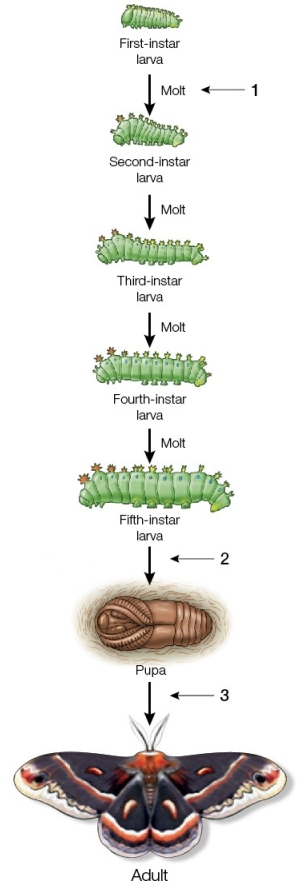 If the corpora allata are removed from the larva at the fourth-instar stage, the organism will go through another molt to become a(n) _______.
 (Short Answer)
4.9/5  (79)
(79) Patients with thyroid cancer often have the entire thyroid gland removed.What conditions can these patients develop if they don't receive hormone replacement therapy?
(Short Answer)
4.8/5 (67)
(67) Prior to the introduction of iodized table salt, it was more common to see people with goiters.If using iodized salt causes a person's goiter to disappear, what can you say about that person's condition?
(Multiple Choice)
4.8/5 (67)
(67) Thyrotropin-releasing hormone (TRH), which is secreted by the hypothalamus, causes the anterior pituitary to produce thyroid-stimulating hormone (TSH).TSH, in turn, leads the thyroid to produce thyroxine, and thyroxine eventually causes reduced TRH secretion.This chain of events is an example of _______ feedback.
(Multiple Choice)
4.8/5 (90)
(90) A hormone that helps to reduce inflammation and allergic reactions is _______.
(Short Answer)
4.9/5 (81)
(81) Rhodnius is an arthropod that can be decapitated and live for up to a year without its head.Prothoracicotropic hormone (PTTH) is a molting hormone that is stored in the head and released after a blood meal.Because of this you would expect that a Rhodnius that is decapitated within an hour of its last blood meal would
(Multiple Choice)
5.0/5 (73)
(73) If the endocrine system is likened to a television broadcasting system and hormones are the signal being broadcast, then your television would represent the _______ in the system.
(Short Answer)
4.8/5 (85)
(85) Pituitary peptide hormones that affect other endocrine glands are called _______ hormones.
(Short Answer)
4.8/5 (85)
(85) One might hypothesize that northern Native peoples, such as the Inuit, who live where sunlight is relatively limited, would suffer from increased incidences of _______ deficiency, and consequently _______.However, evidence indicates these populations have compensated for this potential deficiency by developing more sensitive receptors.
(Multiple Choice)
4.9/5 (85)
(85) Protein hormones do not cross the cell membrane, but _______ hormones do.
(Short Answer)
4.8/5 (85)
(85) If you were testing newly identified compounds for the possibility that they serve as hormones, which types of molecule would be least likely to show hormonal activity on the target cells you are testing?
(Multiple Choice)
4.8/5 (81)
(81) Hormonal and other systems in which production is shut off when the product becomes abundant are known as _______ feedback systems.
(Short Answer)
4.9/5 (86)
(86) A castaway on a deserted island puts a message in a bottle and throws it into the ocean, hoping it will wash up on some inhabited shore and bring help.In endocrine signaling, the castaway is analogous to a(n)
(Multiple Choice)
4.9/5 (61)
(61) 
Filters
- Essay(0)
- Multiple Choice(0)
- Short Answer(0)
- True False(0)
- Matching(0)