



 Chat with AI
Exam 39: Physiology, Homeostasis, and Temperature Regulation

Exam 1: Studying Life246 Questions
Exam 2: Small Molecules and the Chemistry of Life246 Questions
Exam 3: Proteins, Carbohydrates, and Lipids246 Questions
Exam 4: Nucleic Acids and the Origin of Life246 Questions
Exam 5: Cells: the Working Units of Life248 Questions
Exam 6: Cell Membranes246 Questions
Exam 7: Cell Communication and Multicellularity246 Questions
Exam 8: Energy, Enzymes, and Metabolism246 Questions
Exam 9: Pathways That Harvest Chemical Energy246 Questions
Exam 10: Photosynthesis: Energy From Sunlight242 Questions
Exam 11: The Cell Cycle and Cell Division260 Questions
Exam 12: Inheritance, Genes, and Chromosomes250 Questions
Exam 13: Dna and Its Role in Heredity257 Questions
Exam 14: From Dna to Protein: Gene Expression252 Questions
Exam 15: Gene Mutation and Molecular Medicine251 Questions
Exam 16: Regulation of Gene Expression245 Questions
Exam 17: Genomes249 Questions
Exam 18: Recombinant Dna and Biotechnology243 Questions
Exam 20: Mechanisms of Evolution243 Questions
Exam 21: Reconstructing and Using Phylogenies246 Questions
Exam 22: Speciation247 Questions
Exam 23: Evolution of Genes and Genomes252 Questions
Exam 24: The History of Life on Earth246 Questions
Exam 25: Bacteria, Archaea, and Viruses262 Questions
Exam 26: The Origin and Diversification of Eukaryotes252 Questions
Exam 27: Plants Without Seeds: From Water to Land251 Questions
Exam 28: The Evolution of Seed Plants259 Questions
Exam 29: The Evolution and Diversity of Fungi261 Questions
Exam 30: Animal Origins and the Evolution of Body Plans248 Questions
Exam 31: Protostome Animals244 Questions
Exam 32: Deuterostome Animals246 Questions
Exam 33: The Plant Body243 Questions
Exam 34: Transport in Plants248 Questions
Exam 35: Plant Nutrition247 Questions
Exam 36: Regulation of Plant Growth246 Questions
Exam 37: Reproduction in Flowering Plants247 Questions
Exam 38: Plant Responses to Environmental Challenges246 Questions
Exam 39: Physiology, Homeostasis, and Temperature Regulation258 Questions
Exam 40: Animal Hormones249 Questions
Exam 41: Immunology: Animal Defense Systems265 Questions
Exam 42: Animal Reproduction261 Questions
Exam 43: Animal Development261 Questions
Exam 44: Neurons, Glia, and Nervous Systems250 Questions
Exam 45: Sensory Systems249 Questions
Exam 46: The Mammalian Nervous System: Structure and Higher Functions254 Questions
Exam 47: Musculoskeletal Systems259 Questions
Exam 48: Gas Exchange247 Questions
Exam 49: Circulatory Systems252 Questions
Exam 50: Nutrition, Digestion, and Absorption259 Questions
Exam 51: Salt and Water Balance and Nitrogen Excretion251 Questions
Exam 52: Animal Behavior249 Questions
Exam 53: The Physical Environment and Biogeography of Life248 Questions
Exam 54: Populations259 Questions
Exam 55: Species Interactions254 Questions
Exam 56: Communities247 Questions
Exam 57: Ecosystems238 Questions
Exam 58: A Changing Biosphere222 Questions
Select questions type


Refer to the figure showing two animals. 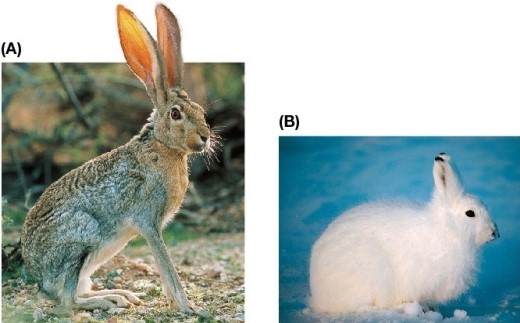 Which statement about the animals shown is most likely correct?
 (Multiple Choice)
4.9/5  (85)
(85) Refer to the graphs showing the results of an experiment in which researchers heated and cooled the hypothalamus of a mammal and determined its metabolic rates at different environmental (ambient) temperatures. 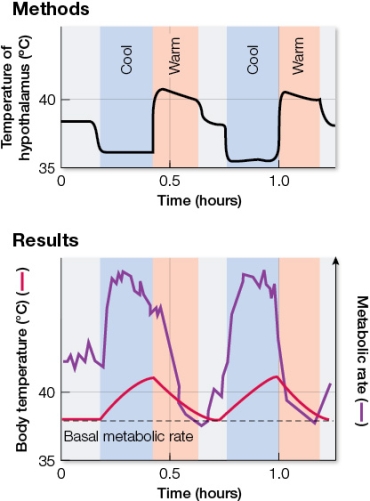 In this experiment, the hypothalamic temperature provides
 (Multiple Choice)
4.8/5 (83)
(83) Which would have the highest basal metabolic rate (BMR) per gram of tissue?
(Multiple Choice)
4.9/5 (75)
(75) Which statement about thermoregulatory set points is true?
(Multiple Choice)
4.9/5 (79)
(79) A chemical reaction has a Q10 of 2.5.At 30°C, the rate of the chemical reaction is 5.What is its rate at 40°C?
(Multiple Choice)
4.9/5 (79)
(79) Which activity would cause a decrease in the hypothalamic temperature set point for metabolic heat production?
(Multiple Choice)
4.7/5 (84)
(84) Canada geese have a countercurrent heat exchanger in their feet.It is reasonable to assume that heat is transferred
(Multiple Choice)
4.7/5 (79)
(79) The countercurrent heat exchanger of some large, rapidly swimming "hot" fish
(Multiple Choice)
4.8/5 (84)
(84) Because they _______, lizards and snakes will position themselves in the sun to warm their bodies.
(Multiple Choice)
4.8/5 (66)
(66) You measure metabolic rates of several four-toed salamanders at 20°C and at 30°C and calculate a Q10 equal to 2 for the species.Based on this information, which statement is true?
(Multiple Choice)
4.8/5 (90)
(90) Organisms that sometimes regulate their own internal temperature but sometimes allow their temperature to be determined by the environment are called
(Multiple Choice)
4.9/5 (77)
(77) Some bats maintain their internal temperatures metabolically during spring and summer but hibernate in large groups during the winter.They therefore can be considered
(Multiple Choice)
4.9/5 (72)
(72) Which feature is an important characteristic of connective tissues?
(Multiple Choice)
4.9/5 (86)
(86) 
Filters
- Essay(0)
- Multiple Choice(0)
- Short Answer(0)
- True False(0)
- Matching(0)