



 Chat with AI
Exam 39: Physiology, Homeostasis, and Temperature Regulation

Exam 1: Studying Life246 Questions
Exam 2: Small Molecules and the Chemistry of Life246 Questions
Exam 3: Proteins, Carbohydrates, and Lipids246 Questions
Exam 4: Nucleic Acids and the Origin of Life246 Questions
Exam 5: Cells: the Working Units of Life248 Questions
Exam 6: Cell Membranes246 Questions
Exam 7: Cell Communication and Multicellularity246 Questions
Exam 8: Energy, Enzymes, and Metabolism246 Questions
Exam 9: Pathways That Harvest Chemical Energy246 Questions
Exam 10: Photosynthesis: Energy From Sunlight242 Questions
Exam 11: The Cell Cycle and Cell Division260 Questions
Exam 12: Inheritance, Genes, and Chromosomes250 Questions
Exam 13: Dna and Its Role in Heredity257 Questions
Exam 14: From Dna to Protein: Gene Expression252 Questions
Exam 15: Gene Mutation and Molecular Medicine251 Questions
Exam 16: Regulation of Gene Expression245 Questions
Exam 17: Genomes249 Questions
Exam 18: Recombinant Dna and Biotechnology243 Questions
Exam 20: Mechanisms of Evolution243 Questions
Exam 21: Reconstructing and Using Phylogenies246 Questions
Exam 22: Speciation247 Questions
Exam 23: Evolution of Genes and Genomes252 Questions
Exam 24: The History of Life on Earth246 Questions
Exam 25: Bacteria, Archaea, and Viruses262 Questions
Exam 26: The Origin and Diversification of Eukaryotes252 Questions
Exam 27: Plants Without Seeds: From Water to Land251 Questions
Exam 28: The Evolution of Seed Plants259 Questions
Exam 29: The Evolution and Diversity of Fungi261 Questions
Exam 30: Animal Origins and the Evolution of Body Plans248 Questions
Exam 31: Protostome Animals244 Questions
Exam 32: Deuterostome Animals246 Questions
Exam 33: The Plant Body243 Questions
Exam 34: Transport in Plants248 Questions
Exam 35: Plant Nutrition247 Questions
Exam 36: Regulation of Plant Growth246 Questions
Exam 37: Reproduction in Flowering Plants247 Questions
Exam 38: Plant Responses to Environmental Challenges246 Questions
Exam 39: Physiology, Homeostasis, and Temperature Regulation258 Questions
Exam 40: Animal Hormones249 Questions
Exam 41: Immunology: Animal Defense Systems265 Questions
Exam 42: Animal Reproduction261 Questions
Exam 43: Animal Development261 Questions
Exam 44: Neurons, Glia, and Nervous Systems250 Questions
Exam 45: Sensory Systems249 Questions
Exam 46: The Mammalian Nervous System: Structure and Higher Functions254 Questions
Exam 47: Musculoskeletal Systems259 Questions
Exam 48: Gas Exchange247 Questions
Exam 49: Circulatory Systems252 Questions
Exam 50: Nutrition, Digestion, and Absorption259 Questions
Exam 51: Salt and Water Balance and Nitrogen Excretion251 Questions
Exam 52: Animal Behavior249 Questions
Exam 53: The Physical Environment and Biogeography of Life248 Questions
Exam 54: Populations259 Questions
Exam 55: Species Interactions254 Questions
Exam 56: Communities247 Questions
Exam 57: Ecosystems238 Questions
Exam 58: A Changing Biosphere222 Questions
Select questions type


The list below shows possible metabolic responses of a mammal to environmental temperature change.Choose the most likely response of a mammal when the environmental temperature begins at its lower critical temperature and increases by 3°C-5°C.
(Multiple Choice)
4.8/5  (80)
(80) In dissecting a mysterious structure, you find that it has a lumen lined by an epithelium surrounded by connective tissue and smooth muscle.You conclude the structure is a(n) _______ (cell, tissue, organ, or organ system) from an animal.
(Short Answer)
4.9/5 (73)
(73) If you are ill and contract a fever, the portion of your brain called the _______ has generated a new set point for your body's temperature.
(Short Answer)
4.9/5 (90)
(90) The list below shows possible metabolic responses of a mammal to environmental temperature change.Choose the most likely response of a mammal when the environmental temperature begins at its lower critical temperature and decreases by 3°C-5°C.
(Multiple Choice)
4.8/5 (75)
(75) Refer to the graph showing body temperature and heart rate in the Galápagos marine iguana as it moves from feeding in the ocean to basking on hot rocks on shore. 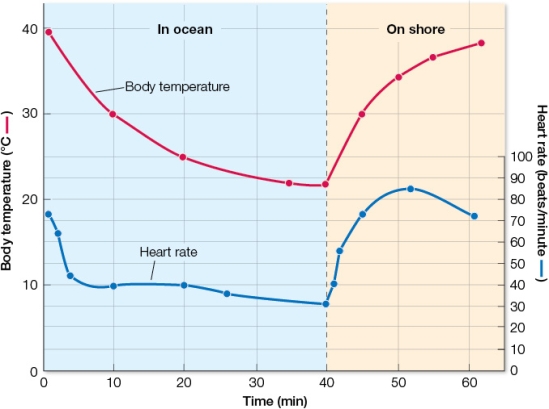 What can you conclude about this animal's body temperature and heart rate from the data?
 (Essay)
4.9/5 (80)
(80) Which is the best description of the limits of the thermoneutral zone in an endotherm?
(Multiple Choice)
4.8/5 (83)
(83) _______ are cells of the nervous system that do not generate signals.
(Multiple Choice)
4.9/5 (74)
(74) Refer to the graph showing body temperature and heart rate in the Galápagos marine iguana as it moves from feeding in the ocean to basking on hot rocks on shore. 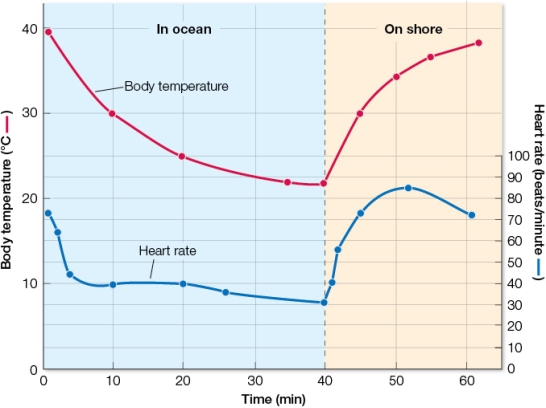 From this graph, a logical conclusion about the iguana is that
 (Multiple Choice)
4.7/5 (81)
(81) When an ectotherm and an endotherm of the same body size are held in a closed chamber and the temperature is lowered, the
(Multiple Choice)
4.8/5 (77)
(77) The list below shows possible metabolic responses of a mammal to environmental temperature change.Choose the most likely response of a mammal when the environmental temperature begins at its upper critical temperature and increases by 3°C-5°C.
(Multiple Choice)
4.7/5 (67)
(67) To calculate the sensitivity of a physiological process or reaction to temperature, you must calculate its rate both at a certain temperature and at a temperature that is lower by _______°C.
(Short Answer)
5.0/5 (80)
(80) The four major types of tissues are epithelial, muscle, nervous, and _______.
(Short Answer)
4.9/5 (79)
(79) Macrophages engulf cellular debris, microbes, cancer cells, and foreign substances, so it is advantageous for them to be large, but their size is limited by the amount of _______ they have as they grow in size.
(Short Answer)
4.8/5 (85)
(85) Compared with large mammals such as elephants and horses, small animals such as mice and shrews have
(Multiple Choice)
4.9/5 (90)
(90) 
Filters
- Essay(0)
- Multiple Choice(0)
- Short Answer(0)
- True False(0)
- Matching(0)