



 Chat with AI
Exam 39: Physiology, Homeostasis, and Temperature Regulation

Exam 1: Studying Life246 Questions
Exam 2: Small Molecules and the Chemistry of Life246 Questions
Exam 3: Proteins, Carbohydrates, and Lipids246 Questions
Exam 4: Nucleic Acids and the Origin of Life246 Questions
Exam 5: Cells: the Working Units of Life248 Questions
Exam 6: Cell Membranes246 Questions
Exam 7: Cell Communication and Multicellularity246 Questions
Exam 8: Energy, Enzymes, and Metabolism246 Questions
Exam 9: Pathways That Harvest Chemical Energy246 Questions
Exam 10: Photosynthesis: Energy From Sunlight242 Questions
Exam 11: The Cell Cycle and Cell Division260 Questions
Exam 12: Inheritance, Genes, and Chromosomes250 Questions
Exam 13: Dna and Its Role in Heredity257 Questions
Exam 14: From Dna to Protein: Gene Expression252 Questions
Exam 15: Gene Mutation and Molecular Medicine251 Questions
Exam 16: Regulation of Gene Expression245 Questions
Exam 17: Genomes249 Questions
Exam 18: Recombinant Dna and Biotechnology243 Questions
Exam 20: Mechanisms of Evolution243 Questions
Exam 21: Reconstructing and Using Phylogenies246 Questions
Exam 22: Speciation247 Questions
Exam 23: Evolution of Genes and Genomes252 Questions
Exam 24: The History of Life on Earth246 Questions
Exam 25: Bacteria, Archaea, and Viruses262 Questions
Exam 26: The Origin and Diversification of Eukaryotes252 Questions
Exam 27: Plants Without Seeds: From Water to Land251 Questions
Exam 28: The Evolution of Seed Plants259 Questions
Exam 29: The Evolution and Diversity of Fungi261 Questions
Exam 30: Animal Origins and the Evolution of Body Plans248 Questions
Exam 31: Protostome Animals244 Questions
Exam 32: Deuterostome Animals246 Questions
Exam 33: The Plant Body243 Questions
Exam 34: Transport in Plants248 Questions
Exam 35: Plant Nutrition247 Questions
Exam 36: Regulation of Plant Growth246 Questions
Exam 37: Reproduction in Flowering Plants247 Questions
Exam 38: Plant Responses to Environmental Challenges246 Questions
Exam 39: Physiology, Homeostasis, and Temperature Regulation258 Questions
Exam 40: Animal Hormones249 Questions
Exam 41: Immunology: Animal Defense Systems265 Questions
Exam 42: Animal Reproduction261 Questions
Exam 43: Animal Development261 Questions
Exam 44: Neurons, Glia, and Nervous Systems250 Questions
Exam 45: Sensory Systems249 Questions
Exam 46: The Mammalian Nervous System: Structure and Higher Functions254 Questions
Exam 47: Musculoskeletal Systems259 Questions
Exam 48: Gas Exchange247 Questions
Exam 49: Circulatory Systems252 Questions
Exam 50: Nutrition, Digestion, and Absorption259 Questions
Exam 51: Salt and Water Balance and Nitrogen Excretion251 Questions
Exam 52: Animal Behavior249 Questions
Exam 53: The Physical Environment and Biogeography of Life248 Questions
Exam 54: Populations259 Questions
Exam 55: Species Interactions254 Questions
Exam 56: Communities247 Questions
Exam 57: Ecosystems238 Questions
Exam 58: A Changing Biosphere222 Questions
Select questions type


How does seasonal acclimatization affect an animal's long-term versus short-term sensitivity to environmental temperature changes?
(Essay)
4.8/5  (78)
(78) The strength of the connections between bones is most likely due to the protein
(Multiple Choice)
4.9/5 (92)
(92) Refer to the graph. 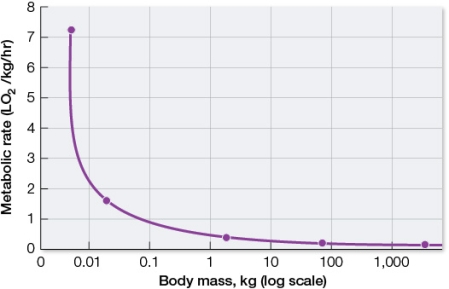 Arrange these animals on the graph by writing the name of each animal next to an appropriate dot on the graph: cat, elephant, human, mouse, shrew.What conclusion can you draw from this graph?
 (Essay)
4.9/5 (69)
(69) In order to survive, multicellular animals such as earthworms had to evolve methods ensuring that internal cells not in contact with the external environment were in contact with _______.
(Short Answer)
4.7/5 (66)
(66) Your body is 60 percent water, two-thirds of which is intracellular fluid.If you weigh 150 pounds, about how much of your weight is due to water contained within your cells?
(Multiple Choice)
4.9/5 (86)
(86) You feel cooler when standing directly in front of a fan, because heat is transferred away from your body by
(Multiple Choice)
4.9/5 (83)
(83) Heat is transferred from an animal's core to its surface primarily by
(Multiple Choice)
4.8/5 (82)
(82) You are a graduate student on an expedition studying animals in an area of a national park that is about to be opened to the public for recreation and limited logging.Part of this study is to survey and describe the mammalian life in the area.You find a small rodent that has a short tail, copious brown fat deposits, and oil in its fur.From these anatomical features, what can you infer about this animal?
(Multiple Choice)
4.8/5 (79)
(79) Which occurs when the mammalian hypothalamus is directly cooled during an experiment?
(Multiple Choice)
4.9/5 (74)
(74) The upper temperature limit at which cells can function is determined by the _______ point of _______.
(Multiple Choice)
4.9/5 (78)
(78) Refer to the graph showing the body temperatures of different types of organisms in the same environmental temperatures.  The reaction of a lizard to different environmental temperatures is represented by the curve labeled _______.When the lizard is at the environmental temperature marked by an asterisk (*) on the x axis, the lizard might _______.
 (Multiple Choice)
4.9/5 (80)
(80) In human babies, nonshivering heat production occurs in the adipose tissue called _______.
(Short Answer)
4.7/5 (86)
(86) The hypothalamus serves in part as an integrated thermoregulatory center defining an organism's response to changes in its thermal environment.Because the hypothalamus normally serves to produce metabolic responses that reverse the direction of environmental temperature change, the control it exerts is termed
(Multiple Choice)
4.8/5 (72)
(72) Endotherms invest energy to maintain their body temperatures across the range of environmental temperatures they encounter, except in the range of environmental temperatures
(Multiple Choice)
4.9/5 (84)
(84) When a condition of below-normal body temperature is regulated, lasts for days or weeks, and is characterized by very low body temperatures, it is called _______.
(Short Answer)
4.8/5 (79)
(79) While working in a laboratory, you are shown a slide containing animal tissue composed of long cells with a regular array of cross striations.The nuclei of the cells are pressed up against the sides of the cells.You are told this is an abundant tissue type in the body.What is the major function of this tissue?
(Multiple Choice)
4.8/5 (90)
(90) Which feature is an important adaptation of animals to cold climates?
(Multiple Choice)
4.8/5 (81)
(81) 
Filters
- Essay(0)
- Multiple Choice(0)
- Short Answer(0)
- True False(0)
- Matching(0)