



 Chat with AI
Exam 39: Physiology, Homeostasis, and Temperature Regulation

Exam 1: Studying Life246 Questions
Exam 2: Small Molecules and the Chemistry of Life246 Questions
Exam 3: Proteins, Carbohydrates, and Lipids246 Questions
Exam 4: Nucleic Acids and the Origin of Life246 Questions
Exam 5: Cells: the Working Units of Life248 Questions
Exam 6: Cell Membranes246 Questions
Exam 7: Cell Communication and Multicellularity246 Questions
Exam 8: Energy, Enzymes, and Metabolism246 Questions
Exam 9: Pathways That Harvest Chemical Energy246 Questions
Exam 10: Photosynthesis: Energy From Sunlight242 Questions
Exam 11: The Cell Cycle and Cell Division260 Questions
Exam 12: Inheritance, Genes, and Chromosomes250 Questions
Exam 13: Dna and Its Role in Heredity257 Questions
Exam 14: From Dna to Protein: Gene Expression252 Questions
Exam 15: Gene Mutation and Molecular Medicine251 Questions
Exam 16: Regulation of Gene Expression245 Questions
Exam 17: Genomes249 Questions
Exam 18: Recombinant Dna and Biotechnology243 Questions
Exam 20: Mechanisms of Evolution243 Questions
Exam 21: Reconstructing and Using Phylogenies246 Questions
Exam 22: Speciation247 Questions
Exam 23: Evolution of Genes and Genomes252 Questions
Exam 24: The History of Life on Earth246 Questions
Exam 25: Bacteria, Archaea, and Viruses262 Questions
Exam 26: The Origin and Diversification of Eukaryotes252 Questions
Exam 27: Plants Without Seeds: From Water to Land251 Questions
Exam 28: The Evolution of Seed Plants259 Questions
Exam 29: The Evolution and Diversity of Fungi261 Questions
Exam 30: Animal Origins and the Evolution of Body Plans248 Questions
Exam 31: Protostome Animals244 Questions
Exam 32: Deuterostome Animals246 Questions
Exam 33: The Plant Body243 Questions
Exam 34: Transport in Plants248 Questions
Exam 35: Plant Nutrition247 Questions
Exam 36: Regulation of Plant Growth246 Questions
Exam 37: Reproduction in Flowering Plants247 Questions
Exam 38: Plant Responses to Environmental Challenges246 Questions
Exam 39: Physiology, Homeostasis, and Temperature Regulation258 Questions
Exam 40: Animal Hormones249 Questions
Exam 41: Immunology: Animal Defense Systems265 Questions
Exam 42: Animal Reproduction261 Questions
Exam 43: Animal Development261 Questions
Exam 44: Neurons, Glia, and Nervous Systems250 Questions
Exam 45: Sensory Systems249 Questions
Exam 46: The Mammalian Nervous System: Structure and Higher Functions254 Questions
Exam 47: Musculoskeletal Systems259 Questions
Exam 48: Gas Exchange247 Questions
Exam 49: Circulatory Systems252 Questions
Exam 50: Nutrition, Digestion, and Absorption259 Questions
Exam 51: Salt and Water Balance and Nitrogen Excretion251 Questions
Exam 52: Animal Behavior249 Questions
Exam 53: The Physical Environment and Biogeography of Life248 Questions
Exam 54: Populations259 Questions
Exam 55: Species Interactions254 Questions
Exam 56: Communities247 Questions
Exam 57: Ecosystems238 Questions
Exam 58: A Changing Biosphere222 Questions
Select questions type


Rainbow trout use acetylcholinesterase to break down the neurotransmitter acetylcholine.Researchers measured the rate at which this happened at 17°C and after the fish was acclimatized to 2°C.Their results showed that the rate was close to the same at both temperatures.Which is the most likely explanation for this result?
(Multiple Choice)
4.9/5  (73)
(73) Suppose your car represents a physiological system.The desired speed of your car is
(Multiple Choice)
4.8/5 (79)
(79) Some birds, such as swifts, can lower their body temperature during periods of inactivity, which is an example of _______ hypothermia.
(Short Answer)
4.9/5 (85)
(85) If you test the maximal tension a person can exert in her skeletal muscles at 35°C, it will be close to what she can exert at 25°C.But if she falls into icy water that is about 15°C, her ability to exert maximal tension in her skeletal muscles decreases sharply to about 30% of what she can exert at 25°C.From these data, you can conclude that the Q10 value of exerting maximal tension in humans
(Multiple Choice)
4.9/5 (69)
(69) Refer to the figure.  If you were running very fast, which of these tissues would tire most quickly?
 (Multiple Choice)
4.9/5 (73)
(73) Refer to the graph. 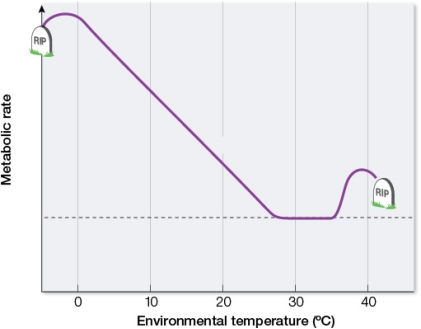 If the plot shows data collected from an experiment on a dog, at which environmental temperature does the dog expend energy to lose heat?
 (Multiple Choice)
4.9/5 (82)
(82) In an organ that secretes saliva, the tissue secreting the saliva is epithelial, and the tissue providing support for the organ is _______.
(Short Answer)
4.8/5 (83)
(83) Which Q10 value indicates that a reaction is not temperature sensitive?
(Multiple Choice)
4.9/5 (67)
(67) Most biological Q10 values are between _______ and _______.
(Multiple Choice)
4.8/5 (80)
(80) Refer to the graph showing data collected from a mouse exposed to different ambient temperatures. 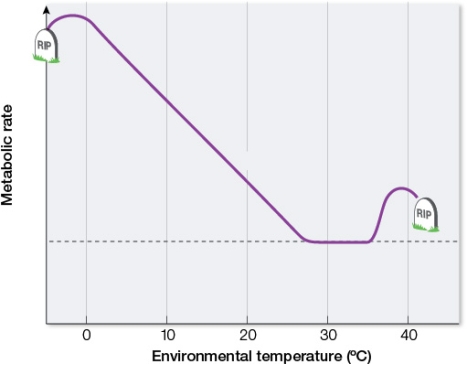 What is the mouse's lower critical temperature?
 (Multiple Choice)
4.8/5 (74)
(74) The temperature sensitivity of a physiological process or reaction is described in terms of its _______ value.
(Short Answer)
4.8/5 (75)
(75) Refer to the figure showing the results of an experiment on a ground squirrel.Experimenters used a probe to directly heat or cool the squirrel's hypothalamus and measured the animal's metabolic rate and body temperature in response to this manipulation. 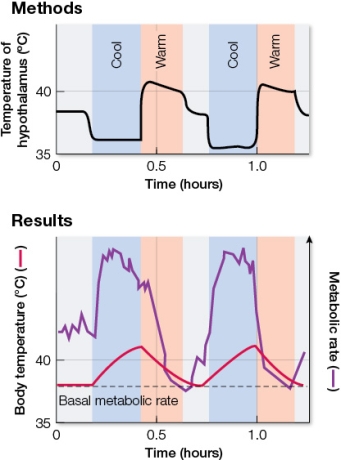 A reasonable conclusion from these results is that the hypothalamus acts as a thermostat, controlling _______.
 (Short Answer)
4.9/5 (74)
(74) Refer to the figure.  Which part of the figure shows the tissue most likely to be found lining ducts or tubules with a transport function?
 (Multiple Choice)
4.8/5 (82)
(82) 
Filters
- Essay(0)
- Multiple Choice(0)
- Short Answer(0)
- True False(0)
- Matching(0)