



 Chat with AI
Exam 39: Physiology, Homeostasis, and Temperature Regulation

Exam 1: Studying Life246 Questions
Exam 2: Small Molecules and the Chemistry of Life246 Questions
Exam 3: Proteins, Carbohydrates, and Lipids246 Questions
Exam 4: Nucleic Acids and the Origin of Life246 Questions
Exam 5: Cells: the Working Units of Life248 Questions
Exam 6: Cell Membranes246 Questions
Exam 7: Cell Communication and Multicellularity246 Questions
Exam 8: Energy, Enzymes, and Metabolism246 Questions
Exam 9: Pathways That Harvest Chemical Energy246 Questions
Exam 10: Photosynthesis: Energy From Sunlight242 Questions
Exam 11: The Cell Cycle and Cell Division260 Questions
Exam 12: Inheritance, Genes, and Chromosomes250 Questions
Exam 13: Dna and Its Role in Heredity257 Questions
Exam 14: From Dna to Protein: Gene Expression252 Questions
Exam 15: Gene Mutation and Molecular Medicine251 Questions
Exam 16: Regulation of Gene Expression245 Questions
Exam 17: Genomes249 Questions
Exam 18: Recombinant Dna and Biotechnology243 Questions
Exam 20: Mechanisms of Evolution243 Questions
Exam 21: Reconstructing and Using Phylogenies246 Questions
Exam 22: Speciation247 Questions
Exam 23: Evolution of Genes and Genomes252 Questions
Exam 24: The History of Life on Earth246 Questions
Exam 25: Bacteria, Archaea, and Viruses262 Questions
Exam 26: The Origin and Diversification of Eukaryotes252 Questions
Exam 27: Plants Without Seeds: From Water to Land251 Questions
Exam 28: The Evolution of Seed Plants259 Questions
Exam 29: The Evolution and Diversity of Fungi261 Questions
Exam 30: Animal Origins and the Evolution of Body Plans248 Questions
Exam 31: Protostome Animals244 Questions
Exam 32: Deuterostome Animals246 Questions
Exam 33: The Plant Body243 Questions
Exam 34: Transport in Plants248 Questions
Exam 35: Plant Nutrition247 Questions
Exam 36: Regulation of Plant Growth246 Questions
Exam 37: Reproduction in Flowering Plants247 Questions
Exam 38: Plant Responses to Environmental Challenges246 Questions
Exam 39: Physiology, Homeostasis, and Temperature Regulation258 Questions
Exam 40: Animal Hormones249 Questions
Exam 41: Immunology: Animal Defense Systems265 Questions
Exam 42: Animal Reproduction261 Questions
Exam 43: Animal Development261 Questions
Exam 44: Neurons, Glia, and Nervous Systems250 Questions
Exam 45: Sensory Systems249 Questions
Exam 46: The Mammalian Nervous System: Structure and Higher Functions254 Questions
Exam 47: Musculoskeletal Systems259 Questions
Exam 48: Gas Exchange247 Questions
Exam 49: Circulatory Systems252 Questions
Exam 50: Nutrition, Digestion, and Absorption259 Questions
Exam 51: Salt and Water Balance and Nitrogen Excretion251 Questions
Exam 52: Animal Behavior249 Questions
Exam 53: The Physical Environment and Biogeography of Life248 Questions
Exam 54: Populations259 Questions
Exam 55: Species Interactions254 Questions
Exam 56: Communities247 Questions
Exam 57: Ecosystems238 Questions
Exam 58: A Changing Biosphere222 Questions
Select questions type


Refer to the figure. 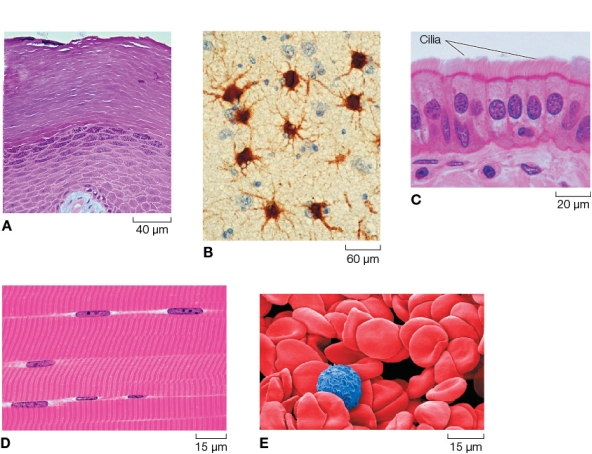 If you scrape your knuckle, you will damage tissue shown in A, called _______.
 (Short Answer)
4.8/5  (70)
(70) Refer to the graph. 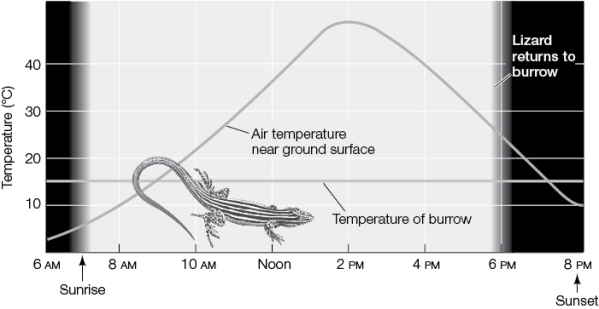 Draw a line on the graph showing the lizard's predicted body temperature based on your knowledge of how ectotherms regulate their temperature with behavior.Explain why the line looks the way it does.
 (Essay)
4.8/5 (77)
(77) Refer to the graph showing body temperature and heart rate in the Galápagos marine iguana as it moves from feeding in the ocean to basking on hot rocks on shore. 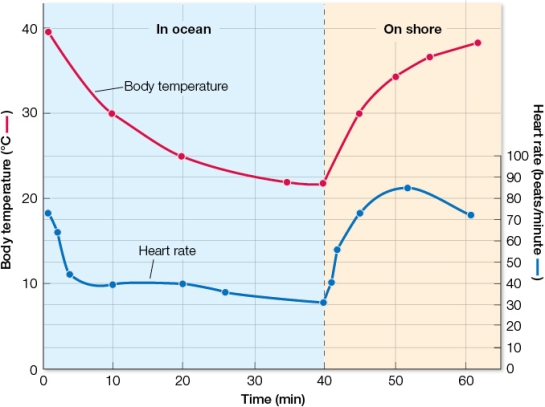 If you saw a Galápagos marine iguana sunning itself for over an hour on warm rocks, you would expect its body temperature to be around _______ and its heart rate to be around _______.
 (Short Answer)
4.9/5 (61)
(61) A high school cross-country runner ignores her coach's rule about drinking water and taking breaks regularly.She overheats and collapses.The paramedics that come to her aid will most likely
(Multiple Choice)
4.9/5 (80)
(80) Refer to the graph showing body temperature and heart rate in the Galápagos marine iguana as it moves from feeding in the ocean to basking on hot rocks on shore. 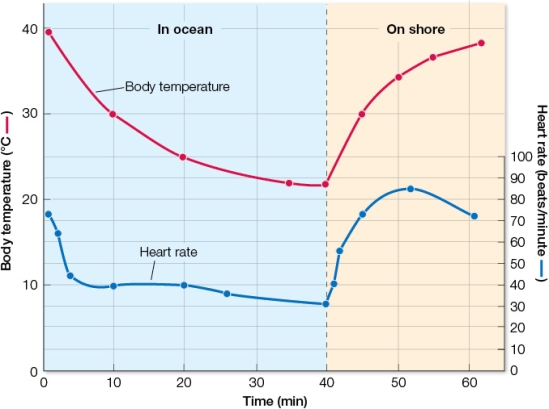 What is the heart rate of the iguana when its body temperature is 30°C in the ocean and when it is 30°C after coming out on land? How could this change in heart rate be related to the rate of warming of the iguana's body when moving from the water to land?
 (Essay)
4.8/5 (77)
(77) You are working in a lab and discover a hibernating animal with a mutation that does not allow it to develop brown fat.If this animal were in the wild, what would be the most severe problem it might face?
(Multiple Choice)
4.8/5 (61)
(61) Red-tailed hawks drop their body temperature at night by 2°C-4°C.This is an example of ________, which is different from the _______ experienced by humans when under anesthesia.
(Multiple Choice)
4.9/5 (82)
(82) Researchers have found that king penguin chicks can drop the temperature of their internal organs by more than 15°C but then maintain the lower temperature metabolically.These birds can therefore be characterized as
(Multiple Choice)
4.9/5 (82)
(82) In humans, prolactin is involved in the production of milk from the breast.When a mother is breastfeeding, the suckling of the baby on the nipple sends a nerve response to the mother's brain, which stimulates the pituitary gland to secrete more prolactin.This, in turn, causes more milk to be produced.This is an example of
(Multiple Choice)
4.8/5 (82)
(82) At the end of the summer you notice that a cool breeze signaling the approach of autumn is actually at a temperature that felt warm when you encountered it the previous winter.Which hypothesis best explains this observation?
(Multiple Choice)
4.8/5 (75)
(75) Refer to the figure. 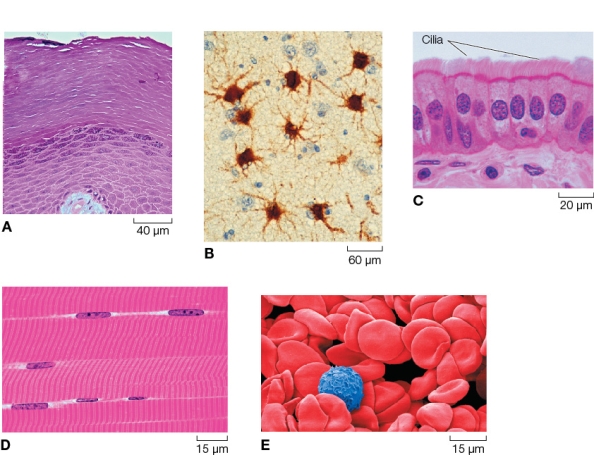 Two tissues you would find in your lungs are shown in _______.
 (Short Answer)
4.8/5 (81)
(81) Which characteristic would you expect to find in endotherms living in colder climates compared with their close relatives living in warmer climates?
(Multiple Choice)
4.9/5 (81)
(81) The elephant is better adapted to the temperatures of tropical habitats than those of polar climates because of its
(Multiple Choice)
4.8/5 (85)
(85) The list below shows possible metabolic responses of a mammal to environmental temperature change.Choose the most likely response of a mammal when the environmental temperature begins at its upper critical temperature and decreases by 3°C-5°.
(Multiple Choice)
4.9/5 (77)
(77) The metabolic rate of a resting endotherm at a temperature within the thermoneutral zone is called the _______ metabolic rate.
(Short Answer)
5.0/5 (68)
(68) 
Filters
- Essay(0)
- Multiple Choice(0)
- Short Answer(0)
- True False(0)
- Matching(0)