



 Chat with AI
Exam 39: Physiology, Homeostasis, and Temperature Regulation

Exam 1: Studying Life246 Questions
Exam 2: Small Molecules and the Chemistry of Life246 Questions
Exam 3: Proteins, Carbohydrates, and Lipids246 Questions
Exam 4: Nucleic Acids and the Origin of Life246 Questions
Exam 5: Cells: the Working Units of Life248 Questions
Exam 6: Cell Membranes246 Questions
Exam 7: Cell Communication and Multicellularity246 Questions
Exam 8: Energy, Enzymes, and Metabolism246 Questions
Exam 9: Pathways That Harvest Chemical Energy246 Questions
Exam 10: Photosynthesis: Energy From Sunlight242 Questions
Exam 11: The Cell Cycle and Cell Division260 Questions
Exam 12: Inheritance, Genes, and Chromosomes250 Questions
Exam 13: Dna and Its Role in Heredity257 Questions
Exam 14: From Dna to Protein: Gene Expression252 Questions
Exam 15: Gene Mutation and Molecular Medicine251 Questions
Exam 16: Regulation of Gene Expression245 Questions
Exam 17: Genomes249 Questions
Exam 18: Recombinant Dna and Biotechnology243 Questions
Exam 20: Mechanisms of Evolution243 Questions
Exam 21: Reconstructing and Using Phylogenies246 Questions
Exam 22: Speciation247 Questions
Exam 23: Evolution of Genes and Genomes252 Questions
Exam 24: The History of Life on Earth246 Questions
Exam 25: Bacteria, Archaea, and Viruses262 Questions
Exam 26: The Origin and Diversification of Eukaryotes252 Questions
Exam 27: Plants Without Seeds: From Water to Land251 Questions
Exam 28: The Evolution of Seed Plants259 Questions
Exam 29: The Evolution and Diversity of Fungi261 Questions
Exam 30: Animal Origins and the Evolution of Body Plans248 Questions
Exam 31: Protostome Animals244 Questions
Exam 32: Deuterostome Animals246 Questions
Exam 33: The Plant Body243 Questions
Exam 34: Transport in Plants248 Questions
Exam 35: Plant Nutrition247 Questions
Exam 36: Regulation of Plant Growth246 Questions
Exam 37: Reproduction in Flowering Plants247 Questions
Exam 38: Plant Responses to Environmental Challenges246 Questions
Exam 39: Physiology, Homeostasis, and Temperature Regulation258 Questions
Exam 40: Animal Hormones249 Questions
Exam 41: Immunology: Animal Defense Systems265 Questions
Exam 42: Animal Reproduction261 Questions
Exam 43: Animal Development261 Questions
Exam 44: Neurons, Glia, and Nervous Systems250 Questions
Exam 45: Sensory Systems249 Questions
Exam 46: The Mammalian Nervous System: Structure and Higher Functions254 Questions
Exam 47: Musculoskeletal Systems259 Questions
Exam 48: Gas Exchange247 Questions
Exam 49: Circulatory Systems252 Questions
Exam 50: Nutrition, Digestion, and Absorption259 Questions
Exam 51: Salt and Water Balance and Nitrogen Excretion251 Questions
Exam 52: Animal Behavior249 Questions
Exam 53: The Physical Environment and Biogeography of Life248 Questions
Exam 54: Populations259 Questions
Exam 55: Species Interactions254 Questions
Exam 56: Communities247 Questions
Exam 57: Ecosystems238 Questions
Exam 58: A Changing Biosphere222 Questions
Select questions type


Refer to the figure.  When the dentist drills your tooth and you feel a sudden sharp pain, what type of cell has carried that pain information to your brain?
 (Multiple Choice)
4.9/5  (79)
(79) The metabolic rate of a mammal resting at a temperature within its thermoneutral zone is
(Multiple Choice)
4.9/5 (79)
(79) Refer to the figure. 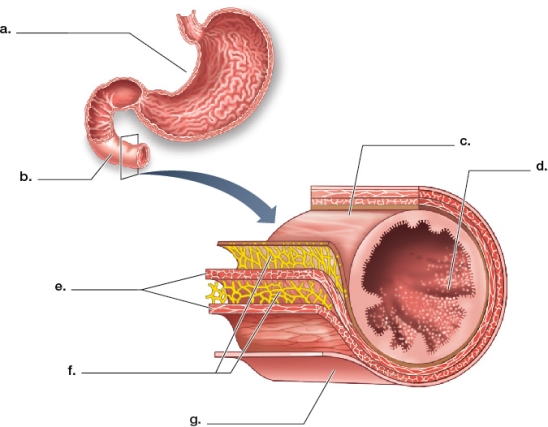 Use the following terms to label the organs and four main tissue types in the figure: connective tissue, epithelial cells, mucosa, nervous tissue, small intestine, smooth muscle, stomach.(Note: Terms may be used more than once.)
 (Short Answer)
4.8/5 (86)
(86) Refer to the graph. 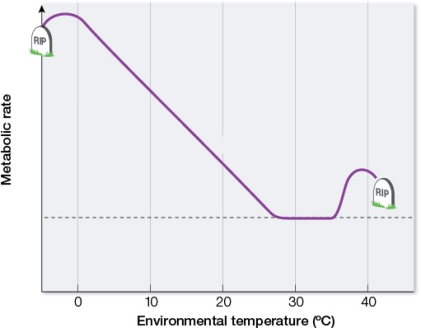 If the plot shows data collected from an experiment on a dog, at which environmental temperature(s) is the metabolism of the dog at its basal metabolic rate (BMR)?
 (Multiple Choice)
4.8/5 (69)
(69) Refer to the graph showing the body temperatures of different types of organisms in the same environmental temperatures.  The reaction of a mouse to different environmental temperatures is represented by the curve labeled _______.When the mouse is at the environmental temperature marked by an X on the x axis, the mouse might _______.
 (Multiple Choice)
4.7/5 (69)
(69) If a woman has about 3 liters of blood plasma, then she will have about _______ liters of interstitial fluid, the fluid that bathes all her cells.
(Short Answer)
4.8/5 (70)
(70) Which type of tissue is responsible for secreting digestive enzymes?
(Multiple Choice)
4.8/5 (78)
(78) Which parameters do physiologists use to measure metabolic rate?
(Multiple Choice)
4.9/5 (90)
(90) Suppose an airline pilot sets an aircraft's engines to produce a velocity of 450 mph and measures that speed using an instrument on the outside of the plane.When another pilot reports turbulence ahead, the pilot changes the velocity set point to 350 mph.The other pilot is providing
(Multiple Choice)
4.7/5 (87)
(87) Which is an adaptation used by endotherms, but not by ectotherms, to produce an increase in body temperature?
(Multiple Choice)
4.8/5 (66)
(66) A lizard lives in a temperate desert environment where the temperature is cold at night and warm during the day.In order for the lizard to maintain the most stable body temperature, it would most likely
(Multiple Choice)
4.8/5 (86)
(86) Refer to the graph showing how different types of organisms respond to changes in environmental temperature. 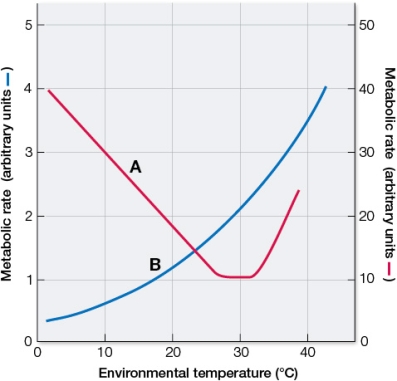 One of these curves represents a lizard, and the other represents a mouse.Which curve corresponds to which animal? At what environmental temperatures are the metabolic rates of the lizard the highest and the lowest? At what environmental temperatures are the metabolic rates of the mouse the highest and the lowest?
 (Essay)
4.9/5 (65)
(65) 
Filters
- Essay(0)
- Multiple Choice(0)
- Short Answer(0)
- True False(0)
- Matching(0)