



 Chat with AI
Exam 39: Physiology, Homeostasis, and Temperature Regulation

Exam 1: Studying Life246 Questions
Exam 2: Small Molecules and the Chemistry of Life246 Questions
Exam 3: Proteins, Carbohydrates, and Lipids246 Questions
Exam 4: Nucleic Acids and the Origin of Life246 Questions
Exam 5: Cells: the Working Units of Life248 Questions
Exam 6: Cell Membranes246 Questions
Exam 7: Cell Communication and Multicellularity246 Questions
Exam 8: Energy, Enzymes, and Metabolism246 Questions
Exam 9: Pathways That Harvest Chemical Energy246 Questions
Exam 10: Photosynthesis: Energy From Sunlight242 Questions
Exam 11: The Cell Cycle and Cell Division260 Questions
Exam 12: Inheritance, Genes, and Chromosomes250 Questions
Exam 13: Dna and Its Role in Heredity257 Questions
Exam 14: From Dna to Protein: Gene Expression252 Questions
Exam 15: Gene Mutation and Molecular Medicine251 Questions
Exam 16: Regulation of Gene Expression245 Questions
Exam 17: Genomes249 Questions
Exam 18: Recombinant Dna and Biotechnology243 Questions
Exam 20: Mechanisms of Evolution243 Questions
Exam 21: Reconstructing and Using Phylogenies246 Questions
Exam 22: Speciation247 Questions
Exam 23: Evolution of Genes and Genomes252 Questions
Exam 24: The History of Life on Earth246 Questions
Exam 25: Bacteria, Archaea, and Viruses262 Questions
Exam 26: The Origin and Diversification of Eukaryotes252 Questions
Exam 27: Plants Without Seeds: From Water to Land251 Questions
Exam 28: The Evolution of Seed Plants259 Questions
Exam 29: The Evolution and Diversity of Fungi261 Questions
Exam 30: Animal Origins and the Evolution of Body Plans248 Questions
Exam 31: Protostome Animals244 Questions
Exam 32: Deuterostome Animals246 Questions
Exam 33: The Plant Body243 Questions
Exam 34: Transport in Plants248 Questions
Exam 35: Plant Nutrition247 Questions
Exam 36: Regulation of Plant Growth246 Questions
Exam 37: Reproduction in Flowering Plants247 Questions
Exam 38: Plant Responses to Environmental Challenges246 Questions
Exam 39: Physiology, Homeostasis, and Temperature Regulation258 Questions
Exam 40: Animal Hormones249 Questions
Exam 41: Immunology: Animal Defense Systems265 Questions
Exam 42: Animal Reproduction261 Questions
Exam 43: Animal Development261 Questions
Exam 44: Neurons, Glia, and Nervous Systems250 Questions
Exam 45: Sensory Systems249 Questions
Exam 46: The Mammalian Nervous System: Structure and Higher Functions254 Questions
Exam 47: Musculoskeletal Systems259 Questions
Exam 48: Gas Exchange247 Questions
Exam 49: Circulatory Systems252 Questions
Exam 50: Nutrition, Digestion, and Absorption259 Questions
Exam 51: Salt and Water Balance and Nitrogen Excretion251 Questions
Exam 52: Animal Behavior249 Questions
Exam 53: The Physical Environment and Biogeography of Life248 Questions
Exam 54: Populations259 Questions
Exam 55: Species Interactions254 Questions
Exam 56: Communities247 Questions
Exam 57: Ecosystems238 Questions
Exam 58: A Changing Biosphere222 Questions
Select questions type


Which is most likely to occur if a baby bat's hypothalamus is experimentally cooled using an implanted probe?
(Multiple Choice)
5.0/5  (88)
(88) Refer to the figure showing the results of an experiment on a ground squirrel.Experimenters used a probe to directly heat or cool the squirrel's hypothalamus and measured the animal's metabolic rate and body temperature in response to this manipulation. 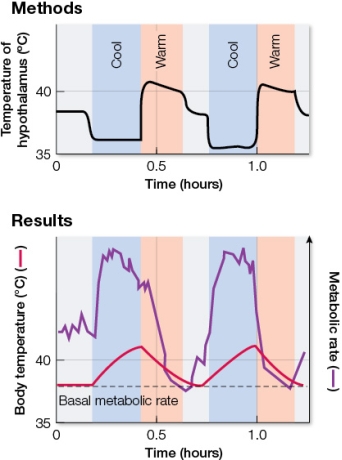 When the hypothalamus was cooled, the squirrel's metabolic rate and body temperature _______.
 (Short Answer)
4.8/5 (83)
(83) Organisms that depend largely on external sources of heat to maintain body temperature are called
(Multiple Choice)
4.9/5 (81)
(81) If a cancer patient develops a fever of 104°F, it is likely that a physician will prescribe a treatment to lower the patient's temperature because
(Multiple Choice)
5.0/5 (87)
(87) Which of the following would serve to change the set point of a regulatory system?
(Multiple Choice)
4.7/5 (71)
(71) Heterotherms differ from endotherms in that only heterotherms
(Multiple Choice)
4.8/5 (84)
(84) The reactions that make up animal metabolism are not equally sensitive to temperature.Which value reflects that fact?
(Multiple Choice)
4.9/5 (79)
(79) A weight lifter does multiple sets of bench presses, as many repetitions per set as she can.If she cools her palms while resting between sets, she can increase the total number of lifts she can complete in her workout.The most likely explanation for this is that
(Multiple Choice)
4.8/5 (82)
(82) The maintenance of stable physiological conditions in the internal environment of an organism is called _______.
(Short Answer)
4.9/5 (84)
(84) Tissues that secrete digestive juices into the gut are composed of
(Multiple Choice)
5.0/5 (89)
(89) While you sit quietly on a warm beach, a breeze picks up and you suddenly feel cold.This loss of body heat is most likely due to
(Multiple Choice)
4.8/5 (77)
(77) Which situation would not be suitable for obtaining an accurate measurement of a mammal's basal metabolic rate?
(Multiple Choice)
4.8/5 (67)
(67) When you start exercising, your breathing rate and heart rate increase in anticipation of the additional oxygen your muscles will need.Is this an example of negative feedback, positive feedback, or a feedforward control mechanism? Explain your answer.
(Essay)
5.0/5 (88)
(88) Which of the following would be stimulated by a rise in a mammal's hypothalamic temperature?
(Multiple Choice)
4.7/5 (73)
(73) The list below shows possible metabolic responses of a mammal to environmental temperature change.Choose the most likely response of a mammal when the environmental temperature increases far above 50°C.
(Multiple Choice)
4.7/5 (86)
(86) 
Filters
- Essay(0)
- Multiple Choice(0)
- Short Answer(0)
- True False(0)
- Matching(0)