



 Chat with AI
Exam 10: Photosynthesis: Energy From Sunlight

Exam 1: Studying Life246 Questions
Exam 2: Small Molecules and the Chemistry of Life246 Questions
Exam 3: Proteins, Carbohydrates, and Lipids246 Questions
Exam 4: Nucleic Acids and the Origin of Life246 Questions
Exam 5: Cells: the Working Units of Life248 Questions
Exam 6: Cell Membranes246 Questions
Exam 7: Cell Communication and Multicellularity246 Questions
Exam 8: Energy, Enzymes, and Metabolism246 Questions
Exam 9: Pathways That Harvest Chemical Energy246 Questions
Exam 10: Photosynthesis: Energy From Sunlight242 Questions
Exam 11: The Cell Cycle and Cell Division260 Questions
Exam 12: Inheritance, Genes, and Chromosomes250 Questions
Exam 13: Dna and Its Role in Heredity257 Questions
Exam 14: From Dna to Protein: Gene Expression252 Questions
Exam 15: Gene Mutation and Molecular Medicine251 Questions
Exam 16: Regulation of Gene Expression245 Questions
Exam 17: Genomes249 Questions
Exam 18: Recombinant Dna and Biotechnology243 Questions
Exam 20: Mechanisms of Evolution243 Questions
Exam 21: Reconstructing and Using Phylogenies246 Questions
Exam 22: Speciation247 Questions
Exam 23: Evolution of Genes and Genomes252 Questions
Exam 24: The History of Life on Earth246 Questions
Exam 25: Bacteria, Archaea, and Viruses262 Questions
Exam 26: The Origin and Diversification of Eukaryotes252 Questions
Exam 27: Plants Without Seeds: From Water to Land251 Questions
Exam 28: The Evolution of Seed Plants259 Questions
Exam 29: The Evolution and Diversity of Fungi261 Questions
Exam 30: Animal Origins and the Evolution of Body Plans248 Questions
Exam 31: Protostome Animals244 Questions
Exam 32: Deuterostome Animals246 Questions
Exam 33: The Plant Body243 Questions
Exam 34: Transport in Plants248 Questions
Exam 35: Plant Nutrition247 Questions
Exam 36: Regulation of Plant Growth246 Questions
Exam 37: Reproduction in Flowering Plants247 Questions
Exam 38: Plant Responses to Environmental Challenges246 Questions
Exam 39: Physiology, Homeostasis, and Temperature Regulation258 Questions
Exam 40: Animal Hormones249 Questions
Exam 41: Immunology: Animal Defense Systems265 Questions
Exam 42: Animal Reproduction261 Questions
Exam 43: Animal Development261 Questions
Exam 44: Neurons, Glia, and Nervous Systems250 Questions
Exam 45: Sensory Systems249 Questions
Exam 46: The Mammalian Nervous System: Structure and Higher Functions254 Questions
Exam 47: Musculoskeletal Systems259 Questions
Exam 48: Gas Exchange247 Questions
Exam 49: Circulatory Systems252 Questions
Exam 50: Nutrition, Digestion, and Absorption259 Questions
Exam 51: Salt and Water Balance and Nitrogen Excretion251 Questions
Exam 52: Animal Behavior249 Questions
Exam 53: The Physical Environment and Biogeography of Life248 Questions
Exam 54: Populations259 Questions
Exam 55: Species Interactions254 Questions
Exam 56: Communities247 Questions
Exam 57: Ecosystems238 Questions
Exam 58: A Changing Biosphere222 Questions
Select questions type


Not all the carbon atoms in the RuBP that enters photorespiration are given off in the form of carbon dioxide.Some of these carbon atoms are able to enter the Calvin cycle in which form?
(Multiple Choice)
4.9/5  (85)
(85) In both photosynthesis and respiration, protons are pumped across a membrane during
(Multiple Choice)
4.9/5 (89)
(89) When C4 and _______ plants are exposed to light and CO2, a four-carbon compound (oxaloacetate) is the first carbon-containing product of carbon fixation.
(Short Answer)
4.8/5 (77)
(77) Refer to the table below. 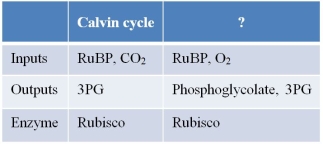 The table summarizes characteristics of two metabolic reactions occurring in the chloroplast.The question mark in the table can be replaced with the word _______.
 (Short Answer)
4.9/5 (87)
(87) Which statement about ribulose bisphosphate carboxylase/oxygenase (rubisco) is false?
(Multiple Choice)
4.9/5 (79)
(79) In C3 plants the Calvin cycle occurs in the chloroplasts of mesophyll cells, whereas in C4 plants the Calvin cycle occurs in the _______ cells.
(Short Answer)
4.9/5 (64)
(64) A student was asked to describe the Calvin cycle in a chloroplast.He began by talking about the carbon-fixation reaction catalyzed by rubisco between carbon dioxide and ribulose 1,5-bisphosphate (RuBP) that produces 3-phosphoglycerate (3PG).The student finished by describing reactions involving ATP and NADPH that convert 3-phosphoglycerate to glyceraldehyde 3-phosphate (G3P), which can be used to produce sucrose and other sugars in the cytoplasm.The student neglected to describe the third process of the Calvin cycle, which involves _______.
(Short Answer)
4.9/5 (72)
(72) What would happen to photosynthesis if a plant were only exposed to light with wavelengths 525-575 nm?
(Multiple Choice)
4.9/5 (92)
(92) It has been estimated that only about 5 percent of the sun's energy that reaches Earth is captured as chemical energy in the form of carbohydrates via photosynthesis.How much of the sun's energy reaching Earth do you estimate is stored in the cells of nonphotosynthetic organisms?
(Multiple Choice)
4.8/5 (80)
(80) In C4 plants, the four-carbon compound that is synthesized by carbon fixation in the mesophyll cells
(Multiple Choice)
4.9/5 (80)
(80) Refer to the table below, which summarizes conditions used in four experiments in which isotopes were used to trace the fate of oxygen atoms during photosynthesis by a terrestrial green plant species. 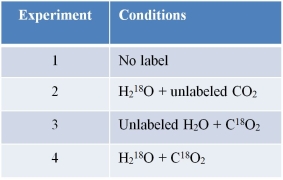 Which set of experiments would provide the best data for determining the source of O2 produced by the plants?
 (Multiple Choice)
4.7/5 (98)
(98) Photosynthesis takes place in plants only in the light.Respiration takes place
(Multiple Choice)
4.9/5 (73)
(73) In sunny, hot weather, corn, which is a C4 plant, has a survival advantage over wheat, which is a C3 plant, because
(Multiple Choice)
4.8/5 (84)
(84) At hourly intervals, researchers measured the change in growth rate of a cactus, a CAM plant, over a 5-day period.The results were used to prepare the graph below.The shaded areas denote dark periods, while white areas denote daylight periods. 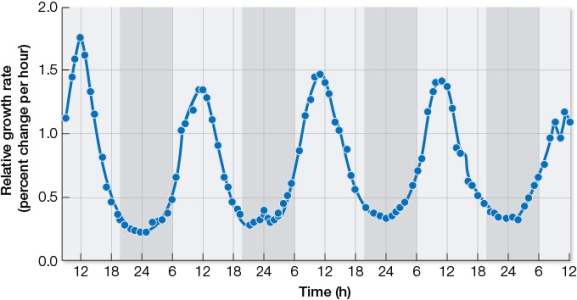 Which statement reasonably explains the pattern in the growth rate revealed in this graph? Remember to apply what you know about CAM plants and cells in general as you consider the various statement options.
 (Multiple Choice)
4.8/5 (86)
(86) Refer to the figure below. 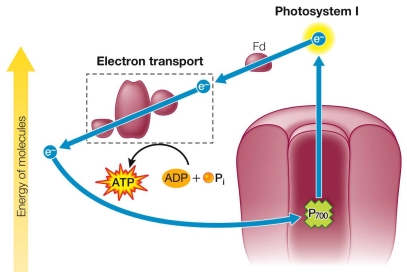 This photosystem produces ATP but not NADPH.Explain why the cyclic nature of this system makes it impossible for NADPH to be formed, and why the noncyclic system is able to form NADPH.
 (Essay)
4.8/5 (90)
(90) Refer to the diagram below showing the 1941 experiments of Samuel Ruben and Martin Kamen that traced isotopes of oxygen through the process of photosynthesis. 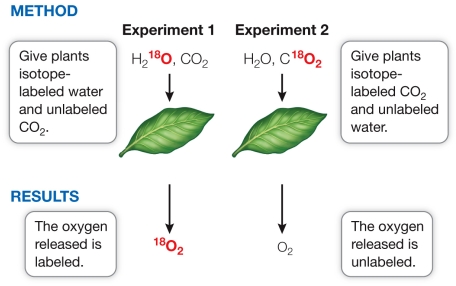 The Ruben and Kamen experiments demonstrated that
 (Multiple Choice)
5.0/5 (68)
(68) 
Filters
- Essay(0)
- Multiple Choice(0)
- Short Answer(0)
- True False(0)
- Matching(0)