



 Chat with AI
Exam 10: Photosynthesis: Energy From Sunlight

Exam 1: Studying Life246 Questions
Exam 2: Small Molecules and the Chemistry of Life246 Questions
Exam 3: Proteins, Carbohydrates, and Lipids246 Questions
Exam 4: Nucleic Acids and the Origin of Life246 Questions
Exam 5: Cells: the Working Units of Life248 Questions
Exam 6: Cell Membranes246 Questions
Exam 7: Cell Communication and Multicellularity246 Questions
Exam 8: Energy, Enzymes, and Metabolism246 Questions
Exam 9: Pathways That Harvest Chemical Energy246 Questions
Exam 10: Photosynthesis: Energy From Sunlight242 Questions
Exam 11: The Cell Cycle and Cell Division260 Questions
Exam 12: Inheritance, Genes, and Chromosomes250 Questions
Exam 13: Dna and Its Role in Heredity257 Questions
Exam 14: From Dna to Protein: Gene Expression252 Questions
Exam 15: Gene Mutation and Molecular Medicine251 Questions
Exam 16: Regulation of Gene Expression245 Questions
Exam 17: Genomes249 Questions
Exam 18: Recombinant Dna and Biotechnology243 Questions
Exam 20: Mechanisms of Evolution243 Questions
Exam 21: Reconstructing and Using Phylogenies246 Questions
Exam 22: Speciation247 Questions
Exam 23: Evolution of Genes and Genomes252 Questions
Exam 24: The History of Life on Earth246 Questions
Exam 25: Bacteria, Archaea, and Viruses262 Questions
Exam 26: The Origin and Diversification of Eukaryotes252 Questions
Exam 27: Plants Without Seeds: From Water to Land251 Questions
Exam 28: The Evolution of Seed Plants259 Questions
Exam 29: The Evolution and Diversity of Fungi261 Questions
Exam 30: Animal Origins and the Evolution of Body Plans248 Questions
Exam 31: Protostome Animals244 Questions
Exam 32: Deuterostome Animals246 Questions
Exam 33: The Plant Body243 Questions
Exam 34: Transport in Plants248 Questions
Exam 35: Plant Nutrition247 Questions
Exam 36: Regulation of Plant Growth246 Questions
Exam 37: Reproduction in Flowering Plants247 Questions
Exam 38: Plant Responses to Environmental Challenges246 Questions
Exam 39: Physiology, Homeostasis, and Temperature Regulation258 Questions
Exam 40: Animal Hormones249 Questions
Exam 41: Immunology: Animal Defense Systems265 Questions
Exam 42: Animal Reproduction261 Questions
Exam 43: Animal Development261 Questions
Exam 44: Neurons, Glia, and Nervous Systems250 Questions
Exam 45: Sensory Systems249 Questions
Exam 46: The Mammalian Nervous System: Structure and Higher Functions254 Questions
Exam 47: Musculoskeletal Systems259 Questions
Exam 48: Gas Exchange247 Questions
Exam 49: Circulatory Systems252 Questions
Exam 50: Nutrition, Digestion, and Absorption259 Questions
Exam 51: Salt and Water Balance and Nitrogen Excretion251 Questions
Exam 52: Animal Behavior249 Questions
Exam 53: The Physical Environment and Biogeography of Life248 Questions
Exam 54: Populations259 Questions
Exam 55: Species Interactions254 Questions
Exam 56: Communities247 Questions
Exam 57: Ecosystems238 Questions
Exam 58: A Changing Biosphere222 Questions
Select questions type


If four molecules of ribulose bisphosphate (RuBP) were added to a solution containing rubisco and CO2, what would be the products of the reaction?
(Multiple Choice)
4.7/5  (71)
(71) In the 1930s, researchers worked with green algae to experimentally determine the minimum light exposure in a single flash that produced the maximal oxygen output.When the researchers calculated the amount of chlorophyll present, they found that there were 300 times more chlorophyll molecules present than would be needed to produce this amount of oxygen with a single light flash.How are these observations consistent with the way that scientists today describe the light-harvesting complex in chloroplasts?
(Multiple Choice)
4.9/5 (70)
(70) In the overall reaction describing photosynthesis, which class of compounds is represented in one of the products?
(Multiple Choice)
4.9/5 (77)
(77) The final electron acceptor in noncyclic electron transport is _______.
(Short Answer)
4.8/5 (78)
(78) The energy difference between an electron excited by a photon and the electron in its ground state is
(Multiple Choice)
4.9/5 (74)
(74) Refer to the table below. 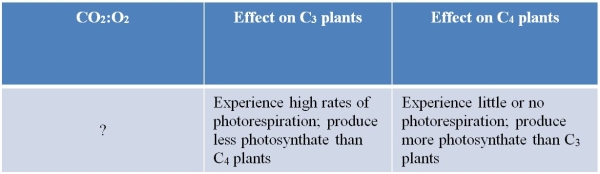 An entry in this table comparing C3 and C4 plants is missing, as shown by the question mark.The best word to fill in this location on the table is _______.
 (Short Answer)
4.7/5 (80)
(80) When the ratio of O2 to CO2 within their leaves _______, C3 plants undergo a shift toward more _______ and less _______.
(Multiple Choice)
4.9/5 (77)
(77) Compared with long-wavelength light, short-wavelength light has
(Multiple Choice)
4.8/5 (72)
(72) While reading an online resource, a student noticed an error in the paragraph below: In photosynthesis, ATP is generated in the light reactions and used in the light-independent reactions as a reducing agent to reduce carbon dioxide to form carbohydrates, which the plant can use for structure and energy.
Which word or phrase could be changed to eliminate the error?
(Multiple Choice)
4.8/5 (80)
(80) When a suspension of algae is incubated in a flask in the presence of light and CO2 and then transferred to the dark, the reduction of 3-phosphoglycerate to glyceraldehyde 3-phosphate slows and then stops.This happens because
(Multiple Choice)
4.8/5 (81)
(81) During photophosphorylation, the energy to produce ATP is provided by
(Multiple Choice)
5.0/5 (84)
(84) Refer to the graph below. 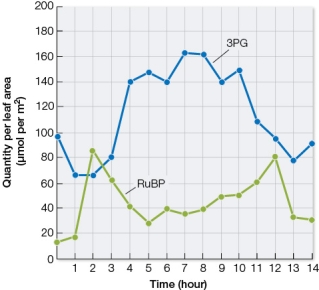 The graph shows changes in the quantities of ribulose 1,5-bisphosphate (RuBP) and 3-phosphoglycerate (3PG) in sugar beet leaves over a 14-hour time period from just before dawn to sunset.One hypothesis that could be posed based on these data is that light _______ the enzyme rubisco.
 (Short Answer)
4.8/5 (79)
(79) What part of the electromagnetic spectrum has more energy than yellow light?
(Multiple Choice)
4.8/5 (76)
(76) Refer to the graphs below summarizing results from experiments on sugar beet plants grown in an environmental chamber with a 14-hour light/10-hour dark cycle.Pieces of leaves were cut from the plants every hour during the light period and ground up to release their cells' contents.Assays were then done to measure the enzyme activities of three different enzymes that participate in the Calvin cycle.The results were graphed in separate graphs as shown. 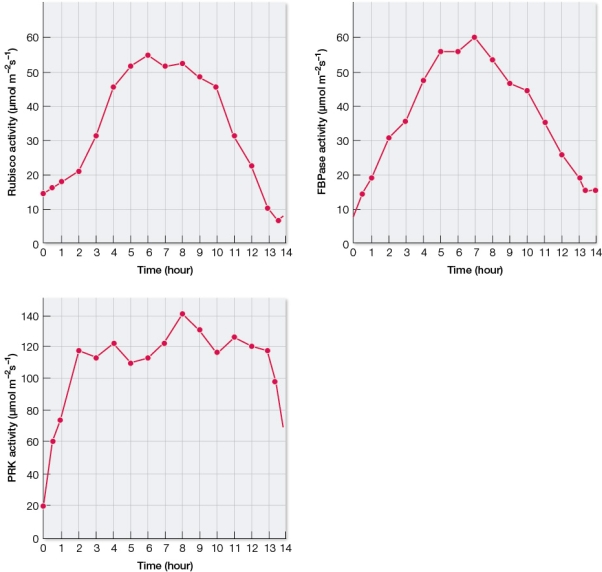 The enzymes include rubisco, fructose bisphosphatase (FBPase), and phosphoribulokinase (PRK).What do the data indicate about the effect of light on enzymes in the Calvin cycle? Explain why this effect is beneficial to the plant.
 (Essay)
4.9/5 (81)
(81) A molecule that has an absorption spectrum showing maximum absorption within the wavelengths of visible light is
(Multiple Choice)
4.8/5 (83)
(83) 
Filters
- Essay(0)
- Multiple Choice(0)
- Short Answer(0)
- True False(0)
- Matching(0)