



 Chat with AI
Exam 10: Photosynthesis: Energy From Sunlight

Exam 1: Studying Life246 Questions
Exam 2: Small Molecules and the Chemistry of Life246 Questions
Exam 3: Proteins, Carbohydrates, and Lipids246 Questions
Exam 4: Nucleic Acids and the Origin of Life246 Questions
Exam 5: Cells: the Working Units of Life248 Questions
Exam 6: Cell Membranes246 Questions
Exam 7: Cell Communication and Multicellularity246 Questions
Exam 8: Energy, Enzymes, and Metabolism246 Questions
Exam 9: Pathways That Harvest Chemical Energy246 Questions
Exam 10: Photosynthesis: Energy From Sunlight242 Questions
Exam 11: The Cell Cycle and Cell Division260 Questions
Exam 12: Inheritance, Genes, and Chromosomes250 Questions
Exam 13: Dna and Its Role in Heredity257 Questions
Exam 14: From Dna to Protein: Gene Expression252 Questions
Exam 15: Gene Mutation and Molecular Medicine251 Questions
Exam 16: Regulation of Gene Expression245 Questions
Exam 17: Genomes249 Questions
Exam 18: Recombinant Dna and Biotechnology243 Questions
Exam 20: Mechanisms of Evolution243 Questions
Exam 21: Reconstructing and Using Phylogenies246 Questions
Exam 22: Speciation247 Questions
Exam 23: Evolution of Genes and Genomes252 Questions
Exam 24: The History of Life on Earth246 Questions
Exam 25: Bacteria, Archaea, and Viruses262 Questions
Exam 26: The Origin and Diversification of Eukaryotes252 Questions
Exam 27: Plants Without Seeds: From Water to Land251 Questions
Exam 28: The Evolution of Seed Plants259 Questions
Exam 29: The Evolution and Diversity of Fungi261 Questions
Exam 30: Animal Origins and the Evolution of Body Plans248 Questions
Exam 31: Protostome Animals244 Questions
Exam 32: Deuterostome Animals246 Questions
Exam 33: The Plant Body243 Questions
Exam 34: Transport in Plants248 Questions
Exam 35: Plant Nutrition247 Questions
Exam 36: Regulation of Plant Growth246 Questions
Exam 37: Reproduction in Flowering Plants247 Questions
Exam 38: Plant Responses to Environmental Challenges246 Questions
Exam 39: Physiology, Homeostasis, and Temperature Regulation258 Questions
Exam 40: Animal Hormones249 Questions
Exam 41: Immunology: Animal Defense Systems265 Questions
Exam 42: Animal Reproduction261 Questions
Exam 43: Animal Development261 Questions
Exam 44: Neurons, Glia, and Nervous Systems250 Questions
Exam 45: Sensory Systems249 Questions
Exam 46: The Mammalian Nervous System: Structure and Higher Functions254 Questions
Exam 47: Musculoskeletal Systems259 Questions
Exam 48: Gas Exchange247 Questions
Exam 49: Circulatory Systems252 Questions
Exam 50: Nutrition, Digestion, and Absorption259 Questions
Exam 51: Salt and Water Balance and Nitrogen Excretion251 Questions
Exam 52: Animal Behavior249 Questions
Exam 53: The Physical Environment and Biogeography of Life248 Questions
Exam 54: Populations259 Questions
Exam 55: Species Interactions254 Questions
Exam 56: Communities247 Questions
Exam 57: Ecosystems238 Questions
Exam 58: A Changing Biosphere222 Questions
Select questions type


Which scientific tools helped researchers "crack" the Calvin cycle?
(Multiple Choice)
4.8/5  (72)
(72) Refer to the table below summarizing data from an experiment conducted using chloroplasts isolated from spinach leaves.The chloroplasts were incubated with either no compound (control) or with compound A or B for 1 hour.Chloroplasts were then tested for the three functions listed at the top of the table. 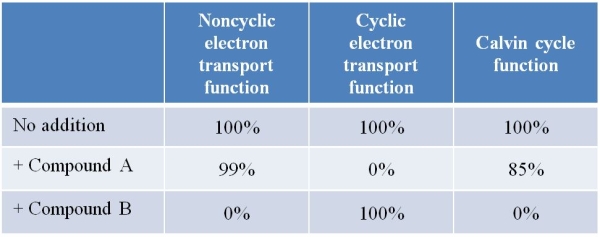 What do these data suggest about the role of NADPH in photosynthesis and why?
 (Multiple Choice)
4.9/5 (78)
(78) During the process of _______, rubisco catalyzes the reaction of RuBP with oxygen.
(Short Answer)
5.0/5 (82)
(82) Photosynthesis and cellular respiration are connected through which pathways?
(Multiple Choice)
4.7/5 (74)
(74) Refer to the graphs below. 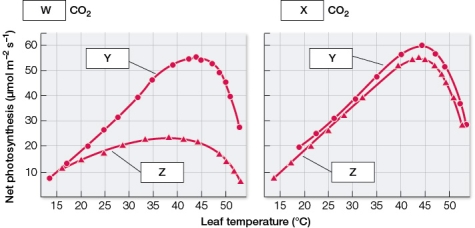 The graphs were generated from photosynthesis rate data collected at varying temperatures from two species of plants measured under different CO2 levels.Match the correct labels to the graphs.
 (Multiple Choice)
4.8/5 (82)
(82) The half-reaction below is used to describe the chemical change that occurs to carbon atoms in carbon dioxide during photosynthesis.
6 CO2 + 24 H+ + 24 e− C6H12O6 + 6 H2O
This half-reaction illustrates that carbon atoms in carbon dioxide undergo _______ to form C6H12O6.
(Short Answer)
4.9/5 (90)
(90) The immediate source of energy for ATP synthesis in chloroplasts is _______, while the ultimate source of energy for ATP synthesis in chloroplasts is _______.
(Multiple Choice)
4.9/5 (85)
(85) Refer to the diagram below. 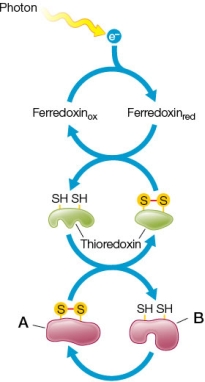 This diagram illustrates how several enzymes of the Calvin cycle are activated indirectly by light through the proteins ferredoxin and thioredoxin.The active form of any of these enzymes is depicted by the molecule labeled _______ in the diagram.
 (Short Answer)
4.8/5 (81)
(81) Which type of plant increases the concentration of CO2 prior to carbon fixation by rubisco?
(Multiple Choice)
4.8/5 (87)
(87) What percentage of sunlight is used as chemical energy for carbon fixation?
(Multiple Choice)
4.9/5 (73)
(73) The flow chart below outlines the stoichiometries of reaction during photorespiration. 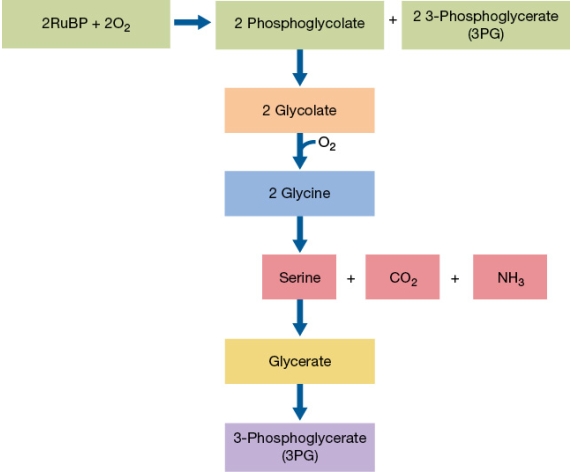 For every 100 RuBP molecules that enter photorespiration, how many 3PG molecules are produced that can be used in the Calvin cycle?
 (Multiple Choice)
4.8/5 (75)
(75) In noncyclic photophosphorylation, the electrons for the reduction of oxidized chlorophyll in photosystem II come from _______.
(Short Answer)
4.9/5 (87)
(87) Refer to the diagram below showing the two catalytic activities of rubisco in C3 plants. 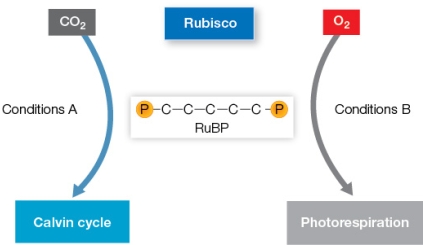 Which pair of conditions could be written into the diagram in place of conditions A and B?
 (Multiple Choice)
4.9/5 (77)
(77) In water, red light is fully absorbed at about 15 meters, orange light is fully absorbed at about 30 meters, yellow light is fully absorbed at about 50 meters, and blue light is fully absorbed at about 100 meters.Based on this information, one can predict that photosynthetic organisms can survive at a depth of up to almost _______ meters.
(Multiple Choice)
4.8/5 (66)
(66) When CO2 is added to RuBP, the first stable product synthesized is
(Multiple Choice)
4.8/5 (83)
(83) Refer to the graph below showing data collected from experiments performed on living leaves attached to two different plants, maize and bean.The rate of photosynthesis in each leaf was measured at varying concentrations of carbon dioxide present in the intercellular spaces within the leaves. 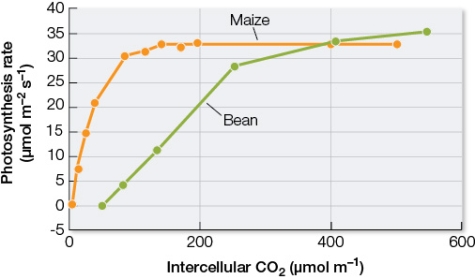 Based on these results, what is the likely classification of maize and bean plants, and which plant would grow better at reduced carbon dioxide levels?
 (Multiple Choice)
4.9/5 (78)
(78) 
Filters
- Essay(0)
- Multiple Choice(0)
- Short Answer(0)
- True False(0)
- Matching(0)