



 Chat with AI
Exam 10: Photosynthesis: Energy From Sunlight

Exam 1: Studying Life246 Questions
Exam 2: Small Molecules and the Chemistry of Life246 Questions
Exam 3: Proteins, Carbohydrates, and Lipids246 Questions
Exam 4: Nucleic Acids and the Origin of Life246 Questions
Exam 5: Cells: the Working Units of Life248 Questions
Exam 6: Cell Membranes246 Questions
Exam 7: Cell Communication and Multicellularity246 Questions
Exam 8: Energy, Enzymes, and Metabolism246 Questions
Exam 9: Pathways That Harvest Chemical Energy246 Questions
Exam 10: Photosynthesis: Energy From Sunlight242 Questions
Exam 11: The Cell Cycle and Cell Division260 Questions
Exam 12: Inheritance, Genes, and Chromosomes250 Questions
Exam 13: Dna and Its Role in Heredity257 Questions
Exam 14: From Dna to Protein: Gene Expression252 Questions
Exam 15: Gene Mutation and Molecular Medicine251 Questions
Exam 16: Regulation of Gene Expression245 Questions
Exam 17: Genomes249 Questions
Exam 18: Recombinant Dna and Biotechnology243 Questions
Exam 20: Mechanisms of Evolution243 Questions
Exam 21: Reconstructing and Using Phylogenies246 Questions
Exam 22: Speciation247 Questions
Exam 23: Evolution of Genes and Genomes252 Questions
Exam 24: The History of Life on Earth246 Questions
Exam 25: Bacteria, Archaea, and Viruses262 Questions
Exam 26: The Origin and Diversification of Eukaryotes252 Questions
Exam 27: Plants Without Seeds: From Water to Land251 Questions
Exam 28: The Evolution of Seed Plants259 Questions
Exam 29: The Evolution and Diversity of Fungi261 Questions
Exam 30: Animal Origins and the Evolution of Body Plans248 Questions
Exam 31: Protostome Animals244 Questions
Exam 32: Deuterostome Animals246 Questions
Exam 33: The Plant Body243 Questions
Exam 34: Transport in Plants248 Questions
Exam 35: Plant Nutrition247 Questions
Exam 36: Regulation of Plant Growth246 Questions
Exam 37: Reproduction in Flowering Plants247 Questions
Exam 38: Plant Responses to Environmental Challenges246 Questions
Exam 39: Physiology, Homeostasis, and Temperature Regulation258 Questions
Exam 40: Animal Hormones249 Questions
Exam 41: Immunology: Animal Defense Systems265 Questions
Exam 42: Animal Reproduction261 Questions
Exam 43: Animal Development261 Questions
Exam 44: Neurons, Glia, and Nervous Systems250 Questions
Exam 45: Sensory Systems249 Questions
Exam 46: The Mammalian Nervous System: Structure and Higher Functions254 Questions
Exam 47: Musculoskeletal Systems259 Questions
Exam 48: Gas Exchange247 Questions
Exam 49: Circulatory Systems252 Questions
Exam 50: Nutrition, Digestion, and Absorption259 Questions
Exam 51: Salt and Water Balance and Nitrogen Excretion251 Questions
Exam 52: Animal Behavior249 Questions
Exam 53: The Physical Environment and Biogeography of Life248 Questions
Exam 54: Populations259 Questions
Exam 55: Species Interactions254 Questions
Exam 56: Communities247 Questions
Exam 57: Ecosystems238 Questions
Exam 58: A Changing Biosphere222 Questions
Select questions type


Refer to the graph below, which shows the amount of carbon present as starch, sucrose, and hexose sugars at various times over a 24-hour period in the chloroplasts of leaf cells from a living green plant.Dawn marks the zero time point, and dusk marks the 14-hour time point. 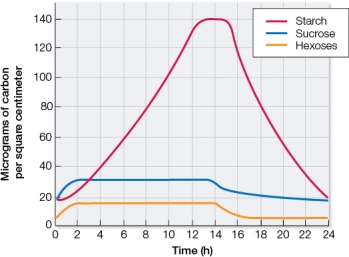 These data provide evidence in support of which statement about chloroplasts?
 (Multiple Choice)
4.9/5  (88)
(88) Plants that carry out crassulacean acid metabolism (CAM) differ from C4 plants in that
(Multiple Choice)
4.9/5 (84)
(84) Refer to the table below, which summarizes similarities and differences between cyclic and noncyclic photophosphorylation. 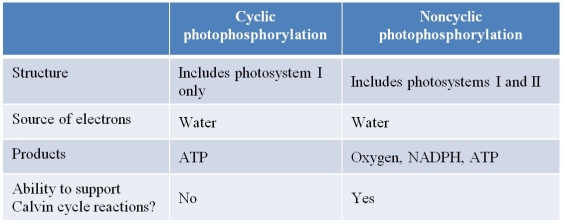 Which statement corrects an inaccuracy present in this table?
 (Multiple Choice)
4.7/5 (80)
(80) Photosynthesis and cellular respiration are metabolically linked through the
(Multiple Choice)
4.9/5 (75)
(75) In both oxygenic photosynthesis and anoxygenic photosynthesis,
(Multiple Choice)
4.9/5 (69)
(69) Refer to the figure below. 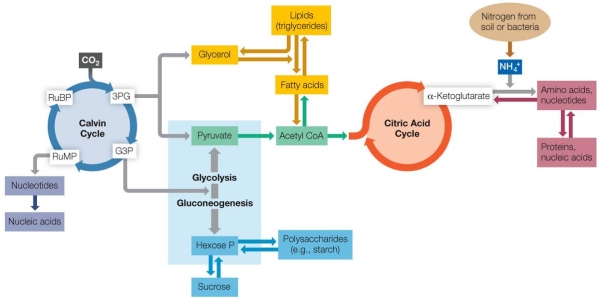 Which is a metabolic pathway that links the Calvin cycle to amino acid biosynthesis?
 (Multiple Choice)
4.9/5 (88)
(88) Refer to the sketch of a chloroplast and the two chemical equations below. 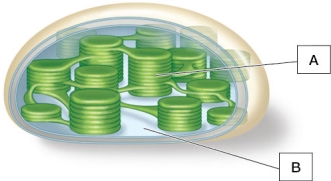 Equation 1: 3 CO2 + 9 ATP + 6 NADPH + 5 H2O G3P + 9 ADP + 9 Pi + 6 NADP+ + 2 H+ Equation 2: 2 H2O + 3 ADP + 3 Pi + 2 NADP+ O2 + 3 ATP + 2 NADPH
Match the structure/location in the chloroplast with its name and the chemical reaction that takes place there.
Equation 1: 3 CO2 + 9 ATP + 6 NADPH + 5 H2O G3P + 9 ADP + 9 Pi + 6 NADP+ + 2 H+ Equation 2: 2 H2O + 3 ADP + 3 Pi + 2 NADP+ O2 + 3 ATP + 2 NADPH
Match the structure/location in the chloroplast with its name and the chemical reaction that takes place there. (Multiple Choice)
4.9/5 (75)
(75) Which sequence gives a correct order of steps taking place during the light reactions?
(Multiple Choice)
4.9/5 (85)
(85) While reading a biology resource text, a student noticed two terms used erroneously in the statement below: Light energy is converted to chemical energy with the production of carrier molecules ATP and NADPH during the endergonic light-dependent reactions of photosynthesis.These carrier molecules provide the energy and reducing power for the synthesis of carbon-carbon bonds during the exergonic light-independent reactions of photosynthesis.
Which terms are used erroneously in the text?
(Multiple Choice)
4.8/5 (86)
(86) If a C3 plant does not open its stomata on a sunny, hot day,
(Multiple Choice)
4.8/5 (72)
(72) Electron transport and photophosphorylation provide the Calvin cycle with
(Multiple Choice)
4.7/5 (68)
(68) Would you expect rising levels of carbon dioxide in the atmosphere to affect C4, C3, or CAM plants differently? Why or why not?
(Essay)
4.7/5 (83)
(83) Which graph illustrates how energy is involved in photosynthesis?
(Multiple Choice)
4.7/5 (77)
(77) What is the source of the O2 produced during photosynthesis? Briefly explain the experiment that led to this discovery.
(Essay)
4.7/5 (85)
(85) 
Filters
- Essay(0)
- Multiple Choice(0)
- Short Answer(0)
- True False(0)
- Matching(0)