



 Chat with AI
Exam 10: Photosynthesis: Energy From Sunlight

Exam 1: Studying Life246 Questions
Exam 2: Small Molecules and the Chemistry of Life246 Questions
Exam 3: Proteins, Carbohydrates, and Lipids246 Questions
Exam 4: Nucleic Acids and the Origin of Life246 Questions
Exam 5: Cells: the Working Units of Life248 Questions
Exam 6: Cell Membranes246 Questions
Exam 7: Cell Communication and Multicellularity246 Questions
Exam 8: Energy, Enzymes, and Metabolism246 Questions
Exam 9: Pathways That Harvest Chemical Energy246 Questions
Exam 10: Photosynthesis: Energy From Sunlight242 Questions
Exam 11: The Cell Cycle and Cell Division260 Questions
Exam 12: Inheritance, Genes, and Chromosomes250 Questions
Exam 13: Dna and Its Role in Heredity257 Questions
Exam 14: From Dna to Protein: Gene Expression252 Questions
Exam 15: Gene Mutation and Molecular Medicine251 Questions
Exam 16: Regulation of Gene Expression245 Questions
Exam 17: Genomes249 Questions
Exam 18: Recombinant Dna and Biotechnology243 Questions
Exam 20: Mechanisms of Evolution243 Questions
Exam 21: Reconstructing and Using Phylogenies246 Questions
Exam 22: Speciation247 Questions
Exam 23: Evolution of Genes and Genomes252 Questions
Exam 24: The History of Life on Earth246 Questions
Exam 25: Bacteria, Archaea, and Viruses262 Questions
Exam 26: The Origin and Diversification of Eukaryotes252 Questions
Exam 27: Plants Without Seeds: From Water to Land251 Questions
Exam 28: The Evolution of Seed Plants259 Questions
Exam 29: The Evolution and Diversity of Fungi261 Questions
Exam 30: Animal Origins and the Evolution of Body Plans248 Questions
Exam 31: Protostome Animals244 Questions
Exam 32: Deuterostome Animals246 Questions
Exam 33: The Plant Body243 Questions
Exam 34: Transport in Plants248 Questions
Exam 35: Plant Nutrition247 Questions
Exam 36: Regulation of Plant Growth246 Questions
Exam 37: Reproduction in Flowering Plants247 Questions
Exam 38: Plant Responses to Environmental Challenges246 Questions
Exam 39: Physiology, Homeostasis, and Temperature Regulation258 Questions
Exam 40: Animal Hormones249 Questions
Exam 41: Immunology: Animal Defense Systems265 Questions
Exam 42: Animal Reproduction261 Questions
Exam 43: Animal Development261 Questions
Exam 44: Neurons, Glia, and Nervous Systems250 Questions
Exam 45: Sensory Systems249 Questions
Exam 46: The Mammalian Nervous System: Structure and Higher Functions254 Questions
Exam 47: Musculoskeletal Systems259 Questions
Exam 48: Gas Exchange247 Questions
Exam 49: Circulatory Systems252 Questions
Exam 50: Nutrition, Digestion, and Absorption259 Questions
Exam 51: Salt and Water Balance and Nitrogen Excretion251 Questions
Exam 52: Animal Behavior249 Questions
Exam 53: The Physical Environment and Biogeography of Life248 Questions
Exam 54: Populations259 Questions
Exam 55: Species Interactions254 Questions
Exam 56: Communities247 Questions
Exam 57: Ecosystems238 Questions
Exam 58: A Changing Biosphere222 Questions
Select questions type


Some plants have the capacity to carry out both cyclic and noncyclic photophosphorylation at the same time.They also have the ability to regulate the rates of these two processes.Which is a correct statement that explains an advantage of this type of regulation?
(Multiple Choice)
4.9/5  (72)
(72) During the light reactions of photosynthesis, the synthesis of _______ is coupled to the diffusion of protons across the thylakoid membrane.
(Short Answer)
4.9/5 (72)
(72) The level of atmospheric CO2 has varied considerably over the history of Earth.Currently, the level of atmospheric CO2
(Multiple Choice)
4.8/5 (81)
(81) Which occurs during the Calvin cycle and also during photorespiration?
(Multiple Choice)
4.7/5 (78)
(78) Refer to the figure below. 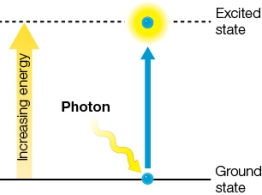 The figure illustrates how a photon of light interacts with chlorophyll in a green plant.A(n) _______ moves from a low energy level to a higher energy level to produce this excited-state chlorophyll molecule.
 (Short Answer)
4.9/5 (88)
(88) C4 plants differ from C3 plants because C3 plants _______, while C4 plants _______.
(Multiple Choice)
4.9/5 (90)
(90) The location within a chloroplast where water is involved as a reactant in a chemical reaction of photosynthesis is the _______.
(Short Answer)
4.8/5 (71)
(71) Photosynthetic organisms that can harvest light to form carbohydrates are called _______.
(Short Answer)
4.8/5 (82)
(82) A student created the following table as a study guide. 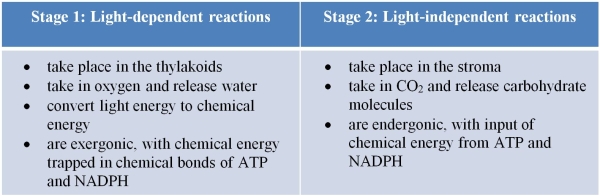 Evaluate the accuracy of the student's table.Should any entry in the table be changed to correct an error?
 (Multiple Choice)
5.0/5 (79)
(79) Examine the following formula: 6 CO2 + 6 H2O C6H12O6 + 6 O2.Which statement is true regarding this equation as a representation of the process of oxygenic photosynthesis?
(Multiple Choice)
4.8/5 (75)
(75) Refer to the table below. 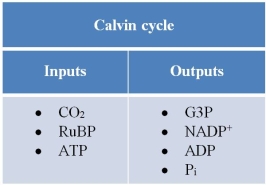 This table summarizing inputs and outputs of the Calvin cycle is missing an input.The missing molecule is _______.
 (Short Answer)
4.9/5 (89)
(89) The reaction catalyzed by rubisco fixes one carbon dioxide molecule with one ribulose 1,5-bisphosphate (RuBP) molecule to yield _______ 3-phosphoglycerate (3PG) molecule(s).
(Short Answer)
4.9/5 (74)
(74) The NADPH required for the reduction of 3PG to G3P comes from
(Multiple Choice)
4.8/5 (82)
(82) 
Filters
- Essay(0)
- Multiple Choice(0)
- Short Answer(0)
- True False(0)
- Matching(0)