



 Chat with AI
Exam 10: Photosynthesis: Energy From Sunlight

Exam 1: Studying Life246 Questions
Exam 2: Small Molecules and the Chemistry of Life246 Questions
Exam 3: Proteins, Carbohydrates, and Lipids246 Questions
Exam 4: Nucleic Acids and the Origin of Life246 Questions
Exam 5: Cells: the Working Units of Life248 Questions
Exam 6: Cell Membranes246 Questions
Exam 7: Cell Communication and Multicellularity246 Questions
Exam 8: Energy, Enzymes, and Metabolism246 Questions
Exam 9: Pathways That Harvest Chemical Energy246 Questions
Exam 10: Photosynthesis: Energy From Sunlight242 Questions
Exam 11: The Cell Cycle and Cell Division260 Questions
Exam 12: Inheritance, Genes, and Chromosomes250 Questions
Exam 13: Dna and Its Role in Heredity257 Questions
Exam 14: From Dna to Protein: Gene Expression252 Questions
Exam 15: Gene Mutation and Molecular Medicine251 Questions
Exam 16: Regulation of Gene Expression245 Questions
Exam 17: Genomes249 Questions
Exam 18: Recombinant Dna and Biotechnology243 Questions
Exam 20: Mechanisms of Evolution243 Questions
Exam 21: Reconstructing and Using Phylogenies246 Questions
Exam 22: Speciation247 Questions
Exam 23: Evolution of Genes and Genomes252 Questions
Exam 24: The History of Life on Earth246 Questions
Exam 25: Bacteria, Archaea, and Viruses262 Questions
Exam 26: The Origin and Diversification of Eukaryotes252 Questions
Exam 27: Plants Without Seeds: From Water to Land251 Questions
Exam 28: The Evolution of Seed Plants259 Questions
Exam 29: The Evolution and Diversity of Fungi261 Questions
Exam 30: Animal Origins and the Evolution of Body Plans248 Questions
Exam 31: Protostome Animals244 Questions
Exam 32: Deuterostome Animals246 Questions
Exam 33: The Plant Body243 Questions
Exam 34: Transport in Plants248 Questions
Exam 35: Plant Nutrition247 Questions
Exam 36: Regulation of Plant Growth246 Questions
Exam 37: Reproduction in Flowering Plants247 Questions
Exam 38: Plant Responses to Environmental Challenges246 Questions
Exam 39: Physiology, Homeostasis, and Temperature Regulation258 Questions
Exam 40: Animal Hormones249 Questions
Exam 41: Immunology: Animal Defense Systems265 Questions
Exam 42: Animal Reproduction261 Questions
Exam 43: Animal Development261 Questions
Exam 44: Neurons, Glia, and Nervous Systems250 Questions
Exam 45: Sensory Systems249 Questions
Exam 46: The Mammalian Nervous System: Structure and Higher Functions254 Questions
Exam 47: Musculoskeletal Systems259 Questions
Exam 48: Gas Exchange247 Questions
Exam 49: Circulatory Systems252 Questions
Exam 50: Nutrition, Digestion, and Absorption259 Questions
Exam 51: Salt and Water Balance and Nitrogen Excretion251 Questions
Exam 52: Animal Behavior249 Questions
Exam 53: The Physical Environment and Biogeography of Life248 Questions
Exam 54: Populations259 Questions
Exam 55: Species Interactions254 Questions
Exam 56: Communities247 Questions
Exam 57: Ecosystems238 Questions
Exam 58: A Changing Biosphere222 Questions
Select questions type


Conversion of carbon dioxide into carbohydrates relies on energy from
(Multiple Choice)
4.7/5  (87)
(87) Refer to the table below containing data collected from experiments using chloroplasts isolated from leaves taken from living spinach plants.In the experiments, measurements were taken of the catalytic activity of the enzyme sedoheptulose bisphosphatase (SBP), which operates in the part of the Calvin cycle that regenerates ribulose 1,5-bisphosphate (RuBP).The chloroplasts were broken open using a blender, and the resulting mixture was centrifuged and the pellet discarded.The enzyme SBP was present in the supernatant and could be assayed by adding its substrates and measuring how much product was formed from the reaction it catalyzed.Depending on additional treatments listed in the table, the catalytic activity of SBP varied as shown. 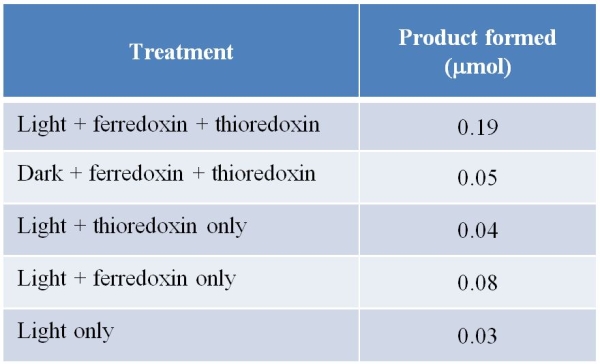 What do the data suggest about the role of ferredoxin and thioredoxin in the function of this enzyme? Explain your reasoning.
 (Essay)
4.7/5 (93)
(93) If a plant has plenty of NADPH available but is running low on ATP, how does the plant make up the ATP deficit during the daylight hours?
(Multiple Choice)
4.9/5 (85)
(85) In cacti, CO2 is fixed during the night in a four-carbon molecule and stored in _______ for use in the Calvin cycle during the day.
(Multiple Choice)
4.9/5 (84)
(84) One reason the absorption spectrum of chlorophyll a is not identical to the action spectrum of photosynthesis is that
(Multiple Choice)
4.8/5 (71)
(71) Which molecule(s) shuttle(s) between the mesophyll and bundle sheath cells in C4 plants during carbon fixation?
(Multiple Choice)
4.9/5 (75)
(75) To study the mechanism of excitation in the reaction center of a photosystem, on what timescale would you need to capture data?
(Multiple Choice)
4.8/5 (81)
(81) During cyclic photophosphorylation, the energy of photons is converted into the chemical energy of the product, which is _______.
(Short Answer)
4.8/5 (77)
(77) Atmospheric oxygen levels have remained constant at 21 percent for thousands of years.Scientists have speculated that low carbon dioxide levels in the atmosphere could be responsible for this steady O2 level.Considering that the majority of plants on Earth are C3 plants, explain how low carbon dioxide levels could have helped maintain constant oxygen levels on the planet.
(Essay)
4.7/5 (78)
(78) The following half-reaction is used to describe the chemical change that occurs to oxygen atoms in water during photosynthesis:
12 H2O 24 H+ + 24 e− + 6 O2
This half-reaction illustrates that oxygen atoms in water undergo _______ to form O2.
(Short Answer)
4.9/5 (74)
(74) Which sequence describes the processes of the Calvin cycle?
(Multiple Choice)
5.0/5 (71)
(71) In the first phase of photosynthesis, a series of reactions converts light energy into ATP and NADPH.These reactions are referred to as
(Multiple Choice)
4.8/5 (83)
(83) When the pH of the stroma shifts from 7 to 8 under illumination,
(Multiple Choice)
4.8/5 (86)
(86) Some anaerobic bacteria carry out anoxygenic photosynthesis using the net chemical conversion shown below:
6 CO2 + 12 H2S C6H12O6 + 6 H2O + 12 S
The discovery of this type of photosynthesis provided evidence for which aspect of the photosynthetic process?
(Multiple Choice)
4.9/5 (73)
(73) How many six-carbon sugar molecules are produced by the Calvin cycle when 18 CO2 are fixed?
(Multiple Choice)
4.9/5 (79)
(79) The most important wavelengths of light for photosynthesis are
(Multiple Choice)
4.9/5 (83)
(83) Refer to the table below. 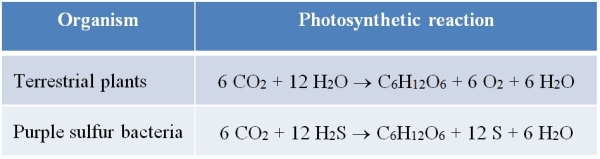 How do these two photosynthetic processes compare?
 (Multiple Choice)
4.9/5 (89)
(89) 
Filters
- Essay(0)
- Multiple Choice(0)
- Short Answer(0)
- True False(0)
- Matching(0)