



 Chat with AI
Exam 10: Photosynthesis: Energy From Sunlight

Exam 1: Studying Life246 Questions
Exam 2: Small Molecules and the Chemistry of Life246 Questions
Exam 3: Proteins, Carbohydrates, and Lipids246 Questions
Exam 4: Nucleic Acids and the Origin of Life246 Questions
Exam 5: Cells: the Working Units of Life248 Questions
Exam 6: Cell Membranes246 Questions
Exam 7: Cell Communication and Multicellularity246 Questions
Exam 8: Energy, Enzymes, and Metabolism246 Questions
Exam 9: Pathways That Harvest Chemical Energy246 Questions
Exam 10: Photosynthesis: Energy From Sunlight242 Questions
Exam 11: The Cell Cycle and Cell Division260 Questions
Exam 12: Inheritance, Genes, and Chromosomes250 Questions
Exam 13: Dna and Its Role in Heredity257 Questions
Exam 14: From Dna to Protein: Gene Expression252 Questions
Exam 15: Gene Mutation and Molecular Medicine251 Questions
Exam 16: Regulation of Gene Expression245 Questions
Exam 17: Genomes249 Questions
Exam 18: Recombinant Dna and Biotechnology243 Questions
Exam 20: Mechanisms of Evolution243 Questions
Exam 21: Reconstructing and Using Phylogenies246 Questions
Exam 22: Speciation247 Questions
Exam 23: Evolution of Genes and Genomes252 Questions
Exam 24: The History of Life on Earth246 Questions
Exam 25: Bacteria, Archaea, and Viruses262 Questions
Exam 26: The Origin and Diversification of Eukaryotes252 Questions
Exam 27: Plants Without Seeds: From Water to Land251 Questions
Exam 28: The Evolution of Seed Plants259 Questions
Exam 29: The Evolution and Diversity of Fungi261 Questions
Exam 30: Animal Origins and the Evolution of Body Plans248 Questions
Exam 31: Protostome Animals244 Questions
Exam 32: Deuterostome Animals246 Questions
Exam 33: The Plant Body243 Questions
Exam 34: Transport in Plants248 Questions
Exam 35: Plant Nutrition247 Questions
Exam 36: Regulation of Plant Growth246 Questions
Exam 37: Reproduction in Flowering Plants247 Questions
Exam 38: Plant Responses to Environmental Challenges246 Questions
Exam 39: Physiology, Homeostasis, and Temperature Regulation258 Questions
Exam 40: Animal Hormones249 Questions
Exam 41: Immunology: Animal Defense Systems265 Questions
Exam 42: Animal Reproduction261 Questions
Exam 43: Animal Development261 Questions
Exam 44: Neurons, Glia, and Nervous Systems250 Questions
Exam 45: Sensory Systems249 Questions
Exam 46: The Mammalian Nervous System: Structure and Higher Functions254 Questions
Exam 47: Musculoskeletal Systems259 Questions
Exam 48: Gas Exchange247 Questions
Exam 49: Circulatory Systems252 Questions
Exam 50: Nutrition, Digestion, and Absorption259 Questions
Exam 51: Salt and Water Balance and Nitrogen Excretion251 Questions
Exam 52: Animal Behavior249 Questions
Exam 53: The Physical Environment and Biogeography of Life248 Questions
Exam 54: Populations259 Questions
Exam 55: Species Interactions254 Questions
Exam 56: Communities247 Questions
Exam 57: Ecosystems238 Questions
Exam 58: A Changing Biosphere222 Questions
Select questions type


Refer to the graph below. 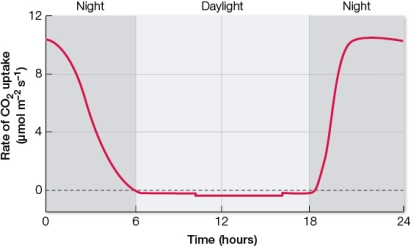 This graph was generated using data collected over a 24-hour period on the rate of carbon dioxide uptake by a leaf on a living plant.Based on the pattern revealed by the data, it can be concluded that the plant can be classified as a _______ plant.
 (Short Answer)
4.9/5  (80)
(80) A group of scientists led by Melvin _______ conducted experiments demonstrating that RuBP is the CO2 acceptor in the dark reactions of photosynthesis.
(Short Answer)
4.7/5 (67)
(67) Which statement regarding the electron transport chain between photosystem II and photosystem I is true?
(Multiple Choice)
4.8/5 (74)
(74) The light-independent reactions cannot run without the products of the _______ reactions.
(Short Answer)
4.8/5 (78)
(78) The chemical energy stored from photosynthesis represents _______ percent of the total energy of the sunlight hitting a green leaf.
(Multiple Choice)
4.9/5 (82)
(82) Refer to the table below showing data collected from chloroplasts isolated from spinach leaves.The chloroplasts were incubated with either compound Q or Z, or with no additions in the control.After 30 minutes of incubation, chloroplasts were analyzed for the photosynthetic functions shown in the table. 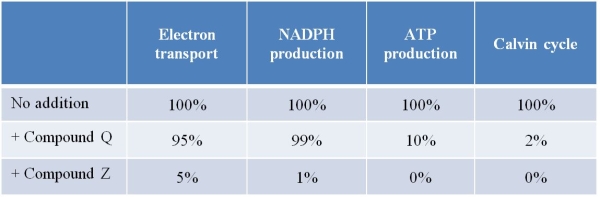 Assume that compounds Q and Z directly affect components involved in the light reactions.What do these data indicate about the relationship between the light reactions and the light-independent reactions?
 (Multiple Choice)
4.7/5 (68)
(68) In noncyclic electron transport, electrons from _______ replenish chlorophyll molecules that have given up electrons.
(Multiple Choice)
4.7/5 (87)
(87) How many micromoles of 3-phosphoglycerate would be formed by rubisco if 4 M of RuBP were added to the solution in the presence of CO2 and the absence of O2?
(Multiple Choice)
4.9/5 (81)
(81) The carbon-fixation reactions of photosynthesis require more ATP than NADPH.The additional ATP is provided by
(Multiple Choice)
4.8/5 (84)
(84) The net chemical changes that result from photosynthesis can be summarized in the following balanced chemical equation:
6 CO2 + 6 H2O C6H12O6 + 6 O2
However, this equation can be made more complete by adding the word "energy" to the (left/right) _______ side of the equation to show how energy is involved in this process.
(Short Answer)
4.9/5 (77)
(77) In noncyclic photophosphorylation, oxidized chlorophyll in photosystem I returns to its reduced state by
(Multiple Choice)
5.0/5 (69)
(69) Refer to the graph below summarizing data collected using rubisco purified from chloroplasts.It shows how the catalytic activity of rubisco changes in response to varying times of incubation, either with an oxidizing agent or with a reducing agent. 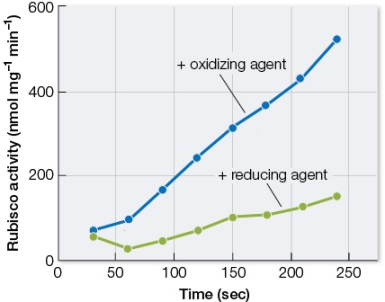 Thioredoxin is a protein inside the stroma of a chloroplast that can act as an oxidizing or a reducing agent.Thioredoxin is reduced by ferredoxin in photosystem I.Based on this information and the graph, how do you predict thioredoxin will affect rubisco inside cells of a living plant when the plant is moved from the dark into the light?
 (Multiple Choice)
4.8/5 (99)
(99) In the hydrolysis of H2O to protons and oxygen during photosynthesis, electrons are transferred to P680.This reaction is an example of
(Multiple Choice)
4.8/5 (86)
(86) Refer to the figure below. 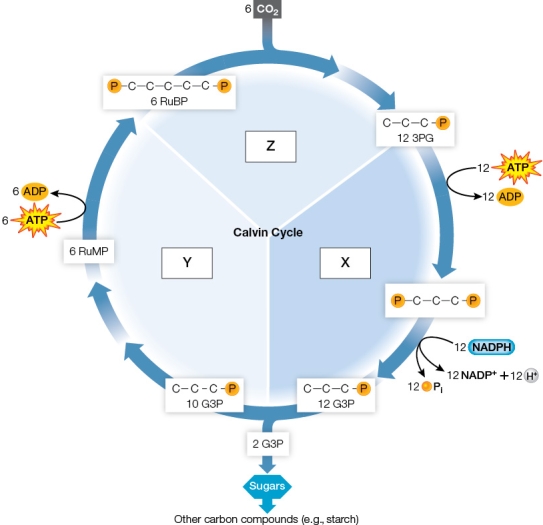 In the figure, how should boxes X, Y, and Z be labeled?
 (Multiple Choice)
5.0/5 (85)
(85) A graph that plots the rate at which CO2 is converted to sugar versus the wavelength of light illuminating a leaf is called
(Multiple Choice)
4.9/5 (87)
(87) Refer to the figure below. 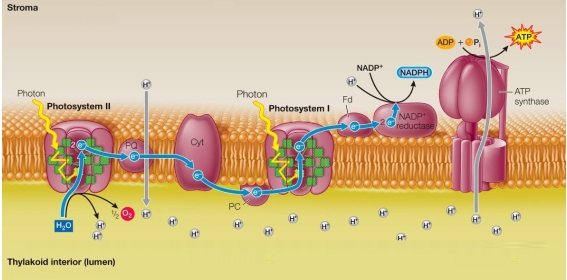 Based on the process shown in the figure, it can be predicted that the pH in the stroma will _______ when a green plant is exposed to light.
 (Short Answer)
4.8/5 (77)
(77) 
Filters
- Essay(0)
- Multiple Choice(0)
- Short Answer(0)
- True False(0)
- Matching(0)