



 Chat with AI
Exam 10: Photosynthesis: Energy From Sunlight

Exam 1: Studying Life246 Questions
Exam 2: Small Molecules and the Chemistry of Life246 Questions
Exam 3: Proteins, Carbohydrates, and Lipids246 Questions
Exam 4: Nucleic Acids and the Origin of Life246 Questions
Exam 5: Cells: the Working Units of Life248 Questions
Exam 6: Cell Membranes246 Questions
Exam 7: Cell Communication and Multicellularity246 Questions
Exam 8: Energy, Enzymes, and Metabolism246 Questions
Exam 9: Pathways That Harvest Chemical Energy246 Questions
Exam 10: Photosynthesis: Energy From Sunlight242 Questions
Exam 11: The Cell Cycle and Cell Division260 Questions
Exam 12: Inheritance, Genes, and Chromosomes250 Questions
Exam 13: Dna and Its Role in Heredity257 Questions
Exam 14: From Dna to Protein: Gene Expression252 Questions
Exam 15: Gene Mutation and Molecular Medicine251 Questions
Exam 16: Regulation of Gene Expression245 Questions
Exam 17: Genomes249 Questions
Exam 18: Recombinant Dna and Biotechnology243 Questions
Exam 20: Mechanisms of Evolution243 Questions
Exam 21: Reconstructing and Using Phylogenies246 Questions
Exam 22: Speciation247 Questions
Exam 23: Evolution of Genes and Genomes252 Questions
Exam 24: The History of Life on Earth246 Questions
Exam 25: Bacteria, Archaea, and Viruses262 Questions
Exam 26: The Origin and Diversification of Eukaryotes252 Questions
Exam 27: Plants Without Seeds: From Water to Land251 Questions
Exam 28: The Evolution of Seed Plants259 Questions
Exam 29: The Evolution and Diversity of Fungi261 Questions
Exam 30: Animal Origins and the Evolution of Body Plans248 Questions
Exam 31: Protostome Animals244 Questions
Exam 32: Deuterostome Animals246 Questions
Exam 33: The Plant Body243 Questions
Exam 34: Transport in Plants248 Questions
Exam 35: Plant Nutrition247 Questions
Exam 36: Regulation of Plant Growth246 Questions
Exam 37: Reproduction in Flowering Plants247 Questions
Exam 38: Plant Responses to Environmental Challenges246 Questions
Exam 39: Physiology, Homeostasis, and Temperature Regulation258 Questions
Exam 40: Animal Hormones249 Questions
Exam 41: Immunology: Animal Defense Systems265 Questions
Exam 42: Animal Reproduction261 Questions
Exam 43: Animal Development261 Questions
Exam 44: Neurons, Glia, and Nervous Systems250 Questions
Exam 45: Sensory Systems249 Questions
Exam 46: The Mammalian Nervous System: Structure and Higher Functions254 Questions
Exam 47: Musculoskeletal Systems259 Questions
Exam 48: Gas Exchange247 Questions
Exam 49: Circulatory Systems252 Questions
Exam 50: Nutrition, Digestion, and Absorption259 Questions
Exam 51: Salt and Water Balance and Nitrogen Excretion251 Questions
Exam 52: Animal Behavior249 Questions
Exam 53: The Physical Environment and Biogeography of Life248 Questions
Exam 54: Populations259 Questions
Exam 55: Species Interactions254 Questions
Exam 56: Communities247 Questions
Exam 57: Ecosystems238 Questions
Exam 58: A Changing Biosphere222 Questions
Select questions type


Suppose atmospheric carbon dioxide levels rise dramatically in the future.How do you predict this will affect competition between C3 and C4 plants?
(Multiple Choice)
4.8/5  (62)
(62) Refer to the table below. 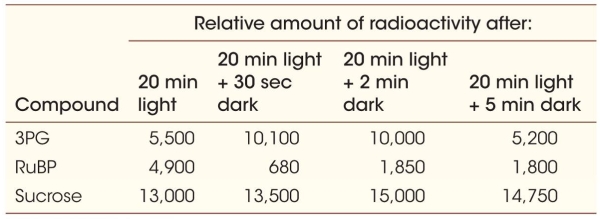 The table contains data collected by Melvin Calvin and his colleagues during experiments designed to trace the pathway of carbon in photosynthesis.Carbon dioxide labeled with carbon-14 was incubated with algal cells under different conditions outlined in the table before the cells were harvested and their contents analyzed for the amount of carbon-14 label in various compounds.Quantities of radioactivity in three compounds are listed in the table.Which statement correctly explains why the amount of carbon-14 present in 3PG increased after 30 seconds of dark?
 (Multiple Choice)
4.9/5 (72)
(72) In C4 plants, starch grains are found in the chloroplasts of
(Multiple Choice)
4.8/5 (80)
(80) When a photon meets a molecule, which of the following cannot happen?
(Multiple Choice)
4.9/5 (75)
(75) What determines whether rubisco acts as an oxygenase or a carboxylase?
(Multiple Choice)
4.8/5 (74)
(74) A new plant is discovered in the desert and determined to be either a C4 or CAM plant.Which measurement will best help you to determine whether it is a C4 or CAM plant?
(Multiple Choice)
4.8/5 (83)
(83) During photorespiration, rubisco uses _______ as a substrate.
(Multiple Choice)
4.8/5 (69)
(69) Which graph illustrates the expected changes in a chloroplast's stroma pH in response to a cycle of light and dark?
(Multiple Choice)
4.7/5 (83)
(83) Refer to the table below. 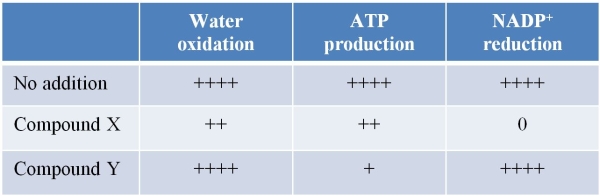 Data in the table summarize a set of experiments in which a plant species was treated with plain water or with additions of compound X or compound Y to its daily waterings.After 7 days of treatment, chloroplasts from the plants were isolated, and their abilities to carry out water oxidation, ATP production, and NADP+ reduction were measured.The number of "+" symbols is proportional to the level of biological activity observed.Both cyclic and noncyclic photophosphorylation processes are active in this plant species.Which hypothesis concerning the mode of action of compounds X and Y is consistent with the data?
 (Multiple Choice)
4.8/5 (75)
(75) Which of the following occurs during the light-independent reactions of photosynthesis?
(Multiple Choice)
4.8/5 (80)
(80) Which statement can be used to describe PEP carboxylase but cannot be used to describe rubisco?
(Multiple Choice)
4.7/5 (78)
(78) Refer to the flowchart below. 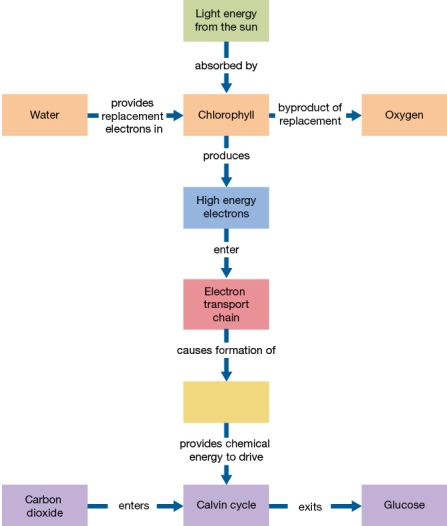 Note that there is an empty box in this flowchart.Adding _______ to this box will complete the flowchart.
 (Short Answer)
4.8/5 (79)
(79) Metabolic pathways are somewhat like roadways: A metabolic path may be one-way or two-way.It may contain intersections that connect many different pathways, or it may be isolated, with a dead end, and only connect to one other pathway.What roadway analogy could be used to describe the location of glyceraldehyde 3-phosphate (product of the Calvin cycle) in plant cell metabolism?
(Multiple Choice)
4.8/5 (82)
(82) Refer to the table below showing observations from experiments conducted on three types of pea plants.One type of pea plant contained a mutation in the gene encoding thioredoxin that resulted in zero production of the protein thioredoxin.Another type contained two mutations: the same thioredoxin mutation as in the previous type and a mutation in the gene encoding the Calvin cycle enzyme phosphoribulokinase (PRK) that did not affect its expression.The third type contained no mutations in either gene and was designated as "wild type." Before the experiments, all plants were kept on a 14-hour light/10-hour dark cycle for several weeks. 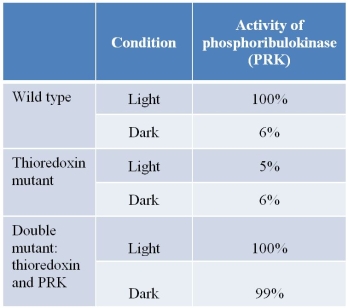 In conducting the experiments, researchers excised leaves either toward the end of a light cycle or toward the end of a dark cycle.Chloroplasts were then isolated and lysed to release the contents of the stroma, and PRK was assayed to determine its catalytic activity.Which statement about thioredoxin is consistent with these data?
 (Multiple Choice)
4.8/5 (78)
(78) Refer to the figure below. 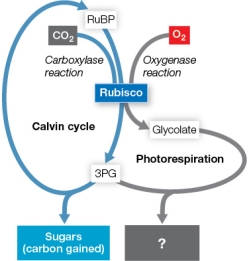 The figure compares the inputs and outputs of the carboxylase and oxygenase reactions catalyzed by rubisco.Which compound fits in the box containing a question mark?
 (Multiple Choice)
4.8/5 (87)
(87) Refer to the graph below summarizing results from experiments on lysed chloroplasts.These are chloroplasts that have been isolated from green plant cells and then broken open to release all of the chloroplast contents into a mixture in a test tube.The mixture contained rubisco enzymes that were tested for their level of catalytic activity under the four conditions shown in the graph.DCMU is an organic molecule that inhibits the photosystem II electron transport chain. 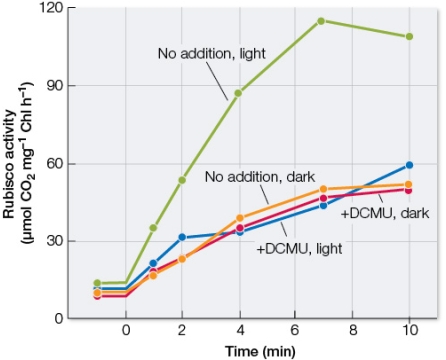 Which statement about photosynthesis is supported by the data presented in the graph?
 (Multiple Choice)
4.9/5 (91)
(91) Refer to the table below, which contains data collected using the same techniques that Calvin and his colleagues used to determine the pathway of carbon atoms during photosynthesis.In this experiment, the starting material was a synthesized compound that contained carbon-14.This 14C-labeled compound was supplied to a living culture of algae at time zero.Then, at 5-second intervals, samples of the culture were harvested and extracted.The extracts were subjected to two-dimensional chromatography, and the resulting spots were numbered and measured for radioactivity.A "0" indicates negligible radioactivity, while a "+" indicates measurable radioactivity; the greater the number of "+" symbols, the greater the radioactivity detected. 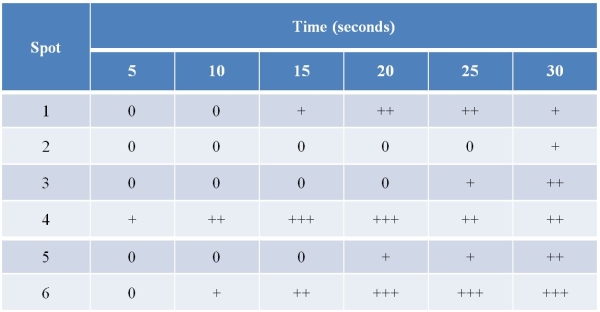 Based on these results, what is the sequence of compounds in the metabolic pathway?
 (Multiple Choice)
4.8/5 (78)
(78) 
Filters
- Essay(0)
- Multiple Choice(0)
- Short Answer(0)
- True False(0)
- Matching(0)