



 Chat with AI
Exam 10: Photosynthesis: Energy From Sunlight

Exam 1: Studying Life246 Questions
Exam 2: Small Molecules and the Chemistry of Life246 Questions
Exam 3: Proteins, Carbohydrates, and Lipids246 Questions
Exam 4: Nucleic Acids and the Origin of Life246 Questions
Exam 5: Cells: the Working Units of Life248 Questions
Exam 6: Cell Membranes246 Questions
Exam 7: Cell Communication and Multicellularity246 Questions
Exam 8: Energy, Enzymes, and Metabolism246 Questions
Exam 9: Pathways That Harvest Chemical Energy246 Questions
Exam 10: Photosynthesis: Energy From Sunlight242 Questions
Exam 11: The Cell Cycle and Cell Division260 Questions
Exam 12: Inheritance, Genes, and Chromosomes250 Questions
Exam 13: Dna and Its Role in Heredity257 Questions
Exam 14: From Dna to Protein: Gene Expression252 Questions
Exam 15: Gene Mutation and Molecular Medicine251 Questions
Exam 16: Regulation of Gene Expression245 Questions
Exam 17: Genomes249 Questions
Exam 18: Recombinant Dna and Biotechnology243 Questions
Exam 20: Mechanisms of Evolution243 Questions
Exam 21: Reconstructing and Using Phylogenies246 Questions
Exam 22: Speciation247 Questions
Exam 23: Evolution of Genes and Genomes252 Questions
Exam 24: The History of Life on Earth246 Questions
Exam 25: Bacteria, Archaea, and Viruses262 Questions
Exam 26: The Origin and Diversification of Eukaryotes252 Questions
Exam 27: Plants Without Seeds: From Water to Land251 Questions
Exam 28: The Evolution of Seed Plants259 Questions
Exam 29: The Evolution and Diversity of Fungi261 Questions
Exam 30: Animal Origins and the Evolution of Body Plans248 Questions
Exam 31: Protostome Animals244 Questions
Exam 32: Deuterostome Animals246 Questions
Exam 33: The Plant Body243 Questions
Exam 34: Transport in Plants248 Questions
Exam 35: Plant Nutrition247 Questions
Exam 36: Regulation of Plant Growth246 Questions
Exam 37: Reproduction in Flowering Plants247 Questions
Exam 38: Plant Responses to Environmental Challenges246 Questions
Exam 39: Physiology, Homeostasis, and Temperature Regulation258 Questions
Exam 40: Animal Hormones249 Questions
Exam 41: Immunology: Animal Defense Systems265 Questions
Exam 42: Animal Reproduction261 Questions
Exam 43: Animal Development261 Questions
Exam 44: Neurons, Glia, and Nervous Systems250 Questions
Exam 45: Sensory Systems249 Questions
Exam 46: The Mammalian Nervous System: Structure and Higher Functions254 Questions
Exam 47: Musculoskeletal Systems259 Questions
Exam 48: Gas Exchange247 Questions
Exam 49: Circulatory Systems252 Questions
Exam 50: Nutrition, Digestion, and Absorption259 Questions
Exam 51: Salt and Water Balance and Nitrogen Excretion251 Questions
Exam 52: Animal Behavior249 Questions
Exam 53: The Physical Environment and Biogeography of Life248 Questions
Exam 54: Populations259 Questions
Exam 55: Species Interactions254 Questions
Exam 56: Communities247 Questions
Exam 57: Ecosystems238 Questions
Exam 58: A Changing Biosphere222 Questions
Select questions type


A researcher exposes a suspension of green algae to different light sources with different combinations of wavelengths.Compared with a suspension of algae that is receiving white light (source C), the algae suspension exposed to artificial light from source A remains healthy but produces less oxygen and has a slower growth rate.The algae suspension exposed to artificial light from source B ceases to produce oxygen, and its growth is halted.Which of the following statements about light sources is correct?
(Multiple Choice)
4.7/5  (82)
(82) Refer to the absorption spectra and action spectrum for a green plant shown below. 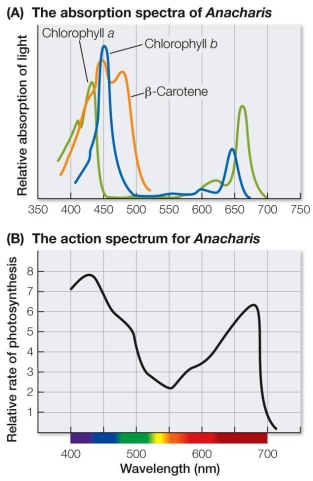 A bulb that emits a full spectrum of visible light is in use in the lamp used to illuminate an aquarium.Suppose that when this bulb burns out, the new bulb used to replace it has an emission spectrum that ranges from 500 to 600 nm.It can be expected that the aquatic plants present in the aquarium will show a(n) _______ in growth.
 (Short Answer)
4.8/5 (89)
(89) Which reaction taking place in a chloroplast directly depends on light?
(Multiple Choice)
4.8/5 (87)
(87) In the 1600s, a Belgian physician named Jan Baptista van Helmont ran an experiment on a young willow tree.He measured the tree's mass as well as the mass of the pot and soil he planted it in.van Helmont placed the tree in a well-lit spot and watered it periodically.After 5 years, he found that the mass of the plant had increased by 75 kilograms (165 pounds).The pot and soil together did not change significantly in mass.Some of the plant's increase in mass was due to water, but not all of it.Plant growth results from an increase in plant cells as well as extracellular materials that are made up of proteins, lipids, and carbohydrates.The source of carbon that went into constructing these molecules in van Helmont's willow tree was _______.
(Short Answer)
4.9/5 (77)
(77) In photosynthetic noncyclic electron transport, water is used for the
(Multiple Choice)
4.9/5 (76)
(76) The Calvin cycle is linked to glycolysis by which intermediate?
(Multiple Choice)
4.9/5 (90)
(90) ATP affects the movement of malate from mesophyll cells to bundle sheath cells in which manner?
(Multiple Choice)
4.9/5 (79)
(79) Refer to the table below, which summarizes similarities and differences between cyclic and noncyclic photophosphorylation. 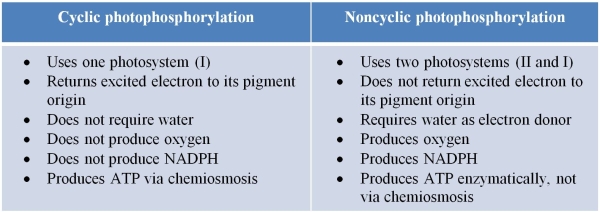 Which statement corrects an inaccuracy in this table?
 (Multiple Choice)
4.9/5 (74)
(74) A species of plant is found to use both cyclic and noncyclic photophosphorylation.Which outcome is most likely for this plant if cyclic photophosphorylation is completely inhibited?
(Multiple Choice)
4.8/5 (74)
(74) Refer to the figure below. 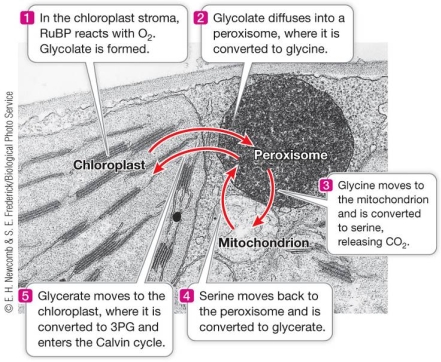 What process is depicted in this figure?
 (Multiple Choice)
4.9/5 (89)
(89) The activity of the Calvin cycle is linked to the light reactions of photosynthesis through the
(Multiple Choice)
4.9/5 (76)
(76) Careful measurements of pH on each side of the thylakoid membrane have shown that the interior lumen is lower in pH than the exterior.This observation provides one piece of evidence that supports the _______ mechanism of ATP production in photophosphorylation.
(Short Answer)
4.9/5 (80)
(80) Mustard plants were grown under 16 hours (hour 0 to 16) of light followed by 8 hours (hour 16 to 24) of dark for several weeks.Leaves were then excised at different times during a single 24-hour cycle and measured for mass before starch content was determined.The graph below summarizes the results of these analyses, showing starch content expressed as starch mass per leaf mass. 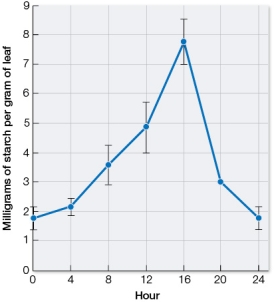 These data provide evidence to directly support which statement about starch that is formed as the result of photosynthesis in plants?
 (Multiple Choice)
4.7/5 (73)
(73) Refer to the table below summarizing how several compounds can be effective as herbicides. 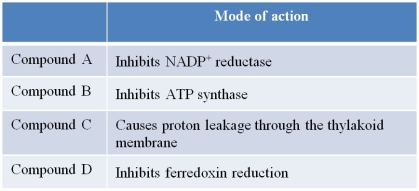 Which compound or compounds applied to a green plant would not change the plant's ability to carry out chemiosmosis, and which compound or compounds would not change the plant's ability to produce NADPH? Assume that the plant uses both cyclic and noncyclic photophosphorylation systems.
 (Multiple Choice)
4.8/5 (89)
(89) Refer to the graph below showing results from experiments in which uptake of carbon dioxide by a leaf was measured as the leaf was irradiated with different quantities of light.The experiments were repeated at different levels of carbon dioxide in the air surrounding the leaf, to give the three curves. 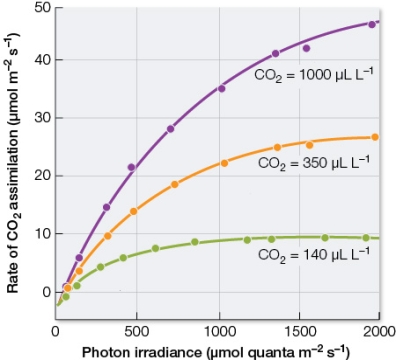 The rate of photosynthesis is increased at all three levels of carbon dioxide.Which causes are consistent with these data?
 (Multiple Choice)
5.0/5 (80)
(80) Evaluate energy flow through the ecosystem.What percentage of the sunlight that reaches Earth is converted into plant growth?
(Essay)
4.9/5 (73)
(73) 
Filters
- Essay(0)
- Multiple Choice(0)
- Short Answer(0)
- True False(0)
- Matching(0)