



 Chat with AI
Exam 3: Proteins, Carbohydrates, and Lipids

Exam 1: Studying Life246 Questions
Exam 2: Small Molecules and the Chemistry of Life246 Questions
Exam 3: Proteins, Carbohydrates, and Lipids246 Questions
Exam 4: Nucleic Acids and the Origin of Life246 Questions
Exam 5: Cells: the Working Units of Life248 Questions
Exam 6: Cell Membranes246 Questions
Exam 7: Cell Communication and Multicellularity246 Questions
Exam 8: Energy, Enzymes, and Metabolism246 Questions
Exam 9: Pathways That Harvest Chemical Energy246 Questions
Exam 10: Photosynthesis: Energy From Sunlight242 Questions
Exam 11: The Cell Cycle and Cell Division260 Questions
Exam 12: Inheritance, Genes, and Chromosomes250 Questions
Exam 13: Dna and Its Role in Heredity257 Questions
Exam 14: From Dna to Protein: Gene Expression252 Questions
Exam 15: Gene Mutation and Molecular Medicine251 Questions
Exam 16: Regulation of Gene Expression245 Questions
Exam 17: Genomes249 Questions
Exam 18: Recombinant Dna and Biotechnology243 Questions
Exam 20: Mechanisms of Evolution243 Questions
Exam 21: Reconstructing and Using Phylogenies246 Questions
Exam 22: Speciation247 Questions
Exam 23: Evolution of Genes and Genomes252 Questions
Exam 24: The History of Life on Earth246 Questions
Exam 25: Bacteria, Archaea, and Viruses262 Questions
Exam 26: The Origin and Diversification of Eukaryotes252 Questions
Exam 27: Plants Without Seeds: From Water to Land251 Questions
Exam 28: The Evolution of Seed Plants259 Questions
Exam 29: The Evolution and Diversity of Fungi261 Questions
Exam 30: Animal Origins and the Evolution of Body Plans248 Questions
Exam 31: Protostome Animals244 Questions
Exam 32: Deuterostome Animals246 Questions
Exam 33: The Plant Body243 Questions
Exam 34: Transport in Plants248 Questions
Exam 35: Plant Nutrition247 Questions
Exam 36: Regulation of Plant Growth246 Questions
Exam 37: Reproduction in Flowering Plants247 Questions
Exam 38: Plant Responses to Environmental Challenges246 Questions
Exam 39: Physiology, Homeostasis, and Temperature Regulation258 Questions
Exam 40: Animal Hormones249 Questions
Exam 41: Immunology: Animal Defense Systems265 Questions
Exam 42: Animal Reproduction261 Questions
Exam 43: Animal Development261 Questions
Exam 44: Neurons, Glia, and Nervous Systems250 Questions
Exam 45: Sensory Systems249 Questions
Exam 46: The Mammalian Nervous System: Structure and Higher Functions254 Questions
Exam 47: Musculoskeletal Systems259 Questions
Exam 48: Gas Exchange247 Questions
Exam 49: Circulatory Systems252 Questions
Exam 50: Nutrition, Digestion, and Absorption259 Questions
Exam 51: Salt and Water Balance and Nitrogen Excretion251 Questions
Exam 52: Animal Behavior249 Questions
Exam 53: The Physical Environment and Biogeography of Life248 Questions
Exam 54: Populations259 Questions
Exam 55: Species Interactions254 Questions
Exam 56: Communities247 Questions
Exam 57: Ecosystems238 Questions
Exam 58: A Changing Biosphere222 Questions
Select questions type


Refer to the figure below. 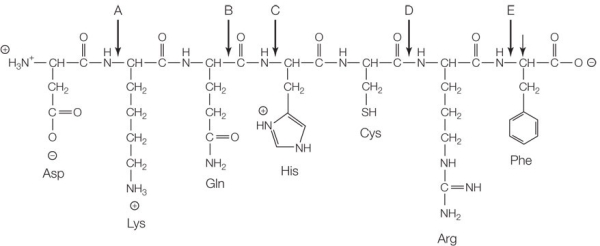 The structure shows an example of a biological polymer called a protein, which is made up of monomers called _______.
 (Short Answer)
5.0/5  (91)
(91) Oil and water do not mix easily because _______ cause the fat molecules of the oil to aggregate together in water.
(Multiple Choice)
4.8/5 (76)
(76) Refer to the figure below. 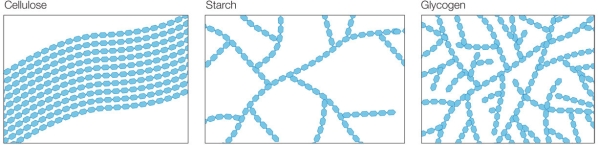 Rank the three structures shown, from lowest to highest density.
 (Multiple Choice)
4.8/5 (80)
(80) A macromolecule that is isolated from the bone of dinosaurs and found to have nitrogen-carbon-carbon repeats would be classified as a(n)
(Multiple Choice)
4.9/5 (76)
(76) A structural isomer for the molecule NaOCH2CH3 would be expected to have how many carbon atoms?
(Multiple Choice)
4.8/5 (90)
(90) Refer to the figure below.  The figure shows a polymeric macromolecule synthesized by cells.The monomer of this polymer is _______.
 (Short Answer)
4.9/5 (89)
(89) Figure 1 shows a protein enzyme labeled E that catalyzes a chemical reaction involving the substrate molecule labeled C.Figure 2 shows how another molecule, labeled D, binds to a site on the protein that is distinct from the catalytic site. 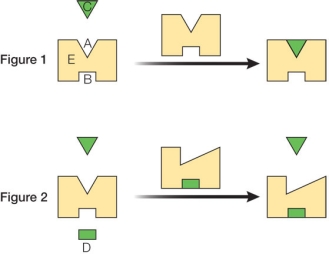 Based on the activities shown, what biological advantage does this protein gain by having the ability to bind molecule D?
 (Multiple Choice)
4.8/5 (67)
(67) You are designing an experiment that requires a protein to be exposed to high heat yet remain functional.You find, however, that the protein has lost its function on returning to its normal physiological temperature.You determine that the loss of function is due to an error in refolding of the protein.To remedy this, you could
(Multiple Choice)
4.8/5 (71)
(71) Refer to the figure below showing a section of a polypeptide chain in a protein. 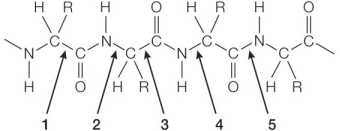 Which bond labeled on the figure undergoes hydrolysis as the chain is broken down to its amino acid building blocks?
 (Multiple Choice)
4.8/5 (90)
(90) An unknown sample known to contain either triglycerides or phospholipids is placed in water.The sample forms a separate layer on top of the water, with no mixing in the bulk volume of water.What type of lipid does the sample contain, and what structural element is responsible for the sample's behavior in water?
(Multiple Choice)
4.8/5 (76)
(76) Refer to the figure below. 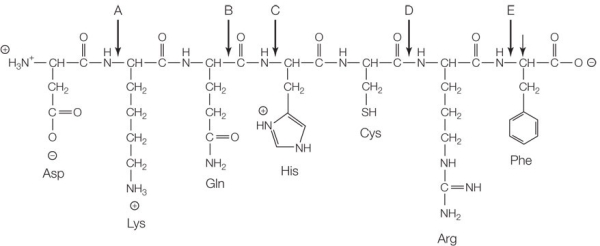 Which of the following is broken during hydrolysis reactions that release the molecule's monomers as products?
 (Multiple Choice)
4.8/5 (86)
(86) Olive oil melts at a lower temperature than beef fat because
(Multiple Choice)
4.9/5 (77)
(77) Glucose and fructose both have the formula C6H12O6, but the atoms in these two compounds are arranged differently.Glucose and fructose are therefore
(Multiple Choice)
4.8/5 (87)
(87) Refer to the figures below. 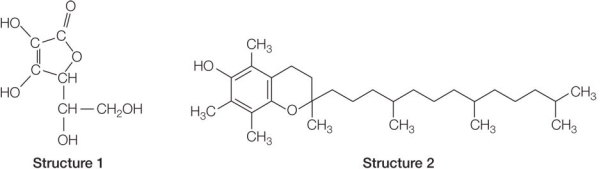 Two vitamin structures are shown.Which would be classified as a lipid, and why?
 (Multiple Choice)
4.7/5 (81)
(81) Hydroxyl groups are polar, and thus a molecule that contains multiple hydroxyl groups will be
(Multiple Choice)
4.8/5 (80)
(80) A protein is discovered to undergo a reversible phosphorylation reaction in the cell.Scientists do not know whether this phosphorylation has any biological function, but one possibility is that
(Multiple Choice)
4.9/5 (79)
(79) All of the following contribute to the three-dimensional shape of a protein except
(Multiple Choice)
4.9/5 (87)
(87) 
Filters
- Essay(0)
- Multiple Choice(0)
- Short Answer(0)
- True False(0)
- Matching(0)