



 Chat with AI
Exam 3: Proteins, Carbohydrates, and Lipids

Exam 1: Studying Life246 Questions
Exam 2: Small Molecules and the Chemistry of Life246 Questions
Exam 3: Proteins, Carbohydrates, and Lipids246 Questions
Exam 4: Nucleic Acids and the Origin of Life246 Questions
Exam 5: Cells: the Working Units of Life248 Questions
Exam 6: Cell Membranes246 Questions
Exam 7: Cell Communication and Multicellularity246 Questions
Exam 8: Energy, Enzymes, and Metabolism246 Questions
Exam 9: Pathways That Harvest Chemical Energy246 Questions
Exam 10: Photosynthesis: Energy From Sunlight242 Questions
Exam 11: The Cell Cycle and Cell Division260 Questions
Exam 12: Inheritance, Genes, and Chromosomes250 Questions
Exam 13: Dna and Its Role in Heredity257 Questions
Exam 14: From Dna to Protein: Gene Expression252 Questions
Exam 15: Gene Mutation and Molecular Medicine251 Questions
Exam 16: Regulation of Gene Expression245 Questions
Exam 17: Genomes249 Questions
Exam 18: Recombinant Dna and Biotechnology243 Questions
Exam 20: Mechanisms of Evolution243 Questions
Exam 21: Reconstructing and Using Phylogenies246 Questions
Exam 22: Speciation247 Questions
Exam 23: Evolution of Genes and Genomes252 Questions
Exam 24: The History of Life on Earth246 Questions
Exam 25: Bacteria, Archaea, and Viruses262 Questions
Exam 26: The Origin and Diversification of Eukaryotes252 Questions
Exam 27: Plants Without Seeds: From Water to Land251 Questions
Exam 28: The Evolution of Seed Plants259 Questions
Exam 29: The Evolution and Diversity of Fungi261 Questions
Exam 30: Animal Origins and the Evolution of Body Plans248 Questions
Exam 31: Protostome Animals244 Questions
Exam 32: Deuterostome Animals246 Questions
Exam 33: The Plant Body243 Questions
Exam 34: Transport in Plants248 Questions
Exam 35: Plant Nutrition247 Questions
Exam 36: Regulation of Plant Growth246 Questions
Exam 37: Reproduction in Flowering Plants247 Questions
Exam 38: Plant Responses to Environmental Challenges246 Questions
Exam 39: Physiology, Homeostasis, and Temperature Regulation258 Questions
Exam 40: Animal Hormones249 Questions
Exam 41: Immunology: Animal Defense Systems265 Questions
Exam 42: Animal Reproduction261 Questions
Exam 43: Animal Development261 Questions
Exam 44: Neurons, Glia, and Nervous Systems250 Questions
Exam 45: Sensory Systems249 Questions
Exam 46: The Mammalian Nervous System: Structure and Higher Functions254 Questions
Exam 47: Musculoskeletal Systems259 Questions
Exam 48: Gas Exchange247 Questions
Exam 49: Circulatory Systems252 Questions
Exam 50: Nutrition, Digestion, and Absorption259 Questions
Exam 51: Salt and Water Balance and Nitrogen Excretion251 Questions
Exam 52: Animal Behavior249 Questions
Exam 53: The Physical Environment and Biogeography of Life248 Questions
Exam 54: Populations259 Questions
Exam 55: Species Interactions254 Questions
Exam 56: Communities247 Questions
Exam 57: Ecosystems238 Questions
Exam 58: A Changing Biosphere222 Questions
Select questions type


The functional group written as -COOH is called the _______ group.
(Short Answer)
5.0/5  (71)
(71) Under what conditions would a biologist be justified in stating that two newly discovered proteins-one isolated from a bacterium and the other isolated from a plant-must have identical properties and functions in the two different organisms?
(Essay)
4.7/5 (70)
(70) Refer to the table below. 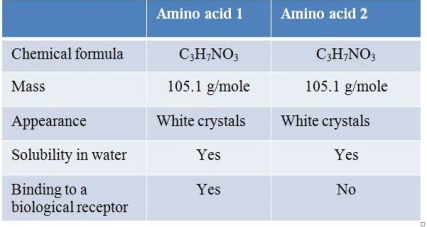 Which statement about amino acids 1 and 2 is valid, given all of the data provided in the table?
 (Multiple Choice)
4.9/5 (75)
(75) A molecule that has an N-C-C repeat in its structure is classified as a
(Multiple Choice)
4.9/5 (75)
(75) People born with the genetic disorder known as glycogen storage disease have impaired glycogen synthase.Glycogen synthase is the protein that catalyzes the polymerization of glucose to form glycogen.Affected people exhibit extreme tiredness and poor muscle function upon developing very low blood sugar levels when they have not eaten in a while.They show improvements soon after taking in food, which boosts their blood sugar concentrations.If the cells of these patients cannot polymerize glucose into glycogen, why don't the cells simply store excess glucose monomers for use during times between meals?
(Multiple Choice)
4.8/5 (76)
(76) Refer to the table below summarizing data obtained from mutation experiments on a protein enzyme. 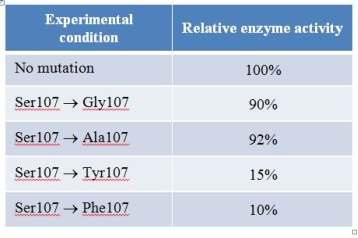 Specific amino acid substitutions were made at residue 107, which is occupied by a serine residue in the normal protein.After the mutant proteins were made and purified, their enzymatic activities were measured and expressed as a percentage of unmutated protein's enzyme activity.Which statement provides the most plausible explanation of why such widely different changes in activity of the enzyme were observed?
 (Multiple Choice)
4.9/5 (84)
(84) A simple sugar with the formula C5H10O5 can be classified as a
(Multiple Choice)
4.8/5 (91)
(91) Refer to the figures below. 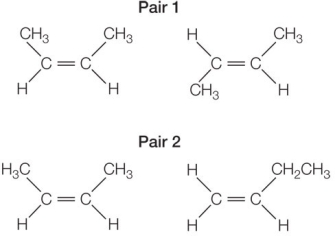 The two pairs of molecules represent different types of isomers.Identify each type and explain how these types are similar and how they differ.
 (Essay)
4.9/5 (74)
(74) Glycogen molecules can vary greatly in size, yet all glycogen molecules perform the same function.Proteins can also vary greatly in size; however, proteins also vary greatly in function.Which statement best explains this difference between glycogen and proteins?
(Multiple Choice)
4.8/5 (75)
(75) Refer to the figure below. 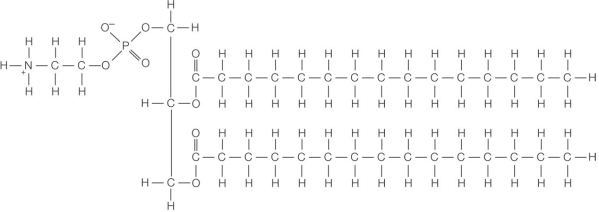 How does the molecule shown differ from a triglyceride?
 (Multiple Choice)
4.9/5 (78)
(78) van der Waals forces can form between _______ side chains in proteins.
(Short Answer)
4.7/5 (79)
(79) A protein is known to be stabilized by a salt bridge between a lysine at position 26 and an aspartic acid at position 108 in the protein's amino acid sequence.When the protein is mutated to substitute a glutamic acid in place of aspartic acid at position 108, the protein cannot fold properly and exhibits no biological activity.What likely contributes to the effects of this amino acid substitution on protein folding?
(Essay)
4.9/5 (97)
(97) The reactive _______ contributes to the ability of aldehydes and ketones to be involved in energy reactions.
(Multiple Choice)
4.8/5 (72)
(72) Due to its six hydroxyl groups attached to its six-carbon backbone, the carbohydrate compound inositol can be classified as a(n) _______.
(Short Answer)
4.8/5 (72)
(72) 
Filters
- Essay(0)
- Multiple Choice(0)
- Short Answer(0)
- True False(0)
- Matching(0)