



 Chat with AI
Exam 3: Proteins, Carbohydrates, and Lipids

Exam 1: Studying Life246 Questions
Exam 2: Small Molecules and the Chemistry of Life246 Questions
Exam 3: Proteins, Carbohydrates, and Lipids246 Questions
Exam 4: Nucleic Acids and the Origin of Life246 Questions
Exam 5: Cells: the Working Units of Life248 Questions
Exam 6: Cell Membranes246 Questions
Exam 7: Cell Communication and Multicellularity246 Questions
Exam 8: Energy, Enzymes, and Metabolism246 Questions
Exam 9: Pathways That Harvest Chemical Energy246 Questions
Exam 10: Photosynthesis: Energy From Sunlight242 Questions
Exam 11: The Cell Cycle and Cell Division260 Questions
Exam 12: Inheritance, Genes, and Chromosomes250 Questions
Exam 13: Dna and Its Role in Heredity257 Questions
Exam 14: From Dna to Protein: Gene Expression252 Questions
Exam 15: Gene Mutation and Molecular Medicine251 Questions
Exam 16: Regulation of Gene Expression245 Questions
Exam 17: Genomes249 Questions
Exam 18: Recombinant Dna and Biotechnology243 Questions
Exam 20: Mechanisms of Evolution243 Questions
Exam 21: Reconstructing and Using Phylogenies246 Questions
Exam 22: Speciation247 Questions
Exam 23: Evolution of Genes and Genomes252 Questions
Exam 24: The History of Life on Earth246 Questions
Exam 25: Bacteria, Archaea, and Viruses262 Questions
Exam 26: The Origin and Diversification of Eukaryotes252 Questions
Exam 27: Plants Without Seeds: From Water to Land251 Questions
Exam 28: The Evolution of Seed Plants259 Questions
Exam 29: The Evolution and Diversity of Fungi261 Questions
Exam 30: Animal Origins and the Evolution of Body Plans248 Questions
Exam 31: Protostome Animals244 Questions
Exam 32: Deuterostome Animals246 Questions
Exam 33: The Plant Body243 Questions
Exam 34: Transport in Plants248 Questions
Exam 35: Plant Nutrition247 Questions
Exam 36: Regulation of Plant Growth246 Questions
Exam 37: Reproduction in Flowering Plants247 Questions
Exam 38: Plant Responses to Environmental Challenges246 Questions
Exam 39: Physiology, Homeostasis, and Temperature Regulation258 Questions
Exam 40: Animal Hormones249 Questions
Exam 41: Immunology: Animal Defense Systems265 Questions
Exam 42: Animal Reproduction261 Questions
Exam 43: Animal Development261 Questions
Exam 44: Neurons, Glia, and Nervous Systems250 Questions
Exam 45: Sensory Systems249 Questions
Exam 46: The Mammalian Nervous System: Structure and Higher Functions254 Questions
Exam 47: Musculoskeletal Systems259 Questions
Exam 48: Gas Exchange247 Questions
Exam 49: Circulatory Systems252 Questions
Exam 50: Nutrition, Digestion, and Absorption259 Questions
Exam 51: Salt and Water Balance and Nitrogen Excretion251 Questions
Exam 52: Animal Behavior249 Questions
Exam 53: The Physical Environment and Biogeography of Life248 Questions
Exam 54: Populations259 Questions
Exam 55: Species Interactions254 Questions
Exam 56: Communities247 Questions
Exam 57: Ecosystems238 Questions
Exam 58: A Changing Biosphere222 Questions
Select questions type


Refer to the figure below. 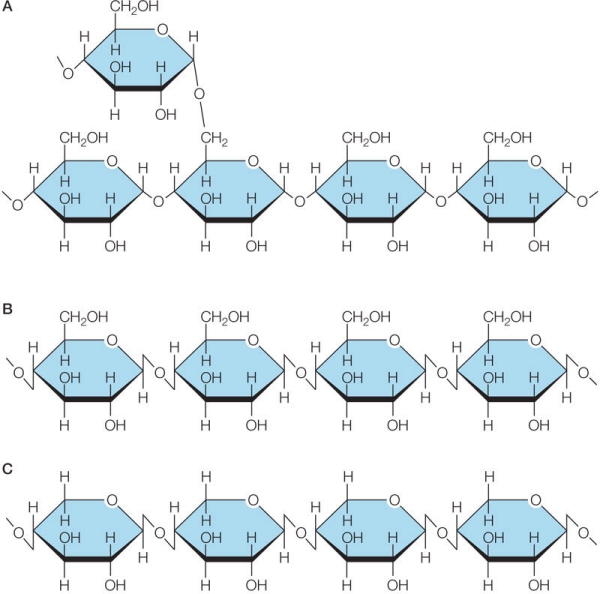 Polysaccharide A functions as an energy source in plants, whereas polysaccharides B and C function as structural polymers in the woody tissues of plants.Based on their molecular structures, which property of these polysaccharides could be important in distinguishing these two different functions?
 (Multiple Choice)
4.7/5  (86)
(86) Why does a starchy food like bread become hard when it dries out?
(Multiple Choice)
4.8/5 (86)
(86) Suppose you have a ball-and-stick model of the amino acid l-valine.What common household item could be used to assist you in drawing d-valine?
(Multiple Choice)
4.7/5 (79)
(79) Lipids play important roles in a number of functions.Which is not one of those functions?
(Multiple Choice)
4.8/5 (79)
(79) You are trying to determine something about the structure of a particular enzyme.For one of your experiments, you mutate the protein to include some cysteine residues in sections you think might be folded close to each other.You place properly folded original proteins and mutant proteins into a denaturing solution (urea), then back into a physiological solution.You find that the mutant has 100 percent enzymatic activity while the nonmutant protein has 90 percent enzymatic activity.What is the best explanation for this observation?
(Multiple Choice)
4.9/5 (79)
(79) Refer to the figure below. 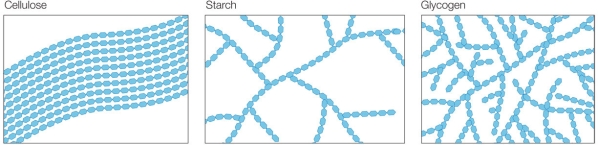 Many more _______ form between chains of cellulose than between chains in starch or glycogen.This helps explain why cellulose strands pack so tightly together.
 (Short Answer)
4.8/5 (87)
(87) When an egg is exposed to extreme heat, it turns from a liquid into a solid.The egg remains solid when it cools.All of the following are reasons for this except:
(Multiple Choice)
4.9/5 (79)
(79) Which amino acid is small enough to fit into tight corners of protein molecules?
(Multiple Choice)
4.9/5 (69)
(69) Which peptide could be found inside a phospholipid bilayer membrane because of its hydrophobic properties? Capital letter abbreviations for amino acids, which can be found in Table 3.2, are used to indicate peptide sequences.
(Multiple Choice)
4.9/5 (96)
(96) Which description applies to polysaccharides, polypeptides, and polynucleotides?
(Multiple Choice)
4.8/5 (87)
(87) In condensation reactions, the atoms that make up a water molecule are derived from
(Multiple Choice)
4.9/5 (87)
(87) Refer to the figure below. 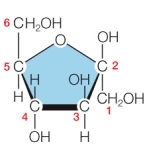 Which structure represents the straight-chain form of the sugar shown in the figure above?
 (Multiple Choice)
4.8/5 (83)
(83) Three different proteins, A, B, and C, from a plant were studied.In each case, a glycine residue was changed to an alanine.Changes in the biological activities of the mutated proteins were then measured, and the results are shown in the table below. 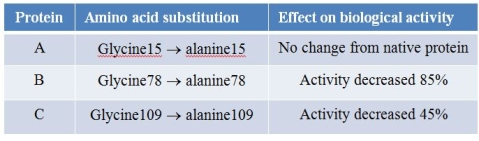 Which statement about structure-function relationships in proteins is supported by the data?
 (Multiple Choice)
4.9/5 (75)
(75) Refer to the figure below. 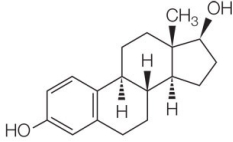 The compound shown is a lipid.Based on its structure, what is its likely function?
 (Multiple Choice)
4.9/5 (84)
(84) The R groups of amino acids have certain properties and allow for amino acids to be organized into all of the following groups except
(Multiple Choice)
4.9/5 (75)
(75) When they need energy, cells break down glycogen and starch into glucose using
(Multiple Choice)
4.9/5 (90)
(90) 
Filters
- Essay(0)
- Multiple Choice(0)
- Short Answer(0)
- True False(0)
- Matching(0)