



 Chat with AI
Exam 3: Proteins, Carbohydrates, and Lipids

Exam 1: Studying Life246 Questions
Exam 2: Small Molecules and the Chemistry of Life246 Questions
Exam 3: Proteins, Carbohydrates, and Lipids246 Questions
Exam 4: Nucleic Acids and the Origin of Life246 Questions
Exam 5: Cells: the Working Units of Life248 Questions
Exam 6: Cell Membranes246 Questions
Exam 7: Cell Communication and Multicellularity246 Questions
Exam 8: Energy, Enzymes, and Metabolism246 Questions
Exam 9: Pathways That Harvest Chemical Energy246 Questions
Exam 10: Photosynthesis: Energy From Sunlight242 Questions
Exam 11: The Cell Cycle and Cell Division260 Questions
Exam 12: Inheritance, Genes, and Chromosomes250 Questions
Exam 13: Dna and Its Role in Heredity257 Questions
Exam 14: From Dna to Protein: Gene Expression252 Questions
Exam 15: Gene Mutation and Molecular Medicine251 Questions
Exam 16: Regulation of Gene Expression245 Questions
Exam 17: Genomes249 Questions
Exam 18: Recombinant Dna and Biotechnology243 Questions
Exam 20: Mechanisms of Evolution243 Questions
Exam 21: Reconstructing and Using Phylogenies246 Questions
Exam 22: Speciation247 Questions
Exam 23: Evolution of Genes and Genomes252 Questions
Exam 24: The History of Life on Earth246 Questions
Exam 25: Bacteria, Archaea, and Viruses262 Questions
Exam 26: The Origin and Diversification of Eukaryotes252 Questions
Exam 27: Plants Without Seeds: From Water to Land251 Questions
Exam 28: The Evolution of Seed Plants259 Questions
Exam 29: The Evolution and Diversity of Fungi261 Questions
Exam 30: Animal Origins and the Evolution of Body Plans248 Questions
Exam 31: Protostome Animals244 Questions
Exam 32: Deuterostome Animals246 Questions
Exam 33: The Plant Body243 Questions
Exam 34: Transport in Plants248 Questions
Exam 35: Plant Nutrition247 Questions
Exam 36: Regulation of Plant Growth246 Questions
Exam 37: Reproduction in Flowering Plants247 Questions
Exam 38: Plant Responses to Environmental Challenges246 Questions
Exam 39: Physiology, Homeostasis, and Temperature Regulation258 Questions
Exam 40: Animal Hormones249 Questions
Exam 41: Immunology: Animal Defense Systems265 Questions
Exam 42: Animal Reproduction261 Questions
Exam 43: Animal Development261 Questions
Exam 44: Neurons, Glia, and Nervous Systems250 Questions
Exam 45: Sensory Systems249 Questions
Exam 46: The Mammalian Nervous System: Structure and Higher Functions254 Questions
Exam 47: Musculoskeletal Systems259 Questions
Exam 48: Gas Exchange247 Questions
Exam 49: Circulatory Systems252 Questions
Exam 50: Nutrition, Digestion, and Absorption259 Questions
Exam 51: Salt and Water Balance and Nitrogen Excretion251 Questions
Exam 52: Animal Behavior249 Questions
Exam 53: The Physical Environment and Biogeography of Life248 Questions
Exam 54: Populations259 Questions
Exam 55: Species Interactions254 Questions
Exam 56: Communities247 Questions
Exam 57: Ecosystems238 Questions
Exam 58: A Changing Biosphere222 Questions
Select questions type


Monomers are joined together by _______ and broken down by _______.
(Multiple Choice)
4.8/5  (86)
(86) Refer to the figure below, showing the structure of l-alanine. 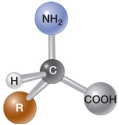 Which is the correct structure for d-alanine?
 (Multiple Choice)
4.8/5 (71)
(71) Glucose is a monosaccharide, maltose is a disaccharide composed of glucose, and glycogen is a polysaccharide composed of glucose.Compare the functions of these three carbohydrates in the human body.
(Essay)
4.8/5 (79)
(79) Molecules containing a large number of hydroxyl groups are
(Multiple Choice)
4.7/5 (76)
(76) Refer to the table below summarizing data obtained from chemical analysis of two proteins isolated from different tissues of a mouse-skin and bone. 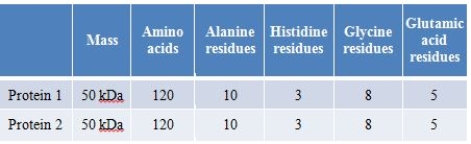 Can it be concluded from this data that the two proteins are the same?
 (Multiple Choice)
4.8/5 (88)
(88) Starch and glycogen, which are both polysaccharides, differ structurally in that glycogen _______, whereas starch _______.
(Multiple Choice)
4.8/5 (80)
(80) What type of amino acid side chains would you expect to find on the surface of a protein embedded in a cell membrane?
(Multiple Choice)
4.8/5 (84)
(84) A research group discovers that a reagent can be used to form covalent cross-links between various types of atoms in both small molecules and proteins.They add the reagent to a mixture of 14C-lactose and a protein that is thought to have a specific binding site for lactose.What should they do next to draw a conclusion about whether the protein specifically binds lactose?
(Multiple Choice)
4.7/5 (87)
(87) When a cysteine residue in a protein is replaced with serine, the protein folds normally and exhibits 95 percent of its normal biological activity.However, when this same cysteine residue is replaced with glycine, the protein does not fold normally and exhibits only 35 percent of its normal biological activity.Which hypothesis is both reasonable and consistent with these observations?
(Multiple Choice)
4.8/5 (81)
(81) Refer to the figure below showing the structure of sucrose. 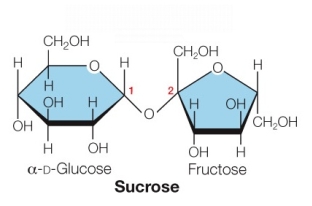 How would sucrose be expected to differ from the monosaccharide glucose?
 (Multiple Choice)
4.8/5 (77)
(77) Two biologically important polymers of glucose contain the same number of monomers and have the same mass, yet one is soluble in water and the other is not.This can be explained by the fact that the two polymers
(Multiple Choice)
4.8/5 (82)
(82) Chondroitin sulfate is a complex polysaccharide found in human cartilage.It consists of glycosaminoglycans, glucuronic acid, and glucosamine, three molecules that all have glucose molecules as their structural basis.Chondroitin sulfate contributes to the weight-bearing and shock-absorbing properties of cartilage.It also inhibits enzymes that tend to break down cartilage.Thus, chondroitin sulfate is a good example of how chemical modification of _______ in a biopolymer leads to unique characteristics of the polymer that can address a variety of functions in an organism.
(Short Answer)
4.9/5 (61)
(61) Protein structure can be affected by environmental conditions, which eventually can lead to denaturation.Differentiate between four environmental effects that can denature proteins, and explain how they affect protein structure.
(Essay)
4.8/5 (77)
(77) 
Filters
- Essay(0)
- Multiple Choice(0)
- Short Answer(0)
- True False(0)
- Matching(0)